Banned Books, Banned Plays

Censorship always begins with good intentions.

Following the George Floyd protests, heightened concern about cultural sensitivity and traumatic events led TeachersPayTeachers to ban pretty much any reader’s theater or history lesson in which students were challenged to see the event through the eyes of a minority figure. Though well-intended (after all, it’s pretty obvious we shouldn’t be simulating slave auctions in class), TpT’s policy essentially silenced Ruby Bridges, Claudette Colvin, Sheyann Webb, MLK, and other heroes of the Civil Rights Movement. The basis behind the ban was that today’s children shouldn’t be forced to relive the verbal abuse Ruby experienced, or the emotional abuse felt by Sacagawea, or the violence Sheyann witnessed. Never mind that all good literature and historical accounts requires the reader to see it from such a perspective. For example, if Claudette Colvin’s story shouldn’t be shared via my play, “The Girl Who Got Arrested,” it also shouldn’t be shared using Phllip Hoose’s National Book Award-winning biography, Twice Toward Justice.

Yet it must be shared. It’s by seeing Claudette’s story through her eyes that it becomes more than just a blurb and a date in a history book. Claudette’s first-hand account is the primary source that makes the event relevant today.

When TpT deactivated all my plays, I sought help from a friend who serves as the director of the local university’s Center for Cultural Diversity, as well as from Dr. Geneva Craig, someone who actually experienced the tear gas in Selma. These are crazy times, they both lamented, but they helped me re-evaluate my content to make sure I was indeed being sensitive. I made a handful of subtle changes and then re-posted my plays on TpT.

Only to have them deactivated all over again.  

I tried re-posting them as JPEG sheets so that TpT’s content bots couldn’t recognize the text. I removed words like “drama” and “scripts” from my headings and changed “reader’s theater” to RT. To further disguise them, I rebranded them as “Paired Texts.” Nothing worked. TpT deactivated them every time. Ironically, it was during this time that The Palace Youth Theater in New Hampshire, with the help of its local BLM chapter, enacted two of the plays TpT had just banned.  

Fortunately, less-reactionary ideals have prevailed and the new ownership at TpT has since reversed the censorship. I suspect they recognize that educators have school district policies, parent input, and professional training to guide us as to the appropriateness of material. We don’t need TpT to do it for us.

Though I lost hundreds of favorable reviews and thousands of clicks, I’m pleased to say that all my civil rights and American history plays are back on TpT. But given the “crazy times” in which we live, I think it’s important for educators to consider how to appropriately use reader’s theater to teach marginalized voices and traumatic events. Here are a few tips:

Community – Consult with the cultural community associated with the events depicted, bringing in guest speakers where appropriate. If you have students from that particular marginalized culture, seek input from their families before introducing the play.

Sensitivity – Characters in a play should not do anything demeaning toward their culture. While every story—whether in a play format or otherwise—has to have conflict, violent acts should only be referenced by narrators or other characters rather than explicitly acted out. If unsure about how a scene plays out, change it. If you’re still unsure how the content will be received, consider using it only for a discussion-based classroom reading or podcast rather than enacting it “on stage.”

Casting – Don’t let race be the basis for casting parts. Dr. King said he dreamed of a day when we would all be “color blind.” A reader’s theater performance is a good place to practice it.

Policy – It’s important to check your school board’s policy before embarking on any content that might be controversial. Some districts restrict subject matter not explicitly identified within a given grade level’s standards.   

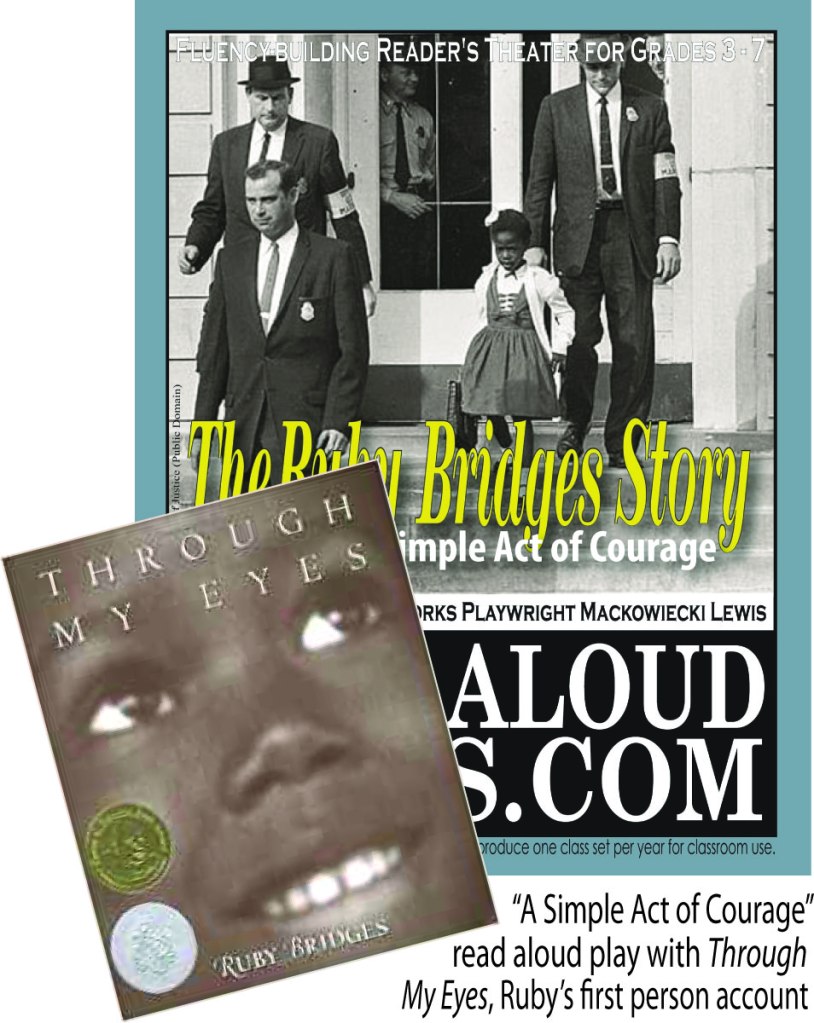
Paired Texts – It’s a good idea to pair reader’s theater content with professionally-published texts. For example, read Ruby Bridge’s book, Through My Eyes while working on the play, A Simple Act of Courage. Not only does the text serve as a vetting agent, it provides material to compare and contrast.

Discussion – No book, play, or video should stand alone. By discussing the content and events depicted, you facilitate understanding. Discussion should happen when introducing a play, while reading specific scenes, and after presenting. Utilizing expert guests enhances those discussions.

Repetition – One of the best reasons to use RT is that if there’s to be a presentation or performance, kids are willing to read plays repetitively. Even a simple reading in front of the class is enough to get kids to read and re-read a script multiple times. The brain science behind repetitive reading suggests students build their fluency at a far greater rate. It holds true with the students’ grasp on the historical events depicted and as well as their ability to empathize with marginalized voices.

Thank you for teaching Black history. Happy directing!
MLK Day is January 15th!

march-on-washington-cover-nb3-700x906If you’re like me, you put a bow on the holidays and then breathed a sigh of relief as you headed home for the break. But here you are heading back to class and MLK Day is already upon you!  You have no time to lose when it comes to planning your MLK Day and Black History Month activities!  So, let’s get right to the point of this post: ReadAloudPlays.com specializes in Black History Month and MLK plays.

In 2021, despite all the Covid-related restrictions, the folks at the Palace Theatre in New Hampshire selected a couple of my plays to enact for Black History Month. I’ve posted the video here so that you can take a look. Whether or not these two plays inspire you to download any of my material, I hope you’ll still share the video with your students. Consider having them watch the production and then read the plays. Or, simply have them follow along with the script while viewing.

The two plays shown are Martin’s Big Dream, which reveals how incidents from King’s childhood inspired his work, and A Simple Act of Courage, which shares the role Ruby Bridges played in integrating America’s schools. They’re both available in my TpT and Etsy stores.

You’ll also find numerous other plays told from the perspective of Civil Right icons like Jackie Robinson, Claudette Colvin, and Sheyann Webb. One of the hallmarks of a quality historical play for kids is that the story is told through the eyes of a child witnessing the events firsthand. These plays all meet that standard.

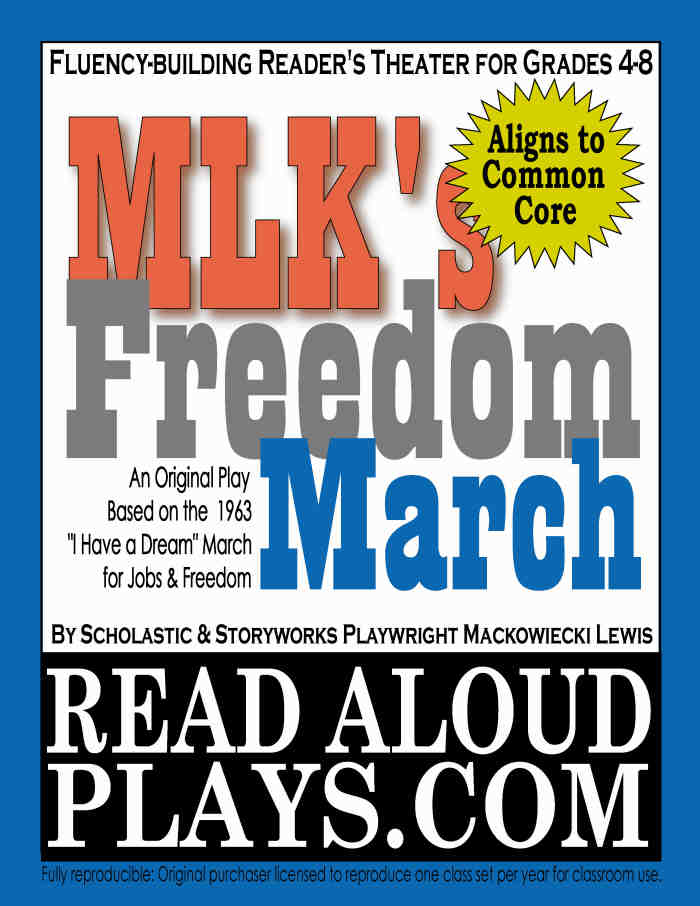
A favorite of mine is MLK’s Freedom March, which is told through the eyes of eleven-year-old Lucy. Her grandmother is dying of cancer, her father is worried about losing his job, and her brother is fired up about The March for Jobs and Freedom, the iconic event where Dr. King delivered his “I Have a Dream” speech. It’s a powerful play with multidimensional characters backed by King’s awe-inspiring speech. 

If you don’t know where else to start, download my free products, Tips for Teaching Marginalized Voices and Traumatic Events and Reader’s Theater Teaching Tips, which outlines best practice when using plays.  Be sure to also download the full previews of my plays deemed sensitive or potentially controversial. When unsure about a text, consider using it for traditional reader’s theater, podcast, or a discussion-based in-class reading rather than a stage production. In such cases, the important content still gets taught without running the risk of someone being offended by a “reenactment” of a traumatic event.

Thank you for continuing Dr. King’s work, and happy directing!

The Miracle of Public Education

People like to talk about how there’s a Starbucks on every corner. Whether true or not, the Starbucks brand is impressive. In fact, there are about 16,000 Starbucks locations in the U.S. That’s really incredible!

Yet it’s totally junior varsity compared to America’s Public School System. While we’re all impressed by Starbucks, our School System has around 100,000 locations. One hundred thousand! That means we’re running six schools for every Starbucks. Now think about how much more challenging it is to run a school than a coffee franchise—let alone six schools—or how much more challenging it is to be a teacher than a barista.  

McDonald’s raves about how many burgers it’s served: “Billion and Billions” it says on its signs.  Well, on average, McD’s serves 6 1/2 million burgers per day. That’s an impressive number—unless you compare it to America’s Public School System. We teach 74 million students per day. Seventy-four million! That’s 11 kids for every burger sold. No matter how you pickle it, there’s no comparing frying up a burger to teaching eleven kids how to read, write, and calculate the surface area of a hamburger wafer. 

Yes, I know all these school districts and schools are “independent” entities, but so too is a Starbucks franchise. The fact is, given the enormous task of teaching, feeding, nurturing, and babysitting America’s kids, there is no corporation in the world that can compare with the American Public School System. None. Not even Amazon.

And yet, when surveyed, only 19% of Americans says our school system is doing a good job.  Wait. Stop the press. When those same people are asked about the school system in their own state, suddenly 44% say the schools in their own state are doing well. But hang on yet again! When those people are then asked about their local schools, 79% give them favorable grades. How can this be?

Setting aside media bias and political propaganda (there’s enough of that to cover every Big Mac ever made with a double portion of special sauce), it suggests that the closer one is to the action, the more they appreciate what’s going on. You see, we have a distant view of the school system as a whole, yet because own kids and grandkids go to the local school, we tend to be more aware and appreciative of all the hard work being done there.  At the local level, too, people tend to see the students and their families as accountable, not just the school itself, which leads us to the gist of this post. You see, there’s also research that shows the more involved one is as a parent, the better one’s child will do in school.

Well of course!

When parents read with their kids, check their homework, communicate regularly with the teachers, hold their children accountable, and validate report cards, kids do better.

When parents attend assemblies, chaperone trips, encourage their kids to participate, and insist that vacations be taken during actual vacation periods, kids do better.

Hands-on parenting benefits kids. Having done this gig for more than 30 years, I can attest to the validity of such research. 

Our schools are not without their problems, weaknesses, and failures. But our system of Public Education really is miraculous. Now, allow me to make a small connection to my specialty, reader’s theater.

One way to encourage parent involvement is to use plays. When given a play script to learn, your kids will be more likely to read at home, and their parents will be more likely to read with them. When you use plays, parents will want to be more involved, such as with set building and costuming.  And finally, when kids are going to be on stage, their parents are more likely to show up.

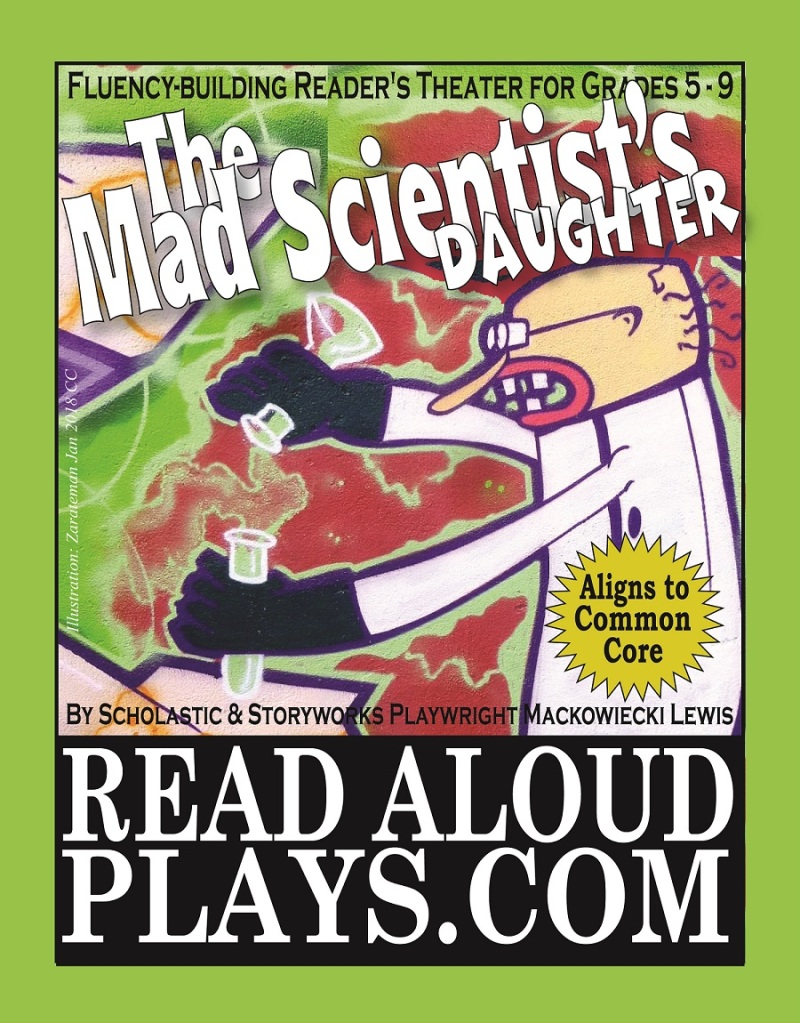
Encourage the parents of your students to be actively involved in the miracle of public school by producing a play. October is a great time to try one of my Gothic classics: The Monkey’s Paw, The Birth-mark, the Mad Scientist’s Daughter, and Tell-Tale Heart.

Happy directing!

Plays and Paired Texts for Black History Month

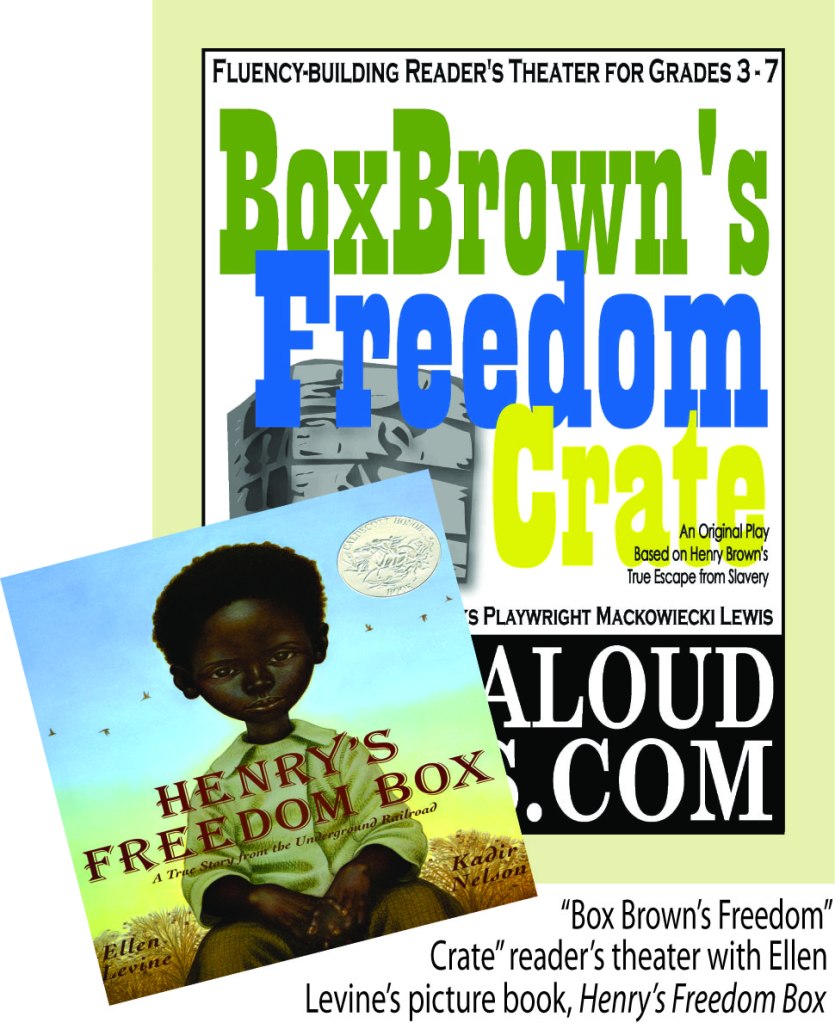
Here are ten compelling paired texts with which to recognize black history month while meeting numerous Language Arts standards. All the plays are based on the given event–not it’s paired text (in most cases the play was published before the given book). That means each pairing represents distinctly unique points of view (Literature CCSS #6), making for livelier discussions and quality comparisons (CCSS Lit #7). And because these plays are based on real events, they’ll also satisfy CCSS Informational Text #6. Each includes a comprehension activity, too, assuring your students will satisfy numerous other standards as well. And because almost all my plays were originally commission by and published in Scholastic’s Storyworks and Scope magazines, they’ve been professionally vetted, making them the best reader’s theater available. Only six of the ten are shown here–just click on the image to preview or purchase on my Etsy or TeachersPayTeachers storefront. Also be sure to check out these recorded performances of “Martin’s Big Dream” and “Ruby Bridges: A Simple Act of Courage” by The Palace Youth Theater. Happy directing!

Build better Readers, Writers, and Math Masters from Day One

My Fact Car Rally program is overdue for an update, but that doesn’t mean you can’t snag a copy right now and use it to lead your elementary students toward mastery of the math facts. When the update comes out, you’ll have full access to the revision. Did I say that kids love Fact Car Rally? They do! Much more so than competing programs—and it’s more effective, too! Follow the simple directions to create your racetrack during pre-service week, and then give your kids some low-key time during Week One to create their “fact cars.” By the second week, your students will be well on their way to true mastery of the facts–the foundation of all things math. Preview or purchase FCR here, and be sure to check out the tutorial video here.

In addition to building math masters, build better writers in grades 3 through 7 with my Super Sentences and Perfect Paragraphs program. It’s a teacher-friendly, student-friendly, daily writing method—the only thing you’ll need all year. No complicated teacher editions to wade through. No workshops to attend. It’s practically plug and play! Check out both the full version, the various ala-carte pieces, and the tutorial videos.

If you’ve never read my shtick about repetitive reading and how read aloud plays build beautiful readers, check it out here, and then snag some fun plays plays to start the year.  Peter Rabbit, Nature Talks Back, and my latest, a “slightly twisted” version of The Pied Piper (see previous post) are all fantastic icebreakers. They’re all available on my TpT storefront.

While you’re there, don’t forget that Halloween is just around the corner, so grab copies of The Monkey’s Paw, Tell-Tale Heart, the Birth-mark, or the Mad Scientist’s Daughter for your Gothic RT!

Happy directing!

The Anatomy of a Play

Like most of you, summer furlough is upon me, which for me means some time to find my mojo on a variety of writing projects. Having just finished a new Read Aloud Play based on the legend of The Pied Piper, I’m reflective about how much work went into it. Allow me to explain.

You might think it easy to churn out these plays, but writing can be quite laborious. Take my friend and Storyworks editor Lauren Tarshis, author of the I Survived series. She tells me how hard it often is to sit down and produce another disaster story. Play writing is no different. It’s serious work, especially since we’re both determined to tell a great story.

In the case of The Pied Piper, my first inclination was to tell the traditional folktale, but I learned something while watching episodes of the The Regular Show with my granddaughter: kids like silliness. The main characters on The Regular Show, which you’ll find on Disney+, include a talking, walking gumball machine, a raccoon, a bluejay, and what I think might by a cloud. They’re all a bunch of nitwit employees of “The Park.” Yes, the plain ol’ park. Much to my astonishment, it’s a great show with strong lessons.

Well, I’m at my best when I get a bit silly, when I think like an elementary kid. So after watching a few episodes (a bit of Jeff Goldblum didn’t hurt, either), I was able to craft a semi-twisted kind of absurd version of The Piper. The traditional story is still there, but there’s just enough silliness to make it extra fun for kids—and easier for me to write. After a couple days of germination, the story sprouted in just two days of writing. Compare that to my more hardcore titles, many of which took weeks of serious slogging.

The writing, though, is only a small portion of the task. Editing takes a few days. I’m guessing I’ve read through a script twenty to thirty times before I share it with you. I also force my poor wife or friends to give it a read, and during the school year, I test run it with my students. (Click here to see what my 5th graders did with the script.)

Meanwhile, I’m pulling images from different sources, verifying copyright and public domain status, building the cover and title banner on Illustrator, and double checking my research. Next begins the formatting. When I’m writing for Scholastic, I don’t need to worry about any of that, but when I’m packaging up a project for ReadAloudPlays.com, developing a pleasing format suitable for kids is really time consuming. It can also be frustrating when images, textboxes, and footers migrate from where I stick ‘em to some random spot three pages away!

There’s also the process of developing comprehension activities. I always try to include a bubble quiz because I think teachers like to be able to give a quick assessment just to keep kids accountable and to have something for the grade book (I’m not a proponent of grading the play performance itself—but that’s a topic for a different day).  I also try to include other activities when I can. In the case of the Piper, I spent a couple days creating a good bubble quiz and a nifty paired text reading activity. They don’t require any real prep for the classroom teacher, and they’re straight-forward enough for kids to figure out without much direction, but they represent quite a bit of labor on my part.

Even after all that’s done, there’s still the task of putting together the information pages and teacher notes, of combining them into a single PDF, of double checking the PDF for weirdness (like migrating images), and of creating a preview file. I just finished accomplishing all that…yet I’m still not done. There remains the process posting the product on TpT, Etsy and ReadAloudPlays.com (All those log-ins! All those Captchas!), and of promoting the darned thing with a nice little blog post like this one.

I hope you like it!  With any luck, there’ll be more to come.

Happy directing!

Promoting the Work and Words of Dr. King

At the height of Covid restrictions, the Palace Youth Theatre in New York state crafted this wonderful pairing of my Ruby Bridges script and my play about Martin Luther King’s childhood. With MLK Day just a few weeks away, and Black History Month right behind it, consider sharing these professionally-produced performances with your students. Perhaps you’ll be inspired to try a few of my other critically-acclaimed plays promoting the work and words of Dr. King and other crusaders. They’re available on my TeachersPayTeachers and Etsy storefronts. Happy directing!

War Stories

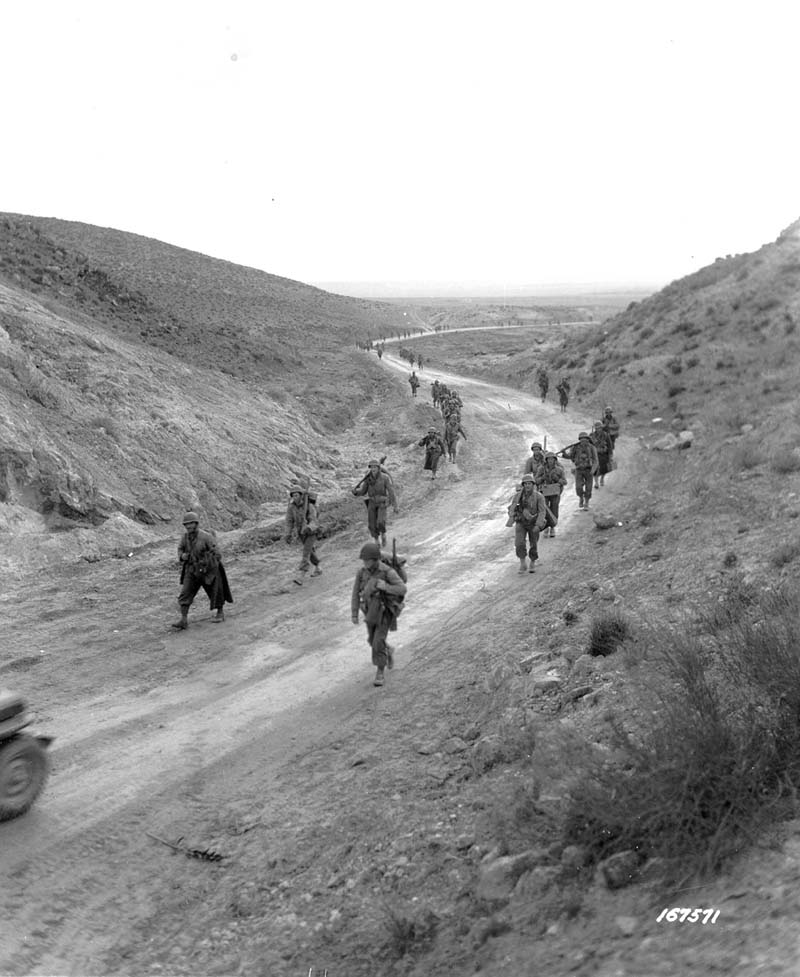
Kasserine Pass, Feb. 1943 (PD McGary)

Both my parents served in the military. My mom had a short stint as a WAC in DC before landing in the secretarial pool at the White House. She eventually had a temporary assignment working for Matthew Connelly, Harry Truman’s executive secretary. She used to tell a story about sneaking down a long corridor in hopes of seeing the presidential swimming pool before being caught by a guard and sent back to her post. Despite her brush with security, she was eventually offered a permanent position but, regretfully I suspect, turned it down because the bus commute from her quarters in Virginia was too long.  Those, she would later tell me, were the best years of her life.

My dad, meanwhile, served in both World War II and Korea. I’m told his experiences were vast and extreme, that he piloted a plane, that he commanded a POW camp, that he was at the disastrously fierce Battle of Kasserine Pass. But he himself never spoke of any of it. Not a word. For him it was far too painful—as it is for many veterans. 

It was with them in mind that I crafted “War Stories” for Scholastic several years ago.  It speaks to the pain of war, the sacrifice of those who’ve served, and the meaning of Veterans’ Day. I encourage you to share it with your students in grades four and up prior to the holiday on November 11.

Happy directing.    

A New Play for Halloween

Back a hundred years ago, ghoulishness was captured in short stories rather than comic books. Writers like Poe, Shelley, and Stevenson creeped out their audiences with dark tales of superstition, mystery, and insanity. The Gothic themes they created have been permeating literature, television, and cinema ever since. Case in point, for the last couple of years I’ve been not-quite-binge watching episodes of Dark Shadows, the Gothic TV show about Barnabas Collins—arguably the world’s second-most famous vampire (Step aside, Edward). The show’s witches, werewolves, and headless dudes had me mesmerized when it originally aired back in the 1960’s. Now, viewing the rather campy soap through adult eyes, I’m recognizing that all its creepiness came from classic short stories like The Cask of AmontilladoFrankenstein, and The Headless Horseman. They’re all in there! Go figure.

Your students know these themes, too. They’ve seen them on the Simpsons and Family Guy, in Goosebumps and Marvel Comics. But do they know from whence they come?  Though the archaic language and complex structures of these classic tales present barriers for most middle grade readers, you can make the stories more accessible by pairing them with reader’s theater. And what better a time to do it than Halloween?

So what if your students are mesmerized by Venom and Doctor Octopus? There are plenty of mangled monsters and the criminally insane in W.W. Jacob’s classic, The Monkey’s Paw, Poe’s The Tell-Tale Heart, and Hawthorne’s The Birthmark. They’ll also find that familiar ol’ headless horseman in Sleepy Hollow, and a hapless ghost in Twain’s A Ghost Story. Finally, I’ve just released my version of Rappaccini’s Daughter.  No, your kids won’t find it Pennywise-creepy or Slenderman-scary, but its chemical concoctions and mad scientists make it very nearly as engaging. Most certainly, it’s a key to unlocking the original’s subtleties and complexities.    

All these plays are available on my TeachersPayTeachersEtsy, and Amazon storefronts. They’re critically-acclaimed. They’re cheap. And they each come with a comprehension exercise. Suitable for reader’s theater, podcast radio drama, or full stage production, they’re perfect for fifth graders and up— but get started early to have them well-rehearsed by Halloween.

Happy directing!

Commemorating Juneteenth

My most poignant play—and it’s perfect for celebrating Juneteenth! Based on actual slave narratives, Freedom for the First Time is historically-accurate, kid-friendly, and comes embedded with comprehension questions and historic photos. It’s the narrative of ten-year old Tyree, a slave during the time of the Civil War. Like many slaves, Tyree believes whatever her masters say. But when Tyree’s brother, Sweet Walter, arrives with a band of Union soldiers to tell her the war is over, she and her family experience their day of Jubilee, the day they know freedom for the first time. Pair it with Days of Jubilee, Patricia and Frederick McKissack’s exceptional non-fiction book about slavery and the Civil War, or try creating a podcast performance or Zoomer’s Theater play. Click here to see the fantastic things the kids at the Baker Montessori School in Houston did with the script! It’s available on my Etsy storefront, and like all my plays, it includes performance rights. Happy directing!