What We Believe

As you head back to school you may find yourself in long-winded meetings wrestling over your institution’s “mission statement.” I hope you don’t have to go through such torture, but you might. The mission has always seemed pretty darned obvious to me: give kids the best academic experience possible. Done. Now can we get to work in our classrooms?

A reader recently asked me what our mission statement is at ReadAloudPlays.com. I guess they felt inclined to subject me to the same kind of torture their admin was inflicting upon them. Well, our mission is pretty straight forward: Craft plays scripts that teachers will want to use because kids love them and learn from them. Done.

But, I guess I can’t shake all those teacher inservice sessions in which admins demanded we define the meaning of every jot and tittle, that we crossed our t’s and dotted our i’s, that we really descended into that rabbit hole of core beliefs, because here I am defining what exactly we believe at ReadAloudPlays.com.   

We believe that reader’s theater represents an excellent way to teach reading and engage students.

We believe that repetition leads to fluency. (See our free product citing the brain research.)

We believe scripts should be well-crafted. (I spent more than twenty years writing professionally for Scholastic.)

We believe in creativity. When I create a play, I’m trying to do something unique with it. We don’t believe AI can duplicate that.

Despite various benefits to AI (its ability to compile and summarize data, for example), we believe it will be detrimental to the arts.

We believe in live theater. We think live performances (of theater, music, etc.) will grow in demand due to the proliferation of AI-generated junk recordings and publications.

We believe standardized testing in its current form (a multi-billion dollar industry) is wasteful and unnecessary.

Though we believe in accountability, we don’t believe standardized tests accurately measure success. Nor do they hold all participants accountable (e.g. the students, their parents, and the community).

We believe “low performing” schools are reflective of struggling communities; not the other way around.

We believe voucher schemes are designed to funnel tax money to private interests and give tax breaks to wealthy people.

We believe schools are not businesses and shouldn’t be viewed as such. (See Jamie Vollmer’s book, Schools Can’t Do It Alone.) 

We believe business “efficiency” is a myth. (According to Harvard Business School, 80 to 90 percent of all businesses fail due to inefficiency, mismanagement, or a lack of demand. Those that succeed do so mostly because they land upon a “viral” product or service, not because they’re efficient.)

We believe in libraries.  Communities with functioning library systems are historically safer, healthier, and better educated than those without.

We believe computers in schools should be extremely limited, that online programs are poor replacements for real human instruction. (See The Talent Code by Daniel Coyle)

We believe teaching requires highly dedicated people (like you!).

We believe that social media and video games are highly addictive and damaging to their users and that the decline of reading is directly correlated to the growth of digital devices. (See The Anxious Generation by Jonathan Haidt.)

We believe the standard social media algorithm is damaging to society and should be restricted.

We believe in respecting copyright. We only create plays from material in the Public Domain or for which we have explicit license.

So there you have a long-winded, in-depth mission statement that’d make any administrator call for a second in-service session in November (right when report cards are due). But at least you have an idea where we stand.

Suffice it to say, when we create a play, we’re thinking first about how kids will enjoy it, secondly about what they’ll learn from it, and thirdly about how useful it will be to the teacher. We’re not getting rich doing this (just as none of us went into teaching dreaming of $$$). We’re doing this because we believe in the power of reader’s theater plays. If you’re into that, check out all the great stuff we have for back to school such as fun introductory plays like our Winnie the Pooh collection, The Sky is Falling, and Cyclops: The Monster in the Cave.


Dragon Poet Trumps State Tests!

What better way to celebrate Spring than to watch evergreens named Bill, Otto, and Luther come to life, . . . Or Mr. Toad hit the open road in his caravan . . . Or Jackie Robinson belt a triple.  At ReadAloudPlays.com we have a host of engaging readers theater play scripts to counteract those test-taking spring time blues. Take our newest script, The Reluctant Dragon, Kenneth Grahame’s classic story about a poetry-spouting dragon who must face-off against the heroic knight, Sir George. It’s loaded with action, character, and vocabulary—and like all our scripts, it’s been kid-tested, so we know your students will love it. It’s a perfect addition to your National Poetry Month activities!

Nature Talks Back is another fun one. It’s an awesome Earth Day activity or simply a great play to teach environmental concepts such as beneficial insects and plant communication. I recently used it with a class of fifth graders who, after working on it for three days, presented it with huge grins to a class of smiling third graders! What a kick!

And of course, it’s baseball season! Our Jackie Robinson play is simply exceptional. Narrated by the hot dog man and the peanut vendor at a modern Yankees game (sorry Red Sox fans), it shows the significance of Jackie Robinson’s breaking of the color barrier in a way that’s both powerful and fun. I dare say, you won’t find a better Jackie story anywhere!

These and other professionally-crafted and uniquely-imagined scripts such as Chicken Little, Grimm’s The Mouse, the Bird, and the Sausage, and Goldie Locks: Home Reno, are all available on our TpT storefront.  

Thank you for your recent 5-star reviews, Rachel R., Chalk Dust & Holy Water, Masters-ful Materials, Jennifer B., Reyes Royals Designs, Savvy Classroom, Melissa G., Nancy R., Ruby R., Sharla S., Shannon R., Augusta S., Emily W., Ebony L., Alissa M., Gretchen F., and Melissa C. from North Carolina who shared this:

This resource was easy to use and very well organized. The directions were clear, and it fit perfectly with my 7th grade curriculum. My students stayed engaged, and it helped reinforce the skills we were working on. I will definitely use this again! Highly recommend for teachers looking for a ready-to-use activity.

Happy directing!

Save Children by Banning Snake Oil Tech

In a recent court appearance Mark Zuckerberg testified that there isn’t any research to substantiate claims that his “product” is addictive or harmful to kids. Yet, there’s a ton. And all of us in education shouldn’t just be taking note—we should be taking action.

Jonathan Haidt’s book, The Anxious Generation connects numerous studies proving screen time “rewires” children’s’ brain in dangerous ways. A recent 15 year study in Canada adds additional clarity: screen time is bad for kids.

Yet in every classroom I visit, screens have become a significant element of instruction.

To be clear, I’m not talking about using computers as “tools.”  Word processing, doing research, and communicating with families may indeed be appropriate uses. But, according to the research, programs that replace instruction are not.  As one recovering tech addict put it, they’re so chock full of artificial stimuli, real books can’t compete. Once indoctrinated in screen-based “learning,” students are unable to tolerate reading a paragraph in a text book or writing a sentence that doesn’t include an emoji. In short, they become non-readers.

Covid has been a convenient scapegoat for both low achievement and high anxiety, but if there’s one thing the pandemic taught us, it’s that screen-based learning didn’t work. Despite returning to regular school, test scores and suicide rates show that the nation’s children are not recovering from spending that year on screen-based programs. That’s because it wasn’t Covid that caused all the problems—it’s that we’ve doubled-down on screens, both at home and in school.

Today our school districts are spending gobs of money on snake oil tech ($30 billion in 2024). All that money spent on one-to-one devices and online programs such as Asselus and disLexia would be put to better use creating extra-curricular opportunities for kids, enhanced support staff scheduling, teacher salaries, improved prep time, or authentic reading instruction. Instead, the only real beneficiaries are the tech companies. Not school districts. Not teachers. And certainly not kids.

On top of the ginormous direct profits, Big Tech is also profiting from data mining.  Everything about you, your students, and your school is being stored on a server somewhere in the high desert of Central Oregon or the low valleys of Northern California and then sold to other companies that want a piece of your pie. Educators have long been concerned that their job security might someday hinge on student test scores, but imagine, too, a future where one of your former students applies for a job or fills out a college application or runs for political office only to have their low performance on an Aimslow or Zurn test way back in third grade sabotage their opportunity. (Yes, we purposely misspelled those to disparage the guilty!)

So what can we do? It’s time to reject screen-based learning. All of it. I know these programs can give overwhelmed teachers a bit of a break, but the studies show it’d be better to give your students time to simply draw, color, or read than to log in. Me, I’m making a commitment to stop relying on tech and I challenge you to do the same.

Because administrative initiatives almost always fail, a ban on screens needs to be organic. It needs to start with teachers rejecting tech and teachers encouraging parents to reject tech at home.  

Not convinced? Read Haidt’s book, The Anxious Generation, or Catherine Price’s book for teens and pre-teens, The Amazing Generation. Watch the 2024 documentary The Cost of Convenience. And share this article from Bloomberg about the Canadian study. Send these things to your board members and your open-minded admins. (In my school, we started seeing change merely by giving Haidt’s book to our principal.)

Here at ReadAloudPlays.com, we’re decommissioning our Google Forms products, the free comprehension quizzes that go with our reader’s theater. They offer a bit of convenience to teachers and they incentivize trying our play scripts, but because we believe our paper-based quizzes promote more authentic discussion, we’re moving on. We’re also making our own social media pages static.

Of course, we believe the best step any teacher can take is to utilize more “real” instruction—such as reader’s theater. In all the classrooms I visit these days, kids will almost always choose reader’s theater over screen-based activities. Visit our storefront at TpT to grab some exceptional play scripts, including our fun Chicken Little play panning social media.

Happy directing!

MLK Day and Black History Month

Now’s the time to start working on classroom activities commemorating Dr. King’s work. This compelling video featuring two inspiring plays from the ReadAloudPlays.com catalogue is a great place to start. The Palace Youth Theater put it together during the pandemic shut down. Share it with your students and then read or act out the plays. The first shows how Ruby Bridges broke the color barrier in New Orleans public schools. The second shows how MLK’s childhood inspired his civil rights leadership. You’ll find both plays, along with many other titles for Black History Month, on our TpT Storefront. Thanks, and happy directing!

Here’s Help for that Holiday Chaos!

The weeks between Thanksgiving and Christmas vacation can be real doozies. While thoughts of sugar plums may not derail that lesson you’ve been planning on verb gerunds, knowing there are new gaming systems, cell phones, and hover boards under the tree certainly will. There’s no doubt about it: this time of year the kids are all a twitter, prompting many a teacher to set aside serious content in favor of coloring pages featuring Rudolph, Frosty, or an occasional dreidel. But it needn’t be so. This is a great time to stage a play!  In so doing your students will get some quality fluency practice, partake in some interesting literary discussions, and, depending on how far you want to take it, occupy themselves with meaningful work creating sets, props, and costumes. And given that Christmas will be upon you in a flash, now is the time to get started, especially if you’re following our repetitive reading approach. Here are five classroom reader’s theater scripts ideal for the next few weeks.

A Christmas Carol—Our best-selling script! Scrooge in two forms!

The Gift of the Magi—A young couple trades their most precious possessions to celebrate Christmas in O. Henry’s famous story!

Gabriel Grub –When the gravedigger shows an unrepentant disdain for Christmas, he’s put on trial in an  underworld court room full of goblins. It’s Dickens’ spookiest Christmas story!  

The Shoemaker and the Christmas Elves—Facing ruin, the shoemaker is saved by a Christmas miracle in this Grimm Brothers classic with our unique conclusion.

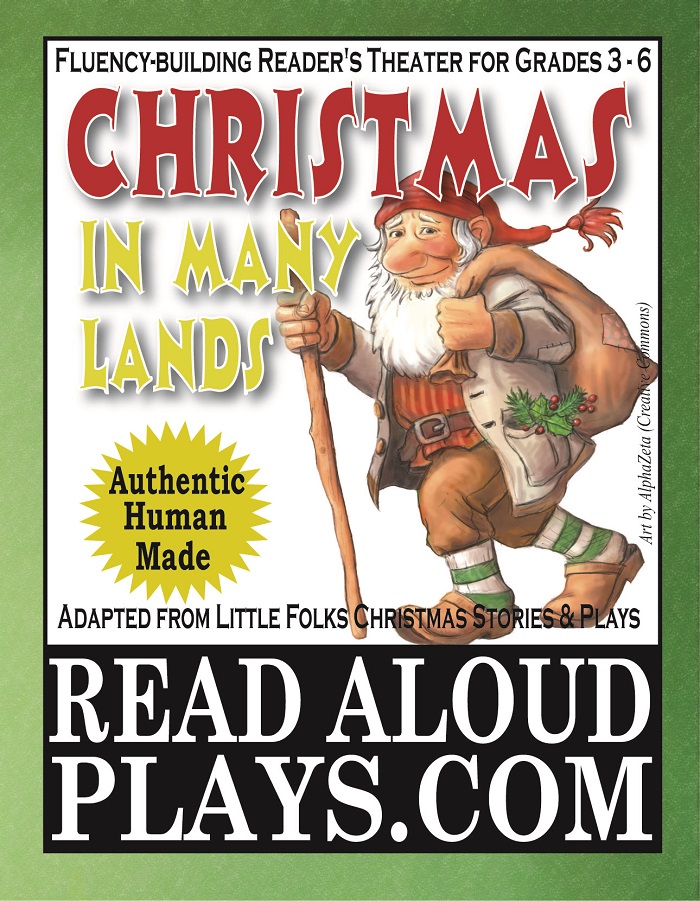
Christmas in Many Lands— Gnomes and reindeer, trees and piñatas . . . it seems like Christmas everywhere is different yet somehow still the same! Our newest and most adorable little Christmas play about Christmas around the world.   

Whether a single play or one of our money-saving bundles, these will be the highlight of your holiday teaching season! Check them out in our TpT store.  Happy directing and Merry Christmas!  

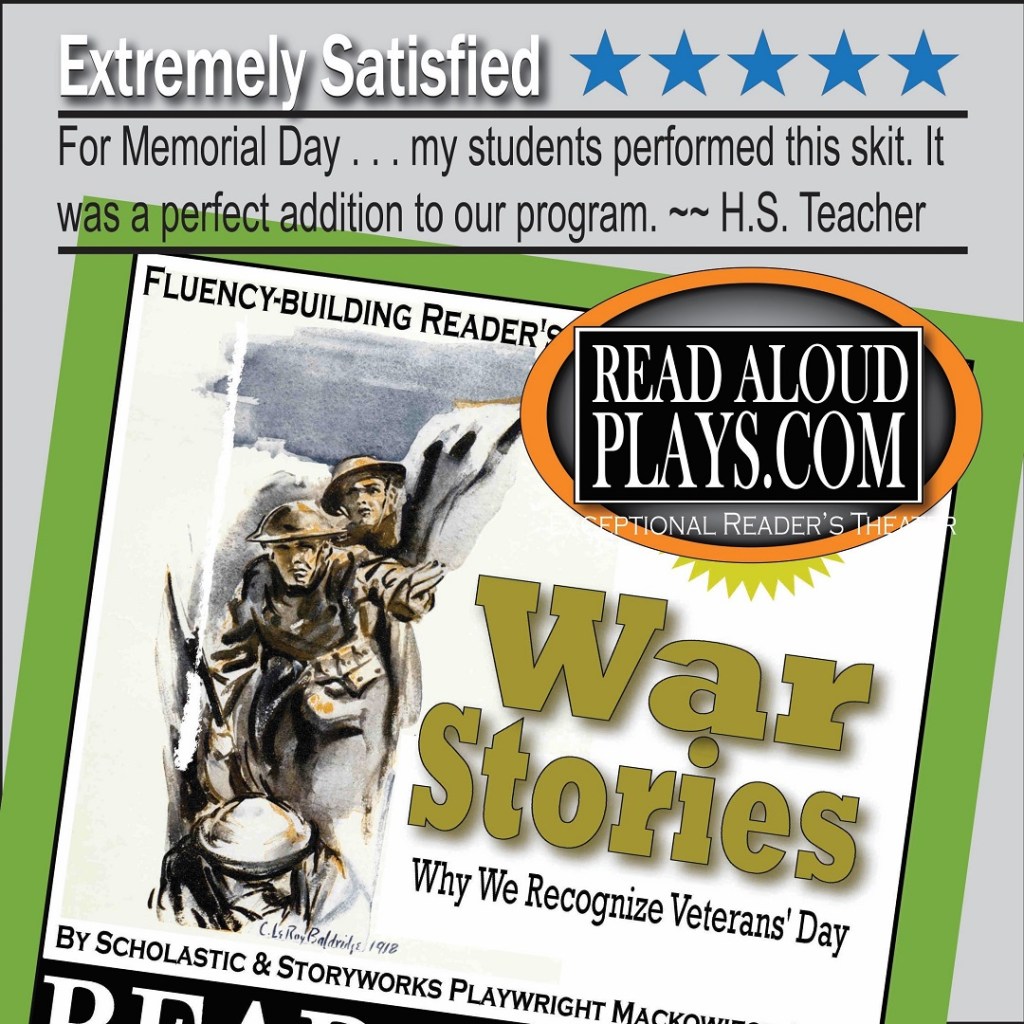
Using Readers Theater to Honor Veterans

Save $ with New Readers Theater Bundles!

We’ve posted four new bundle collections, which offer big savings over single plays. Check them out on our TpT storefront!

Fairy Tales Slightly Twisted–Kids absolutely love performing these plays! Two unique versions of Goldilocks, a wonderful Brothers Grimm tale, and some hysterical Pied Piper action! Perfect for Back-to-School! All include the license to duplicate a full class set, school day performance rights, and comprehension activities. Click on the image to preview or purchase!

Weird Tales for Halloween — a collection of our most popular plays: Sleepy Hollow, The Monkey’s Paw, and a crazy version of Poe’s Tell Tale Heart. Buy now for Halloween!

The American Revolution Bundle — Five exciting reader’s theater scripts covering the American Revolution including The Secret Soldier, one of our most requested plays, and four others. Check our Eagles Over the Battlefield–a kid favorite for sure!

The Explorers Pack — Three reader’s theater scripts covering three eras. Divide the class into thirds and challenge each to present one of the three, then have all your students complete the standards-based compare and contrast activity. Teach history, reading fluency, and reading comprehension while getting your students excited about learning!

Happy directing!

Earth Day + Arbor Day

Nature Talks Back is a great play with which to celebrate Earth Day and Arbor Day while teaching your kids about trees, bees, and centipedes. The play’s ecology and conservation themes include that trees communicate, that some perceived pests are considered beneficial insects, and that honeybees are super-important pollinators.  The stories center around three oddball conifers named Luther, Otto, and Bill and their hysterical encounters with a host of pests.   

It’s aimed specifically at kids in upper 2nd through 4th grade, but it’s also suitable for grade 5 and up for reader’s theater, podcast, or stage— especially when performed for younger kids. (My fifth graders loved preparing a full production!) No time for a big show? Use it instead as in-class reading! It’s a fun way to teach about nature on Earth Day and Arbor Day!

Consider pairing Nature Talks Back with some of my other spring-oriented plays. Peter Rabbit is also aimed at younger students. Use it with 2nd and 3rd graders, or have older students perform it for primary-aged kids.  Rikki Tikki Tavi, Kipling’s much-loved story about the heroic mongoose has some spring-time flair, a singing bird, and an important theme about courage. It too can be presented alongside How the Elephant Got Its Trunk, another classic Kipling tale from The Jungle Books.  And don’t forget that baseball season is upon us, so it’s a great time for my entertaining and socially important play about Jackie Robinson.

Happy directing!

Revolutionary Women’s History

The Sybil cover from Scope magazine

Here are five classroom plays about the American Revolution. Each is politically-neutral, based on well-researched historical accounts, and vetted by professional editors at Scholastic. The first three (four if you count the Liberty Bell) feature strong females, making them perfect for Women’s History Month.  

The Secret Soldier tells the story of Deborah Samson, the perseverant young woman who disguised herself as a man in order to enlist in the Continental Army. History remembers her as America’s “first woman soldier.”

Betsy Ross has a lot of doubters these days. This play exploring the creation of America’s first flag, encourages readers to approach history scientifically: to research the facts themselves before drawing conclusions.

Girl, Fighter, Hero tells the story of Sybil Ludington, the young woman often called “the female Paul Revere.” Sybil rode 40 miles on a stormy night to muster the militia during the American Revolution battle near Danbury.

Eagles Over the Battlefield introduces students to our national emblem, the American bald eagle. This work of historical fiction imagines how the Founding Fathers might have debated the symbol’s selection, especially given Ben Franklin’s tongue-in-cheek disdain for the eagle.

Finally, A Bell for the Statehouse , which comes as a 2 for 1 with Eagles, reveals how the Liberty Bell came to be a national symbol after being sheltered away with other “patriot leaders” in the basement of a church.

All five plays are dramatic, compelling, and fun for kids to present on stage or perform as reader’s theater.

Thank you, Rachel Scott, M. M., Aram Alexander Barboa-Reidy, Alejandra Alejandra Peña, Laura Franklin, Michelle Gribble, Daniel B. Bennett, William Samples, and Jennifer Theis for your recent 5-star reviews!

Happy directing!

A Christmas Play Doesn’t Have to be a Christmas Play

We all know it. During the weeks leading up to Christmas, it can be a challenge to keep the kids engaged. My remedy has always been to stage some classroom plays or readers theater, which leads me to our awesome collection of Christmas themed titles that’ll keep even your grinchiest elf content.

But Santa isn’t going to throw coal at you if your Christmas plays aren’t Christmas plays. Take a look at what my 5th graders did with Hans in Luck, a Brothers Grimm tale that hasn’t a thing to do with wassailing or bread pudding. They used the 1906 illustrations to create a “digital comic book” while simultaneously practicing for a live stage presentation just ahead of the winter break. I can tell you the actors themselves don’t care that the play isn’t about St. Nick. They’re thrilled to be donning costumes regardless whether or not anyone gets to wear a fat suit and a beard.  And you can bet my colleagues are happy to commit some otherwise giddy class time to come watch— whether the Ghost of Christmas Present will be there or not.

Ah, but who has time to throw together an entire show now? If that’s the case, grab some scripts and just do some classroom readings! Try splitting the class into two to four groups and give each one a play. Use class time to have the kids practice them until they can read them with fluency and character, and then have them present them to the class as traditional reader’s theater—merely standing up front and reading aloud.

Ready to streamline your holiday surge? Try my Goldilocks, Pied Piper, Peter Rabbit, and Winnie the Pooh plays. If you still want to stick with the holiday theme, check out A Christmas Carol, The Gift of the Magi, The Shoemaker and the Elves, and Gabriel Grub.  

Whatever the case, make your December memorable—and easy—with ReadAloudPlays.

Happy directing!