
“Sausage? You’re alive?”

Grimm Fairy Tales are indeed grim. Grandmas get eaten, apples get poisoned, children get fattened up for supper… But it doesn’t have to be that way. At ReadAloudPlays.com we’ve taken one of Grimm’s most disturbing tales and turned it into something quite delightful.
In the original story called, “The Mouse, the Bird, and the Sausage,” three roommates (yes, Sausage is one of them) have a happy and contented life until Bird meets another fowl who convinces him that he’s doing too much of the hard work. He goes back and demands change, which results in the sausage getting eaten by a dog, the mouse getting boiled in their kettle, and the bird drowning in a well. Imagine having your third graders enact that!

We couldn’t—so we rewrote it.  And now, having just produced it with a small group of fifth graders, I’m kind of thinking it may just be the best play we offer!  Read on to find out how to view our recording of it!

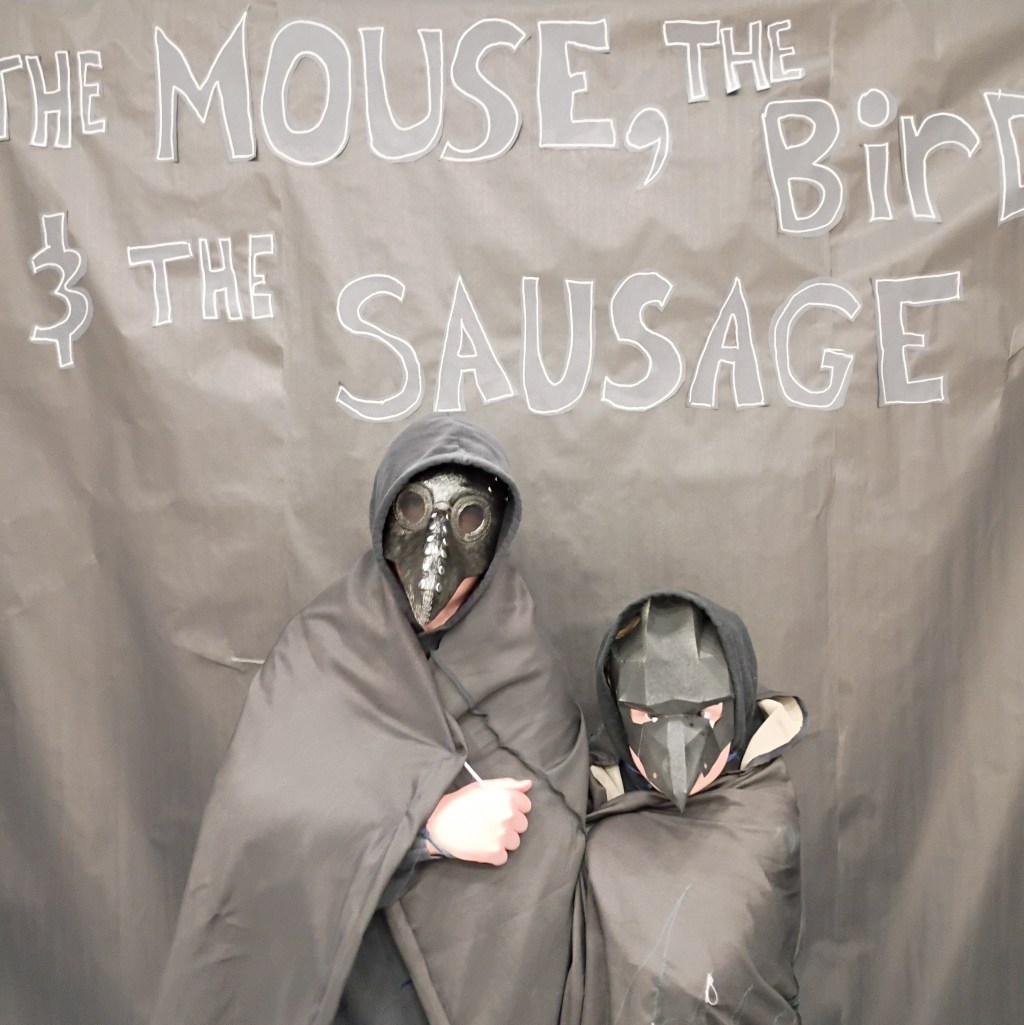
Our version calls for music support, that is, each character has a “walk up” song. With some guidance from me, the students selected pieces such as Who Let the Dogs Out for Dog’s entrance (of course they did!), and a slice of Pavarotti for our Italian Sausage, and for the crows, a German punk hit by Rammstein. Along with some simple but clever costuming and a few props, the play was engaging from beginning to end.

My dog actor did a good job of learning her lines and delivering them in Dog’s deadpan, aloof manner, but she’s shy and unassuming. I wanted her to enter the performance all frisky-like, to jump around the audience, to sniff first graders, but she just couldn’t do it. That is, not until I got her a squeaky dog toy shaped like a bone!  You can watch her and her fellow thespians perform the play on my public school site, The Daily Platypus. The simple recoding comes via a helpful parent (my Ipad decided to quit midway through the first act). You’ll see how each character entered and how our version remains faithful to the Grimms while being a blast to perform. To give you even more insight, we also recorded several important scenes without the audience. You’ll find them at DailyPlatypus.org as well.
The “walk-up” music we used includes Kali Flowers by Chris Joss for Mouse, Build a Nest by Earth, Wind & Fire for Bird, and Pavarotti’s Saint Lucia for Sausage. We also used Sehnsuct by Rammstein for Crow and the afore mentioned Who Let the Dogs Out for Dog. We used Stan Kenton’s morose version of Saint Lucia for Mouse’s boiling scene, and we reprised Kali Flowers for our conclusion. The music was edited for length in Audacity, but your sound person could simply fade out or pause each tune during your show. And don’t forget, you can select any music you want!

We decided to make all our sets black with silver outlines, which made for a cool Grimm-like essence. Our DIY paper masks came from Etsy sellers. The most challenging component of the play (aside from getting young actors to project their voices), was creating a costume for Sausage. It was well worth the extra effort. Here we are almost a week later and younger kids are still approaching the girl who played Sausage and saying, “Sausage, you’re alive?” and then telling her how great she is. She and the rest of the cast have all become celebrities!

Your students can experience the joy of celebrity too!  The Mouse, the Bird, and the Sausage, along with seventy other exceptional readers theater scripts, are available on our TeachersPayTeachers storefront. Each one has been carefully crafted by real humans and then kid-tested by real kids. Plus, they come with teacher notes, comprehension activities, and limited performance rights.

Happy directing!

Dragon Poet Trumps State Tests!

What better way to celebrate Spring than to watch evergreens named Bill, Otto, and Luther come to life, . . . Or Mr. Toad hit the open road in his caravan . . . Or Jackie Robinson belt a triple.  At ReadAloudPlays.com we have a host of engaging readers theater play scripts to counteract those test-taking spring time blues. Take our newest script, The Reluctant Dragon, Kenneth Grahame’s classic story about a poetry-spouting dragon who must face-off against the heroic knight, Sir George. It’s loaded with action, character, and vocabulary—and like all our scripts, it’s been kid-tested, so we know your students will love it. It’s a perfect addition to your National Poetry Month activities!

Nature Talks Back is another fun one. It’s an awesome Earth Day activity or simply a great play to teach environmental concepts such as beneficial insects and plant communication. I recently used it with a class of fifth graders who, after working on it for three days, presented it with huge grins to a class of smiling third graders! What a kick!

And of course, it’s baseball season! Our Jackie Robinson play is simply exceptional. Narrated by the hot dog man and the peanut vendor at a modern Yankees game (sorry Red Sox fans), it shows the significance of Jackie Robinson’s breaking of the color barrier in a way that’s both powerful and fun. I dare say, you won’t find a better Jackie story anywhere!

These and other professionally-crafted and uniquely-imagined scripts such as Chicken Little, Grimm’s The Mouse, the Bird, and the Sausage, and Goldie Locks: Home Reno, are all available on our TpT storefront.  

Thank you for your recent 5-star reviews, Rachel R., Chalk Dust & Holy Water, Masters-ful Materials, Jennifer B., Reyes Royals Designs, Savvy Classroom, Melissa G., Nancy R., Ruby R., Sharla S., Shannon R., Augusta S., Emily W., Ebony L., Alissa M., Gretchen F., and Melissa C. from North Carolina who shared this:

This resource was easy to use and very well organized. The directions were clear, and it fit perfectly with my 7th grade curriculum. My students stayed engaged, and it helped reinforce the skills we were working on. I will definitely use this again! Highly recommend for teachers looking for a ready-to-use activity.

Happy directing!

Banned Books, Banned Plays

Censorship always begins with good intentions.

Following the George Floyd protests, heightened concern about cultural sensitivity and traumatic events led TeachersPayTeachers to ban pretty much any reader’s theater or history lesson in which students were challenged to see the event through the eyes of a minority figure. Though well-intended (after all, it’s pretty obvious we shouldn’t be simulating slave auctions in class), TpT’s policy essentially silenced Ruby Bridges, Claudette Colvin, Sheyann Webb, MLK, and other heroes of the Civil Rights Movement. The basis behind the ban was that today’s children shouldn’t be forced to relive the verbal abuse Ruby experienced, or the emotional abuse felt by Sacagawea, or the violence Sheyann witnessed. Never mind that all good literature and historical accounts requires the reader to see it from such a perspective. For example, if Claudette Colvin’s story shouldn’t be shared via my play, “The Girl Who Got Arrested,” it also shouldn’t be shared using Phllip Hoose’s National Book Award-winning biography, Twice Toward Justice.

Yet it must be shared. It’s by seeing Claudette’s story through her eyes that it becomes more than just a blurb and a date in a history book. Claudette’s first-hand account is the primary source that makes the event relevant today.

When TpT deactivated all my plays, I sought help from a friend who serves as the director of the local university’s Center for Cultural Diversity, as well as from Dr. Geneva Craig, someone who actually experienced the tear gas in Selma. These are crazy times, they both lamented, but they helped me re-evaluate my content to make sure I was indeed being sensitive. I made a handful of subtle changes and then re-posted my plays on TpT.

Only to have them deactivated all over again.  

I tried re-posting them as JPEG sheets so that TpT’s content bots couldn’t recognize the text. I removed words like “drama” and “scripts” from my headings and changed “reader’s theater” to RT. To further disguise them, I rebranded them as “Paired Texts.” Nothing worked. TpT deactivated them every time. Ironically, it was during this time that The Palace Youth Theater in New Hampshire, with the help of its local BLM chapter, enacted two of the plays TpT had just banned.  

Fortunately, less-reactionary ideals have prevailed and the new ownership at TpT has since reversed the censorship. I suspect they recognize that educators have school district policies, parent input, and professional training to guide us as to the appropriateness of material. We don’t need TpT to do it for us.

Though I lost hundreds of favorable reviews and thousands of clicks, I’m pleased to say that all my civil rights and American history plays are back on TpT. But given the “crazy times” in which we live, I think it’s important for educators to consider how to appropriately use reader’s theater to teach marginalized voices and traumatic events. Here are a few tips:

Community – Consult with the cultural community associated with the events depicted, bringing in guest speakers where appropriate. If you have students from that particular marginalized culture, seek input from their families before introducing the play.

Sensitivity – Characters in a play should not do anything demeaning toward their culture. While every story—whether in a play format or otherwise—has to have conflict, violent acts should only be referenced by narrators or other characters rather than explicitly acted out. If unsure about how a scene plays out, change it. If you’re still unsure how the content will be received, consider using it only for a discussion-based classroom reading or podcast rather than enacting it “on stage.”

Casting – Don’t let race be the basis for casting parts. Dr. King said he dreamed of a day when we would all be “color blind.” A reader’s theater performance is a good place to practice it.

Policy – It’s important to check your school board’s policy before embarking on any content that might be controversial. Some districts restrict subject matter not explicitly identified within a given grade level’s standards.   

Paired Texts – It’s a good idea to pair reader’s theater content with professionally-published texts. For example, read Ruby Bridge’s book, Through My Eyes while working on the play, A Simple Act of Courage. Not only does the text serve as a vetting agent, it provides material to compare and contrast.

Discussion – No book, play, or video should stand alone. By discussing the content and events depicted, you facilitate understanding. Discussion should happen when introducing a play, while reading specific scenes, and after presenting. Utilizing expert guests enhances those discussions.

Repetition – One of the best reasons to use RT is that if there’s to be a presentation or performance, kids are willing to read plays repetitively. Even a simple reading in front of the class is enough to get kids to read and re-read a script multiple times. The brain science behind repetitive reading suggests students build their fluency at a far greater rate. It holds true with the students’ grasp on the historical events depicted and as well as their ability to empathize with marginalized voices.

Thank you for teaching Black history. Happy directing!