
Censorship always begins with good intentions.

Following the George Floyd protests, heightened concern about cultural sensitivity and traumatic events led TeachersPayTeachers to ban pretty much any reader’s theater or history lesson in which students were challenged to see the event through the eyes of a minority figure. Though well-intended (after all, it’s pretty obvious we shouldn’t be simulating slave auctions in class), TpT’s policy essentially silenced Ruby Bridges, Claudette Colvin, Sheyann Webb, MLK, and other heroes of the Civil Rights Movement. The basis behind the ban was that today’s children shouldn’t be forced to relive the verbal abuse Ruby experienced, or the emotional abuse felt by Sacagawea, or the violence Sheyann witnessed. Never mind that all good literature and historical accounts requires the reader to see it from such a perspective. For example, if Claudette Colvin’s story shouldn’t be shared via my play, “The Girl Who Got Arrested,” it also shouldn’t be shared using Phllip Hoose’s National Book Award-winning biography, Twice Toward Justice.
Yet it must be shared. It’s by seeing Claudette’s story through her eyes that it becomes more than just a blurb and a date in a history book. Claudette’s first-hand account is the primary source that makes the event relevant today.
When TpT deactivated all my plays, I sought help from a friend who serves as the director of the local university’s Center for Cultural Diversity, as well as from Dr. Geneva Craig, someone who actually experienced the tear gas in Selma. These are crazy times, they both lamented, but they helped me re-evaluate my content to make sure I was indeed being sensitive. I made a handful of subtle changes and then re-posted my plays on TpT.
Only to have them deactivated all over again.
I tried re-posting them as JPEG sheets so that TpT’s content bots couldn’t recognize the text. I removed words like “drama” and “scripts” from my headings and changed “reader’s theater” to RT. To further disguise them, I rebranded them as “Paired Texts.” Nothing worked. TpT deactivated them every time. Ironically, it was during this time that The Palace Youth Theater in New Hampshire, with the help of its local BLM chapter, enacted two of the plays TpT had just banned.
Fortunately, less-reactionary ideals have prevailed and the new ownership at TpT has since reversed the censorship. I suspect they recognize that educators have school district policies, parent input, and professional training to guide us as to the appropriateness of material. We don’t need TpT to do it for us.
Though I lost hundreds of favorable reviews and thousands of clicks, I’m pleased to say that all my civil rights and American history plays are back on TpT. But given the “crazy times” in which we live, I think it’s important for educators to consider how to appropriately use reader’s theater to teach marginalized voices and traumatic events. Here are a few tips:
Community – Consult with the cultural community associated with the events depicted, bringing in guest speakers where appropriate. If you have students from that particular marginalized culture, seek input from their families before introducing the play.
Sensitivity – Characters in a play should not do anything demeaning toward their culture. While every story—whether in a play format or otherwise—has to have conflict, violent acts should only be referenced by narrators or other characters rather than explicitly acted out. If unsure about how a scene plays out, change it. If you’re still unsure how the content will be received, consider using it only for a discussion-based classroom reading or podcast rather than enacting it “on stage.”
Casting – Don’t let race be the basis for casting parts. Dr. King said he dreamed of a day when we would all be “color blind.” A reader’s theater performance is a good place to practice it.
Policy – It’s important to check your school board’s policy before embarking on any content that might be controversial. Some districts restrict subject matter not explicitly identified within a given grade level’s standards.
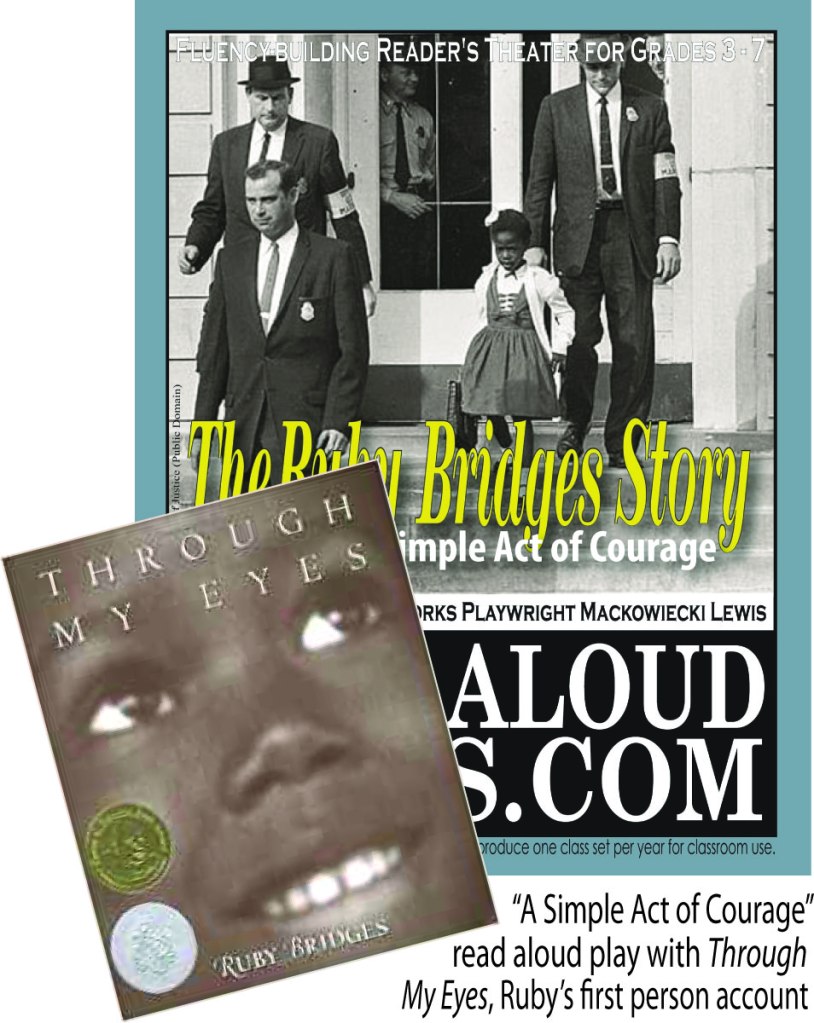
Paired Texts – It’s a good idea to pair reader’s theater content with professionally-published texts. For example, read Ruby Bridge’s book, Through My Eyes while working on the play, A Simple Act of Courage. Not only does the text serve as a vetting agent, it provides material to compare and contrast.
Discussion – No book, play, or video should stand alone. By discussing the content and events depicted, you facilitate understanding. Discussion should happen when introducing a play, while reading specific scenes, and after presenting. Utilizing expert guests enhances those discussions.
Repetition – One of the best reasons to use RT is that if there’s to be a presentation or performance, kids are willing to read plays repetitively. Even a simple reading in front of the class is enough to get kids to read and re-read a script multiple times. The brain science behind repetitive reading suggests students build their fluency at a far greater rate. It holds true with the students’ grasp on the historical events depicted and as well as their ability to empathize with marginalized voices.
Thank you for teaching Black history. Happy directing!





 ReadAloudPlays.com