The Antidote for Spring Fever and the Test Taking Blues

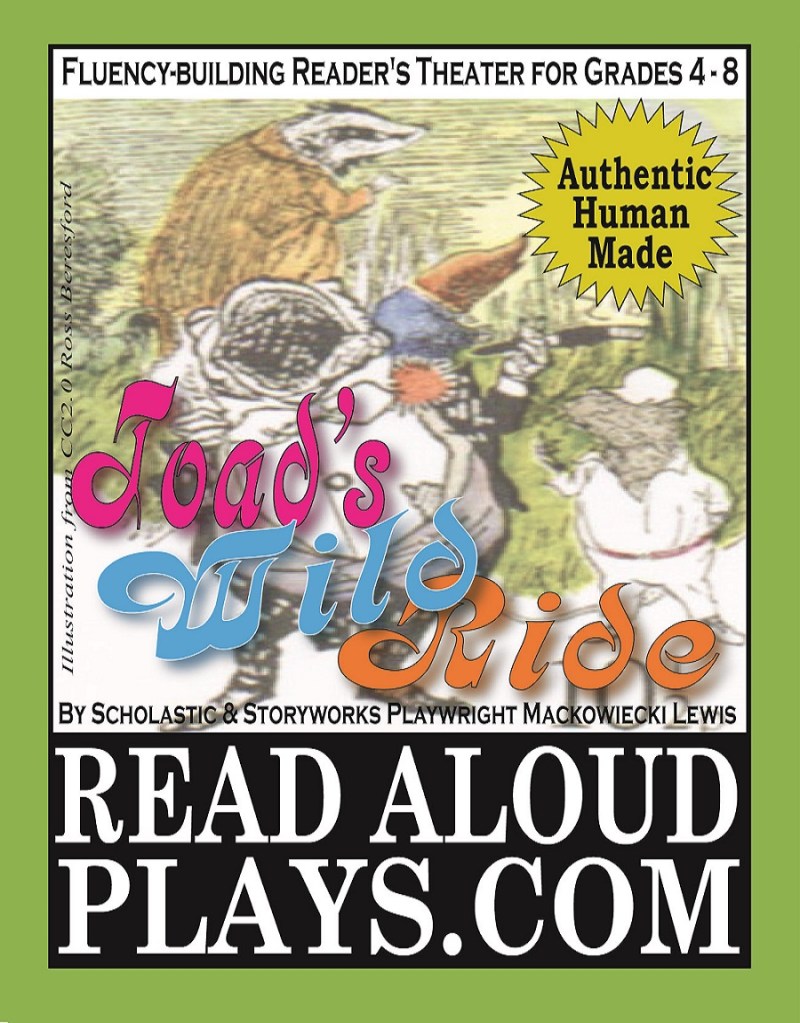
If you’re school is anything like mine, you’re probably gearing up for standardized testing. For many of us and our kids, it’s the bane of our existence. So, my proposal to you is to use what little time remains in your schedule to have some fun staging a play! It can be as simple as an in-class reader’s theater presentation or as complex as a full stage production (start now for an end-of-the-school year performance!). Whatever the case, at ReadAloudPlays.com we have gobs of plays perfectly suited for spring, including our latest release, Toad’s Wild Ride.

We’ve narrowed Wind in the Willows down to its best, most humorous elements. It shows how Mr. Toad becomes infatuated with motor cars, how his friends attempt to “cure” him, and how he goes on a maniacal drive through the village. Yes, Scene 7 resembles the Disneyland ride! The whole play is full of pratfalls, subtle humor, and grand entrances, making it as kid-friendly as it gets. Enjoy Mole’s innocence, Badger’s stodginess, and Otter’s “charisma,” but don’t forget Ratty and Toad! The play includes stage directions, making it ideal for a full production.

BADGER: Then you don’t promise to never touch a motor-car again?

TOAD:  Certainly not! In fact, I promise that the very first motor car I see, poop-poop, off I go!

Baseball season is underway, so many of your male students—who statistically are more likely to be reluctant readers—will jump at the chance to be in a baseball play.  How Jackie Saved the World depicts the circumstances around Jackie Robinson breaking the “color barrier.” As your students portray Jackie, Pee Wee, and others, a radio announcer calls a more modern game between Derek Jeter’s Yankees and Ken Griffey’s Mariners, gently contrasting the two eras. A peanut vendor and the hot dog man lend narration as they walk through the audience hawking ballpark snacks.

HOT DOG MAN: Despite all that pressure, Jackie led the Dodgers to the World Series and was named Rookie of the Year.  Some said it was the toughest season any ball player has ever endured. Last chance for hot dogs!

PEANUT VENDOR: No doubt the reason today’s game is so exciting is because Jackie had the courage to turn the other cheek. Peanuts! Get your peanuts here!

ANNOUNCER: We’re in the top of the ninth. Two outs and two on and the score tied two to two. The Yankees are taking no chances. With Ken Griffey, Jr. up to bat, they’ve brought in their closer, Mariano Rivera.  Here’s the pitch. . .

Perfect for Earth Day, Nature Talks Back “follows” the madcap adventures of three conifers named Otto, Bill, and Luther as they deal with bark beetle scares, woodpeckers, and centipedes. The story uses campy humor to convey scientific (and non-politicized) facts about the environment.

BILL: It’s not a termite is it? Oh, I hate termites!

LUTHER: No, I don’t think it’s a termite.

BILL: Phew. You had me worried for a minute.

OTTO: Too big for a termite. Looks like some kind of beetle. Does it look like some kind of beetle to you, Luther?

BILL (alarmed): A beetle? Is it a bark beetle?!  Oh no. It’s a bark beetle, isn’t it? I just know it! Get it off of me! Get it off of me!

If maniacal drives, spring training, and talking trees don’t entice you, we also have Peter Rabbit (it seems too young for 5th and 6th graders, but they love doing it—especially when they get to perform it for youngers), Winnie the Pooh (and Tigger too!), and on a more serious note, Juneteenth: Freedom for the First Time. Plus we have dozens more: all original, all human-made, and all with teacher notes, writing prompts, comprehension activities, and the license to print a full class set every year for use in one’s own classroom. Other sites charge dramatically more (no pun intended) for plays with far less originality and pizazz!

Plays teach kids to read purposefully and thoughtfully rather than merely for speed. They always have developmentally-appropriate parts for both your advanced readers and your most reluctant ones. And once parts are assigned, you don’t have to prompt kids to chime in. Best of all, plays are fun.  They’re the perfect antidote for spring fever and those test-taking blues.

Happy directing!

Revolutionary Women’s History

The Sybil cover from Scope magazine

Here are five classroom plays about the American Revolution. Each is politically-neutral, based on well-researched historical accounts, and vetted by professional editors at Scholastic. The first three (four if you count the Liberty Bell) feature strong females, making them perfect for Women’s History Month.  

The Secret Soldier tells the story of Deborah Samson, the perseverant young woman who disguised herself as a man in order to enlist in the Continental Army. History remembers her as America’s “first woman soldier.”

Betsy Ross has a lot of doubters these days. This play exploring the creation of America’s first flag, encourages readers to approach history scientifically: to research the facts themselves before drawing conclusions.

Girl, Fighter, Hero tells the story of Sybil Ludington, the young woman often called “the female Paul Revere.” Sybil rode 40 miles on a stormy night to muster the militia during the American Revolution battle near Danbury.

Eagles Over the Battlefield introduces students to our national emblem, the American bald eagle. This work of historical fiction imagines how the Founding Fathers might have debated the symbol’s selection, especially given Ben Franklin’s tongue-in-cheek disdain for the eagle.

Finally, A Bell for the Statehouse , which comes as a 2 for 1 with Eagles, reveals how the Liberty Bell came to be a national symbol after being sheltered away with other “patriot leaders” in the basement of a church.

All five plays are dramatic, compelling, and fun for kids to present on stage or perform as reader’s theater.

Thank you, Rachel Scott, M. M., Aram Alexander Barboa-Reidy, Alejandra Alejandra Peña, Laura Franklin, Michelle Gribble, Daniel B. Bennett, William Samples, and Jennifer Theis for your recent 5-star reviews!

Happy directing!

Time to Unleash Your Ghouls & Goblins

Back a hundred years ago, the idea of ghoulishness was captured in short stories rather than comic books. Writers like Poe, Shelley, and Stevenson creeped out their audiences with dark tales of superstition, mystery, and insanity—and the Gothic themes they created have been permeating literature, television, and cinema ever since. Case in point, for the last couple of years I’ve been not-quite-binge watching episodes of Dark Shadows, the Gothic TV show about Barnabas Collins—arguably the world’s second-most famous vampire. (Step aside, Edward.) The show’s witches, werewolves, and headless dudes had me mesmerized when it originally aired back in the 1960’s. Now, viewing the rather campy soap through adult eyes, I’m recognizing that all its creepiness came from classic short stories like The Cask of Amontillado, Frankenstein, and the Headless Horseman. They’re all in there! Go figure!

Your students know these themes, too. They’ve seen them on the Simpsons and Family Guy, in Goosebumps and Marvel Comics. But do they know from whence they come?  Though the archaic language and complex structures of these classic tales present barriers for middle grade readers, you can make them more accessible by pairing them with reader’s theater. And what better time to do it than Halloween?

So what if your students are mesmerized by Venom and Doctor Octopus! There are plenty of mangled monsters and the criminally insane in W.W. Jacob’s classic, The Monkey’s Paw, Poe’s The Tell-Tale Heart, and Hawthorne’s The Birthmark. They’ll also find that familiar ol’ headless horseman in Sleepy Hollow, and a hapless ghost in Twain’s A Ghost Story. No, your kids won’t find them Pennywise-creepy or Slenderman-scary, but chemical concoctions, mad scientists, and sinister psychopaths make them very nearly as engaging.    

All these plays are available on my TeachersPayTeachers storefront. They’re critically-acclaimed. They’re cheap. And they each come with a comprehension exercise. Suitable for reader’s theater, podcast radio drama, or full stage production, they’re perfect for fifth graders and up— but get started early to have them well-rehearsed by Halloween.

Thank you “Back at Work,” Rebecca Schwartz., Les Cain, Misha Carlstedt, Carolyn Finch,  Jocelyne Matos, Bobbie Kukal, Antonio Costa, Lori Ivy, and Lynn Silvey for your lovely recent reviews of my products.

Happy directing!

Why Your Students Can’t Pay Attention

When LeBron James drains a three-pointer, he gets more than a big chunk of change. He also gets a hit of endorphins. It’s this hit of hormones that makes him want to score again and again. I’m not a neurologist (nor even much of a brainiac), but I’ve read enough about neurotransmitters such as dopamine and serotonin to understand a bit of the brain science behind motivation. What happens in Lebron’s brain is the same thing we all experience when something gives us pleasure or excitement. It’s especially profound in the developing brains of our students. It’s what motivates a kid to learn to read, to pass tests, to win at wall ball, to make friends, and . . . to level up in Fortnite.

Video games, it seems, are designed to stimulate endorphin production. (So too are the algorithms in social media.) It is what makes video games addictive. In a typical video game, the early levels are easy. A player experiences immediate success and therefore an immediate dopamine hit. As the player advances to higher levels, success is harder to come by, but the player sticks with it because their brain is seeking those endorphins. The problem is that getting endorphins in an artificial environment such as a video game is fun and easy, which means it highjacks a person’s motivation to pursue endorphins in the real world. It’s why your video game addict often lacks the work ethic to become a voracious reader, to earn straight A’s, or to drain three-pointers. Small Spaces may be a great book, but it just can’t compete with Roblox.  

Johann Hari spells all this out in his book, Stolen Focus. He’s compiled vast amounts of research to show how addiction to devices is undermining not just education, but society as a whole. It’s a great read—and it’s especially applicable to educators.

Hari contends that today’s kids are being raised by devices from the time they’re born. When our toddlers need attention, instead of actually parenting we merely hand them a tablet. Neither parent nor child learn to deal with whatever the actual problem is because the device serves as a pacifier.

Hari also contends that ADHD is over-diagnosed. Chronic sleep deprivation due to Internet Gaming Addiction (IGA) is the root cause of classroom hyperactivity and focus issues.  Gamers over-stimulate their brain in the evening hours and consequently can’t fall asleep. Rarely do they reach REM sleep. The chronic fatigue manifests itself just like ADHD, but the solution isn’t daily doses of Ritalin; it’s as simple (and as hard) as turning off devices two hours before bedtime.

We’ve all heard the ed gurus telling us for a while now that kids with laptops, tablets, or cell phones will accomplish whole new levels of academic success. The pandemic, though, exposed the many flaws of such digital thinking, yet today, despite plunging test scores, alarmingly low literacy rates, decreasing motivation, and increasing hyperactivity, we’re still subjecting our kids to online platforms–many of which look a lot like video games.

Maybe it’s time we put away all the devices and got back to some fundamentals such as cursive handwriting (it does all kinds of great stuff in the brain), holding actual books in our hands, counting back change, using measuring tape, microscopes, and beakers.

And performing plays.

You can check out Stolen Focus at most any bookseller or public library. (I’m not including a hot link because I want you to know I’m recommending the book solely on its merits, but here’s as honest a review as you’ll ever find.) You can also check out my plays—most of which were originally published by Scholastic—in my TpT store. Consider welcoming kids back to school with my Winnie-the-Pooh reader’s theater. I’ve taken five of Milne’s best stories and crafted them as one-act plays, each with just 4 or 5 actors. Try splitting your class into small groups and have each learn and perform an act during the first week of school! They’ll love it!

Or, I suppose you could instead just assign them some more time on an online reading app.

(Don’t do it! Use a play!)

Happy directing!

Testing Absurdity

When I first started teaching thirty years ago, the state test was a pencil and paper bubble test. It was spread over a three day period, one hour at a time. The results came back a few weeks later and they were used to inform practice. If our students showed weakness on, say, “locating information,” we knew where we needed to beef up our instruction.  I have no issue with testing students in such a way. These days, however, standardized testing seems to be cumbersome, expensive, bureaucratic, punitive, and time-consuming.              

Frankly, it’s absurd.

At my schools we’re trying to compensate by cramming in all the enjoyable and authentic learning experiences we can. Right now our students are deeply engaged in The Checkbook Project, my free financial literacy / behavioral management / practical math system. Students in our 4th and 5th grade classes have been managing their bank accounts since mid-February, renting or purchasing their desk space, applying for jobs, paying taxes, and buying stuff at auction. As we head into the final trimester, they’ll be starting businesses, buying stocks, and donating to actual charities. This program dominates their every moment in class. When they’re well into adulthood, they’ll reflect on “Checkbooks” as a significant piece of their elementary education.

Our Fact Car Rally Race math facts program is winding down. About a third of the students have either already crossed the finish line or are drawing near the checkered flag. Another third of the class is on pace to demonstrate mastery by year’s end. That leaves the remaining kids in need of tow trucks and roadside mechanics to help catch them up.

Of course, we’re also doing all the customary kinds of work: fractions, figures of speech, physical fitness—and writing. You know kids: they’ll limit their written responses to a single paragraph—or even a single sentence if they can get away with it. But that won’t do given the emphasis on writing multi-paragraph responses on that absurd state test mentioned earlier. So, we’re using my Perfect Paragraphs program to show kids how to expand single paragraphs into multi-paragraph essays. By teaching them how to use their “reason why” supporting sentences as topic sentences for the additional paragraphs, they’re better prepared for that darn test, and more importantly, their future school years.

Despite political controversy, we’re delving into slavery.  I’m convinced the likes of Harriet Tubman, Harriet Beecher Stowe, and Dred Scott should be and can be shared tactfully. Among other things, we’ll be reading my researched-based reader’s theater scripts about Box Brown and Juneteenth.   

Speaking of theater, we’re preparing a full stage presentation of my play The Nose, replete with a giant papier-mâché nose costume. It’s based on Gogol’s classic short story of the same name and it’s full of mind-bending humor about bureaucratic absurdity. It’ll take a couple of months to put it all together, but it’ll make for a mind-bending conclusion to a yet another school year full of silliness and absurdity—all the stuff kids remember after all that standardized testing has been forgotten.

To check out any of my programs for use this year or next, visit my storefronts at TpT or Etsy. Be sure also to visit my school page, DailyPlatypus.org.   

Happy directing!

Trees, Bees, and Centipedes . . .

The clocks have all sprung forward, the turkey vultures have returned, and the sprouts are beginning to pop. Spring has arrived! So tell that groundhog to make way for some fun plays celebrating the season, including my newest script, Nature Talks Back. It’s actually four coordinated skits designed to give younger students insight in to trees, bees, and centipedes. Its ecology and conservation themes include that trees communicate, that some perceived pests are considered beneficial insects, and that honeybees are super-important pollinators.  The stories center around three oddball forest trees named Luther, Otto, and Bill and their hysterical encounters with a host of pests.    

It’s aimed specifically at kids in upper 2nd through 4th grade, but it’s also suitable for grade 5 and up for reader’s theater, podcast, or stage— especially when performed for younger kids. (My fifth graders love it and are presently preparing a full production!)

Consider pairing Nature Talks Back with some of my other spring-oriented plays. Peter Rabbit is also aimed at younger students. Use it with 2nd and 3rd graders, or have older students perform it for primary-aged kids. Rikki Tikki Tavi, Kipling’s much-loved story about the heroic mongoose has some spring-time flair, a singing bird, and an important theme about courage. It too can be presented alongside How the Elephant Got Its Trunk, another classic Kipling tale from The Jungle Books.  And don’t forget that baseball season is upon us, so it’s a great time for my entertaining and socially important play about Jackie Robinson.

Happy directing!

Four Plays for the Humbug Holidays

I noticed the artificial Christmas trees arrived at my local home store even before the inflatable Frankensteins and motion-activated witches had been discounted. I guess the stores are worried the holidays will sneak up on us. 

For teachers, that’s a real possibility. After all, our “classroom Christmas” typically comes a week or two before the real one. That means the “cafeteria elves” my students create every year have to be done before Thanksgiving. And in order to have ample time to cast, rehearse, and stage a holiday play, we need to get directing even sooner. So let’s get right to it. Here are four holiday classics you should consider downloading right away.   

A Christmas Carol.  This one comes with two versions. The first, a traditional, kid-friendly version, was originally published in the December 1998 issue of Storyworks.  The second, alternative-gender version, was originally published in my book, Read Aloud Plays: Classic Short Stories. It features the likes of  Eleanora Scrooge, Gladys Marley, and Tiny Tina.

Gabriel Grub. Though it has the same theme as Carol, it’s even more of a ghost story. With its cacophony of goblins, it’s downright creepy—which is why it’s a blast to enact. Check out this radio drama my students created a few years back.

Escape from the Blacking House. If you have some talented student-actors, create “A Dickens Christmas” by stringing together two or three Dickens plays. “Blacking House” isn’t so much a holiday play, but instead beautifully depicts the story of Dickens’ “perilous” youth. Use it as a heart-warming preface to one or both of the other plays.

The Gift of the Magi. You know this story: a young woman sells her beautiful hair so she can buy her hard-working but impoverished husband a fancy chain for his pocket watch. Meanwhile, the young husband sells his prized pocket watch so he can buy his lovely wife some fancy combs for her hair. It’s a lovely version of O.Henry’s story about the spirit of giving.

Each of these plays takes from 15 to 20 minutes to enact, but two to four weeks to prepare a full stage production. Use them as reader’s theater, podcast, or stage performance—or as just a single reading for your classroom Christmas. They’re available on TeachersPayTeachers and Etsy. They come with the license to print a class set, and limited public school performance rights.  There are also FREE Google Forms quizzes for each of them on TpT.

Happy directing!

Monster Plays for Spring

I recently surveyed my fifth graders about what they’d like more of. It probably won’t surprise you that “more Zoom” received zero votes. “More plays,” on the other hand, won hands-down. Sure it did! Whether in-person or remote, reader’s theater works. Plays teach kids to read purposefully and thoughtfully rather than merely for speed. They always have developmentally-appropriate parts for both your advanced readers and your most reluctant ones. And once parts are assigned, you don’t have to prompt kids to chime in. Best of all, plays are fun.

With my kids coming back to class, I want to have fun again, so I’m busting out my favorite monster play: Cyclops. It has some campy lines and a gruesome story, making it super appealing to kids (hint: Cyclops likes Greek food). Here are some other enjoyable plays for spring: Peter Rabbit (it seems too young for 5th and 6th graders, but they love doing it—especially when they get to perform it for youngers); How Jackie Saved the World (The Peanut Vendor and the Hot Dog Man emerge from the grandstands to tell Jackie Robinson’s story); And Fly Me to the Moon (it features Walter Cronkite stuffed inside a TV-shaped box!).

This time of year, many classrooms are focused on the American Revolution.  Though the subject matter is more serious, the plays are just as fun: The Secret Solider (how Deborah Samson disguised herself as a man in order to join the military); Girl. Fighter. Hero.  (“the female Paul Revere”); Betsy Ross: Fact or Fiction (more about examining historical proof than it is about Betsy herself); And Two Plays from the American Revolution (2 for 1–the bald eagle and the Liberty Bell).

I hope you’re as excited as I am to have kids back in class, but whether you’re in-person or remote, give my critically-acclaimed RT a try.  Most of it was originally published by Scholastic, it always comes with standards-based comprehension activities, and need I say it again? It’s fun! You kids will love it. Happy directing!

So Bad, It’s Funny

Call them flops, bombs, fiascos. Read Aloud Plays have turned out to be pretty ideal for the Covid classroom because the pre-assigned parts make for uninterrupted reading, but sometimes they’re just so bad, they’re funny.

If you’ve used “Zoomer’s theater,” you know that feedback and bandwidth lag can sometimes derail a play. But that wasn’t what created such a mess this go-round. After practicing three MLK plays for the last three weeks, my lovely fifth graders met in separate Zoom sessions for the final performances—recordings to be posted on our class web page. That’s when the chaos broke out. Actors showed up to the wrong session or went missing altogether. There was an acute outbreak of ADHD. One kid muted himself and then got his fingers struck in a Chinese finger puzzle. Another kid read half her lines while chomping on leftover pepperoni pizza. Ugh! 

In “MLK’s Freedom March,” the kid playing Dr. King, unbeknownst to the rest of us, left for an extended trip to the bathroom right before his big scene, leaving a broad swath of dead air. That’s when three other actors decided they needed to cover for him. They all attempted to read the lines over the top of one another, which created an effect not-unlike the echo one might have heard on the steps of the Lincoln Memorial. In another play, the distracted student playing Dr. King (who I suspect was knocking out some Happy Numbers minutes in a failed attempt at multi-tasking) missed his cue. When another kid jumped in, Dr. King suddenly interjected, “Hey! That’s my line!” (Now remember, this is our recorded take). “Well are you going to read the rest of it or not?” growled the first kid, which incited a twenty second spat in the middle of our recording.

 And then there’s the word “crap.” It shows up right in the middle of an otherwise well-done reading of “Martin’s Big Dream.” The student in question had just belted out his lines, but upon realizing he was still muted, tapped his space bar, only to lead with his one-word frustration.

Me? As one gaff piled atop the other, all I could do was laugh into my hand and occasionally cover my face in mock distress. It was simultaneously disheartening and hysterical.

Despite the failure, the plays were really a roaring success. The kids had a dozen good practice sessions in which repetitive reading contributed to fluency growth. They spent a ton of time discussing Dr. King and the Civil Rights Movement—which is pretty darned pertinent these days. They developed a bit of character as they owned their mistakes and distractedness. And they also had a good time. I contend that any time this generation of kid has a good time reading, well, that’s solid gold.

All this confirms for me that even classroom flops are academic hits.

Whether you’re still teaching remotely or heading back to the classroom, February is a great month for reader’s theater. I have a host of plays and paired texts for Black History Month (see my previous post), but I also have a handful of fun plays for Presidents’ Day. Because they’re on the easier end of things, you can expect smooth reading in just a handful of practices. “Argument at Mount Rushmore” is a hoot. The four Rushmore presidents argue with one another while attempting to explain to some tourists what they did to be so honored. In “Presidents’ Day Dream,” several presidents humorously share how hard it is to serve. It pairs well with the picture book, “So You Want to Be President” by Judith St. George. There’s also “Eagles Over the Battlefield” (you’ll find it in “Two Plays from the American Revolution”), and “The War of 1812,” which gives some insight into our earliest presidents. Finally, “President Lincoln’s Spies and Rebels” fits both Black History Month and Presidents’ Day.

Happy (and hysterical) directing—even when it’s a flop!

Reader’s Theater for MLK Day

MLK Day feels especially important this year. Let’s face it, we have a lot of work to do if we’re to fulfill the dream Dr. King spoke of so poignantly more than fifty years ago. We have a lot of work to do if we’re to validate the effort and sacrifice of people like John Lewis, Medgar Evers, Rev. Jonathan Daniels, and other heroes of the Civil Rights Crusade. We have a lot of work to do if we’re to heal from all the wounds torn open by the tragedies and injustices of these last few years. Can we accomplish all that on a single holiday in January?

Of course not.

But MLK Day is a platform. It’s a launch pad. It’s a starting point for the hard work of sharing the stories, teaching the history, and promoting the diversity that will make the next generation happier and healthier. I don’t pretend to think my reader’s theater plays will accomplish all that by themselves, but I think you’ll find them useful tools in undertaking that challenge. Download this free preview pack, visit my Black History & Civil Rights page, and see if you can’t make your MLK Day and Black History Month something special. Make it an MLK Day that matters.

Happy directing.