February is Black History Month. While I encourage you to acknowledge it with some dedicated activities, I’m also reminded that black history is American history; it need not be limited to a single month! The end of the Civil War, Jackie Robinson’s breaking of baseball’s color barrier, and MLK’s “I Have a Dream” speech certainly rank among some of the most significant moments in American history. With that in mind, here are twelve great reader’s theater scripts with which to recognize those great moments while meeting numerous Language Arts standards. All the plays can be paired with a printed text, such as “The Ruby Bridges Story” with her autobiography, Through My Eyes. Each pairing represents distinctly unique points of view (Literature CCSS #6), making for livelier discussions and quality comparisons (CCSS Lit #7). And because these plays are based on real events, they’ll also satisfy CCSS Informational Text #6. Each play includes a comprehension activity, too, assuring your students will satisfy numerous other standards as well. And because almost all my plays were originally commission by and published in Scholastic’s Storyworks and Scope magazines, they’ve been professionally vetted, making them the best reader’s theater on the market. Visit ReadAloudPlays.com for detailed pairings, or click on the title to preview or purchase on my TeachersPayTeachers storefront. Happy directing!
Here are nine compelling paired texts with which to recognize black history month. All the plays are based on the given event–not it’s paired text (in most cases the play was published before the given book). That means each pairing represents distinctly unique points of view (Literature CCSS #6), making for livelier discussions and quality comparisons (CCSS Lit #7). And because these plays are based on real events, they’ll also satisfy CCSS Informational Text #6. Each includes a comprehension activity, too, assuring your students will satisfy numerous other standards as well. And because almost all my plays were originally commission by and published in Scholastic’s Storyworks and Scope magazines, they’ve been professionally vetted, making them the best reader’s theater available. Just click on the image to preview or purchase on my TeachersPayTeachers storefront. Also be sure to check out these recorded performances of “Martin’s Big Dream” and “Ruby Bridges: A Simple Act of Courage” by The Palace Youth Theater. Happy directing!
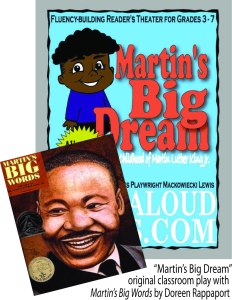
MLK Day is January 20th, so it’s a great time to use some exceptional reader’s theater to teach about this icon of American history. My play, Martin’s Big Dream, tells about how an incident in the sandlot during King’s childhood helped inspire his mission. It’s my top play ever. It’s been published in Storyworks, Scope, Scholastic News, Instructor Magazine, in various textbooks, and in the book, Read Aloud Plays: Symbols of America. It’s also been professionally performed by the Palace Youth Theater and other organizations. You can pair your use with PYT’s performance by visiting here.
Of course, all of these plays are also great picks for Black History Month in February, and now is the time to get started if you want a first-rate presentation. Focusing on one or more of the young heroines of the Civil Rights Movement might inspire some of your female students to greatness, so consider our scripts about Ruby Bridges, Sheyanne Webb, and Claudette Colvin.
We also have plays about Box Brown, the man who escaped slavery by mailing himself in a crate, about baseball great Jackie Robinson, and about the author, Richard Wright.
President’s Day is February 17th. Presidents’ Day Dream looks at the Presidency from a different viewpoint. When the play’s lead character day dreams about being president, she’s met in her “dream” by various former presidents. Each speaks frankly about the challenges and hardships of the job while pointing out the qualities it takes to be a good leader. It’s an easy one to perform.
Another one for February is Argument at Mount Rushmore. It imagines the sixty-foot tall faces on Rushmore “discussing” the merits and accomplishments of each of their presidencies. Though built on a humorous platform, it’s a historically-accurate portrayal of the gracious Washington, the witty Lincoln, and the always-enthusiastic Roosevelt. As for the sometimes over-looked and often under-appreciated Jefferson, well, let’s just say he gets a bit bent out of shape—just as you might be if you miss the chance to snag some of these timely play scripts.
Following the George Floyd protests, heightened concern about cultural sensitivity and traumatic events led TeachersPayTeachers to ban pretty much any reader’s theater or history lesson in which students were challenged to see the event through the eyes of a minority figure. Though well-intended (after all, it’s pretty obvious we shouldn’t be simulating slave auctions in class), TpT’s policy essentially silenced Ruby Bridges, Claudette Colvin, Sheyann Webb, MLK, and other heroes of the Civil Rights Movement. The basis behind the ban was that today’s children shouldn’t be forced to relive the verbal abuse Ruby experienced, or the emotional abuse felt by Sacagawea, or the violence Sheyann witnessed. Never mind that all good literature and historical accounts requires the reader to see it from such a perspective. For example, if Claudette Colvin’s story shouldn’t be shared via my play, “The Girl Who Got Arrested,” it also shouldn’t be shared using Phllip Hoose’s National Book Award-winning biography, Twice Toward Justice.
Yet it must be shared. It’s by seeing Claudette’s story through her eyes that it becomes more than just a blurb and a date in a history book. Claudette’s first-hand account is the primary source that makes the event relevant today.
When TpT deactivated all my plays, I sought help from a friend who serves as the director of the local university’s Center for Cultural Diversity, as well as from Dr. Geneva Craig, someone who actually experienced the tear gas in Selma. These are crazy times, they both lamented, but they helped me re-evaluate my content to make sure I was indeed being sensitive. I made a handful of subtle changes and then re-posted my plays on TpT.
Only to have them deactivated all over again.
I tried re-posting them as JPEG sheets so that TpT’s content bots couldn’t recognize the text. I removed words like “drama” and “scripts” from my headings and changed “reader’s theater” to RT. To further disguise them, I rebranded them as “Paired Texts.” Nothing worked. TpT deactivated them every time. Ironically, it was during this time that The Palace Youth Theater in New Hampshire, with the help of its local BLM chapter, enacted two of the plays TpT had just banned.
Fortunately, less-reactionary ideals have prevailed and the new ownership at TpT has since reversed the censorship. I suspect they recognize that educators have school district policies, parent input, and professional training to guide us as to the appropriateness of material. We don’t need TpT to do it for us.
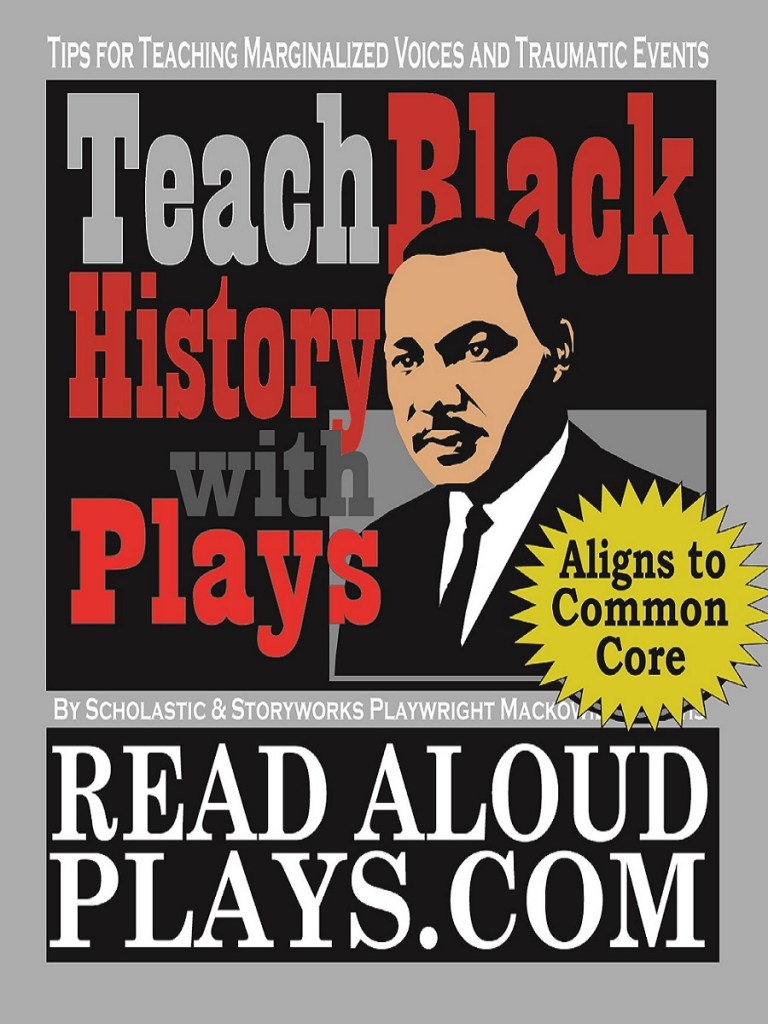
Though I lost hundreds of favorable reviews and thousands of clicks, I’m pleased to say that all my civil rights and American history plays are back on TpT. But given the “crazy times” in which we live, I think it’s important for educators to consider how to appropriately use reader’s theater to teach marginalized voices and traumatic events. Here are a few tips:
Community – Consult with the cultural community associated with the events depicted, bringing in guest speakers where appropriate. If you have students from that particular marginalized culture, seek input from their families before introducing the play.
Sensitivity – Characters in a play should not do anything demeaning toward their culture. While every story—whether in a play format or otherwise—has to have conflict, violent acts should only be referenced by narrators or other characters rather than explicitly acted out. If unsure about how a scene plays out, change it. If you’re still unsure how the content will be received, consider using it only for a discussion-based classroom reading or podcast rather than enacting it “on stage.”
Casting – Don’t let race be the basis for casting parts. Dr. King said he dreamed of a day when we would all be “color blind.” A reader’s theater performance is a good place to practice it.
Policy – It’s important to check your school board’s policy before embarking on any content that might be controversial. Some districts restrict subject matter not explicitly identified within a given grade level’s standards.
Paired Texts – It’s a good idea to pair reader’s theater content with professionally-published texts. For example, read Ruby Bridge’s book, Through My Eyes while working on the play, A Simple Act of Courage. Not only does the text serve as a vetting agent, it provides material to compare and contrast.
Discussion – No book, play, or video should stand alone. By discussing the content and events depicted, you facilitate understanding. Discussion should happen when introducing a play, while reading specific scenes, and after presenting. Utilizing expert guests enhances those discussions.
Repetition – One of the best reasons to use RT is that if there’s to be a presentation or performance, kids are willing to read plays repetitively. Even a simple reading in front of the class is enough to get kids to read and re-read a script multiple times. The brain science behind repetitive reading suggests students build their fluency at a far greater rate. It holds true with the students’ grasp on the historical events depicted and as well as their ability to empathize with marginalized voices.
Thank you for teaching Black history. Happy directing!
February is Black History Month. While I encourage you to acknowledge it with some dedicated activities, I’m also reminded that black history is American history; it need not be limited to a single month! The end of the Civil War, Jackie Robinson’s breaking of baseball’s color barrier, and MLK’s “I Have a Dream” speech certainly rank among some of the most significant moments in American history. With that in mind, here are ten great paired texts with which to recognize Black History Month while also meeting numerous standards. All the plays are based on the given event–not it’s paired text (in most cases the play was published before the given book). That means each pairing represents distinctly unique points of view. Each includes a comprehension activity, too, and all were originally commission by or published in Scholastic’s Storyworks and Scope magazines, so they’ve been professionally vetted, making them the best reader’s theater available. Clicking on an image will take you to either my Etsy or TpT stores. You can also download free previews of each play on my Black History & Civil Rights page, and you’ll find FREE Google Docs versions of the comprehension quizzes on TpT. Happy directing!
No, I’m not talkin’ fictional Powerpuff Girls, those bubble-eyed, oval-faced Cartoon Network kindergarteners (who by now must be middle-aged). I’m talking about real young women from American history, young women who displayed exceptional courage and character under circumstances that would challenge even the strongest among us. These girls stand as positive examples for your students—even your boys.
Let’s start with Sybil Ludington. She’s known as the “female Paul Revere.” Although her story is less well known, her feat during the American Revolution may have been even more impressive. The play was first published in Storyworks (and then Scope) under the title “Girl. Fighter. Hero.”–the theme of this post!
“The Secret Soldier” is the story of Robert Shurtliff…er, Deborah Samson. Deborah disguised herself as a man (Robert) so that she could fight for independence during the American Revolution. She’s considered by many to be America’s first female member of the military.
And who can forget Claudette Colvin? Well, history did for nearly fifty years. Claudette was just fifteen when she was dragged off a Montgomery city bus for refusing to surrender her seat. Unlike Rosa Parks a year later, Claudette was convicted and then ostracized by her peers, by Civil Rights leaders, and by history. Her story has resurfaced thanks to Philip Hoose’s book, Twice Toward Justice.
Ruby Bridges and Sheyann Webb also demonstrated a ton of girl power. They were still elementary-aged kids when they made their courageous contributions to American history, but they’re stories are equally compelling. Ruby, of course, was that six-year-old-girl who integrated New Orleans public schools, while Sheyann was know as Dr. King’s “smallest civil rights crusader.” She, of her own volition, participated in the “Bloody Sunday” events in Selma, making her story a perfect fit for your MLK Day celebrations.
You can also find a bit of girl power in my historical-fiction plays, “Freedom for the First Time” and “MLK’s Freedom March.” Both have female leads and would be great for Black History Month this February.
Many of these plays are available on TpT, with a few only on Etsy. Because they’ve been previously-published in Scholastic classroom magazines, they’ve all been professionally vetted and edited, so you can count on them being of the highest quality. They usually include a Common Core-aligned comprehension activity, too, both in PDF and Google Forms.
So, if you’d like to empower your students with a bit of real girl power from American history, download some ReadAloudPlays today!
February is Black History Month. While I encourage you to acknowledge it with some dedicated activities, I’m also reminded that black history is American history; it need not be limited to a single month! The end of the Civil War, Jackie Robinson’s breaking of baseball’s color barrier, and MLK’s “I Have a Dream” speech certainly rank among some of the most significant moments in American history. With that in mind, here are ten great paired texts with which to recognize those great moments while meeting numerous Language Arts standards. All the plays are based on the given event–not it’s paired text (in most cases the play was published before the given book). That means each pairing represents distinctly unique points of view (Literature CCSS #6), making for livelier discussions and quality comparisons (CCSS Lit #7). And because these plays are based on real events, they’ll also satisfy CCSS Informational Text #6. Each includes a comprehension activity, too, assuring your students will satisfy numerous other standards as well. And because almost all my plays were originally commission by and published in Scholastic’s Storyworks and Scope magazines, they’ve been professionally vetted, making them the best reader’s theater on the market. Just click on the image to preview or purchase on my TeachersPayTeachers storefront. Happy directing!
I recently attended a workshop in which the keynote speaker pointed out that in this current age of information, teaching content is largely irrelevant. Information is at our fingertips, he suggested, so there’s no point in dwelling on it in class. He advocated teaching skills such as coding, collaboration, and even gaming instead, relying on the natural interests of the students to guide them.
While his presentation did have merit, I disagree with the premise that content is no longer relevant. Some things, I believe, still need to be taught explicitly.
The speaker suggested people will seek information when they need it. Often times, though, we don’t know what we need to know until it’s presented to us. How, for example, does a person realize he or she needs to know about Claudette Colvin, a figure in the Civil Rights Movement? Will they wake up some morning and say, “I wonder if Rosa Parks really was the first African-America to be arrested for refusing to give up a seat on the bus.” How does anyone know to ask such a question unless the facts have already been introduced? For that matter, what would compel someone to go looking for information about Rosa Parks, the Montgomery Bus Boycott, or any history event if they hadn’t already heard something about it?
While “natural interests” may motivate children, without accurate information, they’ll be rudderless in their journey. Consequently, it’s essential that certain subjects—history especially—be taught explicitly. While exact dates and capital cities may be good questions to pose Alexa or Siri, the how and why of important events is still of significance in the classroom. Simply put, there are some things everyone must know and understand for our society to survive.
January and February are traditionally the months in which we teach content related to the Civil Rights Movement and our African-American heritage. These are important events and ideas that we all need to understand. Don’t let the opportunity to be explicit slip by. Rather than let their Facebook friends teach them this history, introduce your students to it by using some of my reader’s theater scripts. Many of my plays are told from the perspective of young people—actual heroes from the movement—such as Ruby Bridges, Sheyann Webb, and a young Martin Luther King—and Claudette, too.
My plays are inexpensive, they include teacher-created comprehension activities, they align with standards, and the majority of them were originally published in Scholastic classroom magazines, so you can rest assured they’ve been thoroughly fact-checked. Access them on my storefront at TeachesrPayTeachers. You can even download a free Civil Right RT Preview.
We really need to start viewing this as the Age of Disinformation, which means the facts matter more than ever. The great work you do to teach those facts has never been more important.
Here are ten great paired texts with which to recognize black history month while meeting numerous Language Arts standards. All the plays are based on the given event–not it’s paired text (in most cases the play was published before the given book). That means each pairing represents distinctly unique points of view (Literature CCSS #6), making for livelier discussions and quality comparisons (CCSS Lit #7). And because these plays are based on real events, they’ll also satisfy CCSS Informational Text #6. Each includes a comprehension activity, too, assuring your students will satisfy numerous other standards as well. And because almost all my plays were originally commission by and published in Scholastic’s Storyworks and Scope magazines, they’ve been professionally vetted, making them the best reader’s theater on the market. Just click on the image to preview or purchase on my TeachersPayTeachers storefront. Happy directing!
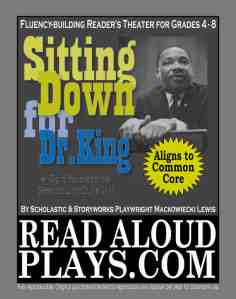
I’ve been fortunate to have forged a lasting relationship with Scholastic publishers, particularly the wonderful editors at Storyworks and Scope magazines. Through my work with them I’ve developed a reputation for writing compelling reader’s theater about Martin Luther King and African-American history in general. Somehow, I’ve been able to accurately represent the historical events and, more importantly, convey the spirit of Dr. King’s work through such plays as “Sitting Down for Dr. King.” With MLK Day upon us, and given that February is Black History Month, I want to encourage you to give some of my reader’s theater scripts a try.
I’m particularly proud of “Sitting Down.” I remember struggling over it when I was writing it back in 2002.There I was, bouncing one bad idea after another off my laptop screen, regretting having accepted the contract at all, when I realized how very simple my task was in comparison to the mammoth challenge undertaken by Dr. King. Soon thereafter I crafted the fictional story of “David,” a twelve-year-old white kid frustrated that these African-American college students were getting in the way of his birthday shortcake at the Woolworths. “Sitting Down” has since appeared in three different Scholastic venues including Storyworks, a text book series, and a leveled reading set, but I’m proud of it because it has a powerful ending that I believe Dr. King would have respected.
I think my play, “Gonna Let it Shine” also conveys the spirit of Dr. King’s work. It’s based upon the true story of Sheyann Webb, who was just eight years old when she braved tear gas and posse men while marching alongside Dr. King. She became known as “Dr. King’s Youngest Freedom Fighter,” and her story is the subject of the Disney movie, “Selma, Lord, Selma.” The play originally appeared in Storyworks under the title “Pigtails & Protests.” In the process of re-writing it for release on TeachersPayTeachers, I had the privilege to talk with Sheyann herself, who is today–some fifty years later–a public speaker and Civil Rights advocate. It was surreal to speak with someone who in my writing was still just a child. It was inspiring to connect with someone who not only knew Dr. King and numerous other heroes of the Movement, but was in fact a Civil Rights hero in her own right.
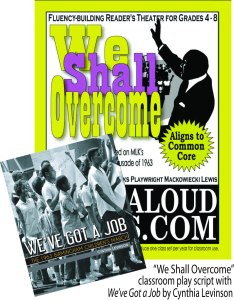
“We Shall Overcome” tells the story of the Birmingham Children’s Crusade. That’s the event where students, some nearly young as Sheyann, were attacked by police dogs and knocked to the ground by blasts from fire hoses. News coverage of their sacrifice swayed worldwide public opinion in favor of desegregation.
“The Girl Who Got Arrested,” meanwhile, tells the true story of Claudette Colvin, the first person to be hauled off a city bus and tried in court for defying Montgomery’s segregated busing law. Her story is depicted in the book, “Twice Toward Justice.” I certainly don’t want to diminish the work of Rosa Parks, but in my humble opinion, Claudette’s story is far more compelling.
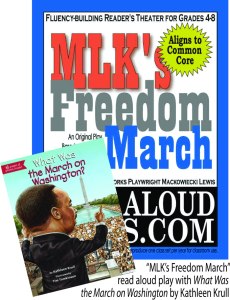
One of my “under sung” plays is “MLK’s Freedom March.” It’s a work of historical fiction about a girl named Lucy who helps her ailing grandmother get to Washington to hear MLK’s “I Have a Dream” speech. There’s also “In the Jailhouse with Dr. King,” about a troubled teenage who turns it around when he witnesses King’s calm demeanor in the face of violence during the Bus Boycott. These and other plays capture the essence of MLK’s work. Consider celebrating MLK Day and/or Black History Month in your classroom by picking any three, dividing your class into three groups, practicing for a couple weeks, and then presenting them with opportunity for discussion in between. In so doing, you’ll be giving your students a strong foundation in MLK history, and perhaps the inspiration to make history themselves.









 ReadAloudPlays.com