Here’s Help for that Holiday Chaos!

The weeks between Thanksgiving and Christmas vacation can be real doozies. While thoughts of sugar plums may not derail that lesson you’ve been planning on verb gerunds, knowing there are new gaming systems, cell phones, and hover boards under the tree certainly will. There’s no doubt about it: this time of year the kids are all a twitter, prompting many a teacher to set aside serious content in favor of coloring pages featuring Rudolph, Frosty, or an occasional dreidel. But it needn’t be so. This is a great time to stage a play!  In so doing your students will get some quality fluency practice, partake in some interesting literary discussions, and, depending on how far you want to take it, occupy themselves with meaningful work creating sets, props, and costumes. And given that Christmas will be upon you in a flash, now is the time to get started, especially if you’re following our repetitive reading approach. Here are five classroom reader’s theater scripts ideal for the next few weeks.

A Christmas Carol—Our best-selling script! Scrooge in two forms!

The Gift of the Magi—A young couple trades their most precious possessions to celebrate Christmas in O. Henry’s famous story!

Gabriel Grub –When the gravedigger shows an unrepentant disdain for Christmas, he’s put on trial in an  underworld court room full of goblins. It’s Dickens’ spookiest Christmas story!  

The Shoemaker and the Christmas Elves—Facing ruin, the shoemaker is saved by a Christmas miracle in this Grimm Brothers classic with our unique conclusion.

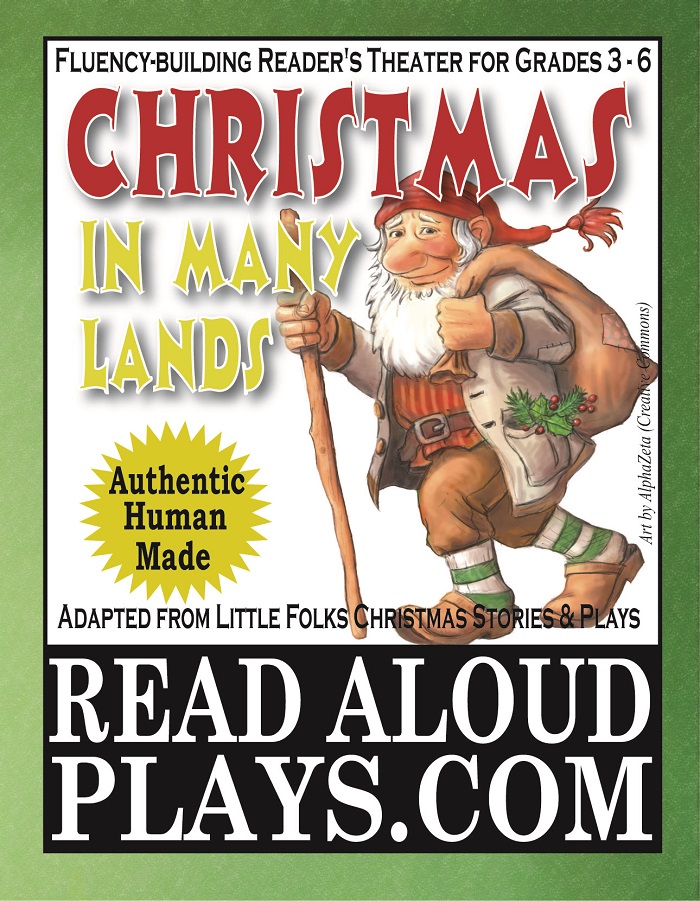
Christmas in Many Lands— Gnomes and reindeer, trees and piñatas . . . it seems like Christmas everywhere is different yet somehow still the same! Our newest and most adorable little Christmas play about Christmas around the world.   

Whether a single play or one of our money-saving bundles, these will be the highlight of your holiday teaching season! Check them out in our TpT store.  Happy directing and Merry Christmas!  

My Kind of People

When I invited motivational speaker Stan Tucker to drop in to play ball with my basketball group, I didn’t expect him to show up. After all, he’s exceptionally busy traveling around the country with his Leap For Literacy program, getting books in the hands of young readers with his Read’n Roll Book Mobile, and hosting his television show, The Very Airy Library, all while writing inspiring picture books of his own. Stan is a very busy man!

Yet show up he did. That’s the kind of person he is. Stan Tucker shows up.

Stan autographing a shoe after presenting at our Literacy Night.

Despite knowing he’d be spending the next ten hours working with students in our school, he popped his head in our middle school gym. “I haven’t played in at least six years,” he said, “and for shoes, all I’ve got are these Chuck Taylors, but I thought I could come down and shoot around with y’all.”

We quickly pushed him out there, and like the rest of us, he put in his 3 to 5 miles of court time. Then, an hour later, he was at our elementary school impressing and inspiring our staff and students.

I encourage you to check out Stan’s work. I can’t promise he’ll be able to join your for basketball, but I can safely say you love having him at your school. Find out more by clicking here.

Also, thank you Eileen B., Lit with Lyns, Melissa C., Shelby J., Candy M., Heidi P., Nicole W., Sherry D., Jarmese R., Melissa N., and Amanda M. for your recent 5-star reviews of my plays and products!  June 19th will be here before you know it, so be sure to download my inspiring Juneteenth play soon!

Happy directing!  

Earth Day + Arbor Day

Nature Talks Back is a great play with which to celebrate Earth Day and Arbor Day while teaching your kids about trees, bees, and centipedes. The play’s ecology and conservation themes include that trees communicate, that some perceived pests are considered beneficial insects, and that honeybees are super-important pollinators.  The stories center around three oddball conifers named Luther, Otto, and Bill and their hysterical encounters with a host of pests.   

It’s aimed specifically at kids in upper 2nd through 4th grade, but it’s also suitable for grade 5 and up for reader’s theater, podcast, or stage— especially when performed for younger kids. (My fifth graders loved preparing a full production!) No time for a big show? Use it instead as in-class reading! It’s a fun way to teach about nature on Earth Day and Arbor Day!

Consider pairing Nature Talks Back with some of my other spring-oriented plays. Peter Rabbit is also aimed at younger students. Use it with 2nd and 3rd graders, or have older students perform it for primary-aged kids.  Rikki Tikki Tavi, Kipling’s much-loved story about the heroic mongoose has some spring-time flair, a singing bird, and an important theme about courage. It too can be presented alongside How the Elephant Got Its Trunk, another classic Kipling tale from The Jungle Books.  And don’t forget that baseball season is upon us, so it’s a great time for my entertaining and socially important play about Jackie Robinson.

Happy directing!

The Antidote for Spring Fever and the Test Taking Blues

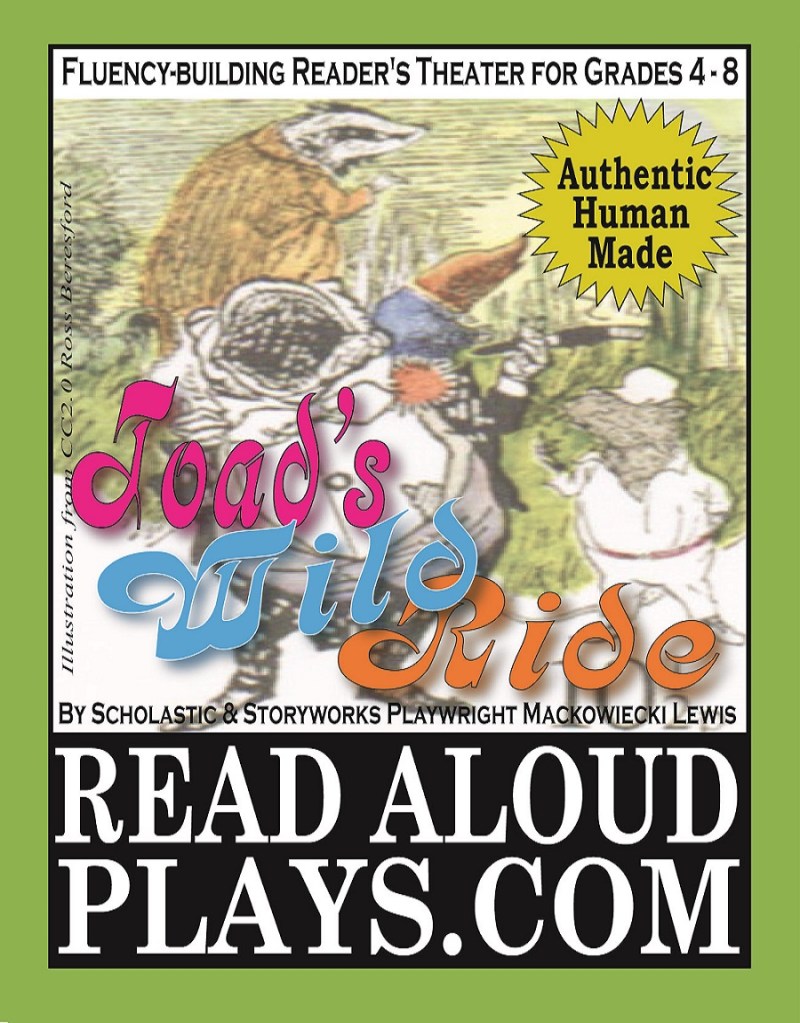
If you’re school is anything like mine, you’re probably gearing up for standardized testing. For many of us and our kids, it’s the bane of our existence. So, my proposal to you is to use what little time remains in your schedule to have some fun staging a play! It can be as simple as an in-class reader’s theater presentation or as complex as a full stage production (start now for an end-of-the-school year performance!). Whatever the case, at ReadAloudPlays.com we have gobs of plays perfectly suited for spring, including our latest release, Toad’s Wild Ride.

We’ve narrowed Wind in the Willows down to its best, most humorous elements. It shows how Mr. Toad becomes infatuated with motor cars, how his friends attempt to “cure” him, and how he goes on a maniacal drive through the village. Yes, Scene 7 resembles the Disneyland ride! The whole play is full of pratfalls, subtle humor, and grand entrances, making it as kid-friendly as it gets. Enjoy Mole’s innocence, Badger’s stodginess, and Otter’s “charisma,” but don’t forget Ratty and Toad! The play includes stage directions, making it ideal for a full production.

BADGER: Then you don’t promise to never touch a motor-car again?

TOAD:  Certainly not! In fact, I promise that the very first motor car I see, poop-poop, off I go!

Baseball season is underway, so many of your male students—who statistically are more likely to be reluctant readers—will jump at the chance to be in a baseball play.  How Jackie Saved the World depicts the circumstances around Jackie Robinson breaking the “color barrier.” As your students portray Jackie, Pee Wee, and others, a radio announcer calls a more modern game between Derek Jeter’s Yankees and Ken Griffey’s Mariners, gently contrasting the two eras. A peanut vendor and the hot dog man lend narration as they walk through the audience hawking ballpark snacks.

HOT DOG MAN: Despite all that pressure, Jackie led the Dodgers to the World Series and was named Rookie of the Year.  Some said it was the toughest season any ball player has ever endured. Last chance for hot dogs!

PEANUT VENDOR: No doubt the reason today’s game is so exciting is because Jackie had the courage to turn the other cheek. Peanuts! Get your peanuts here!

ANNOUNCER: We’re in the top of the ninth. Two outs and two on and the score tied two to two. The Yankees are taking no chances. With Ken Griffey, Jr. up to bat, they’ve brought in their closer, Mariano Rivera.  Here’s the pitch. . .

Perfect for Earth Day, Nature Talks Back “follows” the madcap adventures of three conifers named Otto, Bill, and Luther as they deal with bark beetle scares, woodpeckers, and centipedes. The story uses campy humor to convey scientific (and non-politicized) facts about the environment.

BILL: It’s not a termite is it? Oh, I hate termites!

LUTHER: No, I don’t think it’s a termite.

BILL: Phew. You had me worried for a minute.

OTTO: Too big for a termite. Looks like some kind of beetle. Does it look like some kind of beetle to you, Luther?

BILL (alarmed): A beetle? Is it a bark beetle?!  Oh no. It’s a bark beetle, isn’t it? I just know it! Get it off of me! Get it off of me!

If maniacal drives, spring training, and talking trees don’t entice you, we also have Peter Rabbit (it seems too young for 5th and 6th graders, but they love doing it—especially when they get to perform it for youngers), Winnie the Pooh (and Tigger too!), and on a more serious note, Juneteenth: Freedom for the First Time. Plus we have dozens more: all original, all human-made, and all with teacher notes, writing prompts, comprehension activities, and the license to print a full class set every year for use in one’s own classroom. Other sites charge dramatically more (no pun intended) for plays with far less originality and pizazz!

Plays teach kids to read purposefully and thoughtfully rather than merely for speed. They always have developmentally-appropriate parts for both your advanced readers and your most reluctant ones. And once parts are assigned, you don’t have to prompt kids to chime in. Best of all, plays are fun.  They’re the perfect antidote for spring fever and those test-taking blues.

Happy directing!

Revolutionary Women’s History

The Sybil cover from Scope magazine

Here are five classroom plays about the American Revolution. Each is politically-neutral, based on well-researched historical accounts, and vetted by professional editors at Scholastic. The first three (four if you count the Liberty Bell) feature strong females, making them perfect for Women’s History Month.  

The Secret Soldier tells the story of Deborah Samson, the perseverant young woman who disguised herself as a man in order to enlist in the Continental Army. History remembers her as America’s “first woman soldier.”

Betsy Ross has a lot of doubters these days. This play exploring the creation of America’s first flag, encourages readers to approach history scientifically: to research the facts themselves before drawing conclusions.

Girl, Fighter, Hero tells the story of Sybil Ludington, the young woman often called “the female Paul Revere.” Sybil rode 40 miles on a stormy night to muster the militia during the American Revolution battle near Danbury.

Eagles Over the Battlefield introduces students to our national emblem, the American bald eagle. This work of historical fiction imagines how the Founding Fathers might have debated the symbol’s selection, especially given Ben Franklin’s tongue-in-cheek disdain for the eagle.

Finally, A Bell for the Statehouse , which comes as a 2 for 1 with Eagles, reveals how the Liberty Bell came to be a national symbol after being sheltered away with other “patriot leaders” in the basement of a church.

All five plays are dramatic, compelling, and fun for kids to present on stage or perform as reader’s theater.

Thank you, Rachel Scott, M. M., Aram Alexander Barboa-Reidy, Alejandra Alejandra Peña, Laura Franklin, Michelle Gribble, Daniel B. Bennett, William Samples, and Jennifer Theis for your recent 5-star reviews!

Happy directing!

There’s Still Time to Commemorate Black History Month

Here are nine compelling paired texts with which to recognize black history month. All the plays are based on the given event–not it’s paired text (in most cases the play was published before the given book). That means each pairing represents distinctly unique points of view (Literature CCSS #6), making for livelier discussions and quality comparisons (CCSS Lit #7). And because these plays are based on real events, they’ll also satisfy CCSS Informational Text #6. Each includes a comprehension activity, too, assuring your students will satisfy numerous other standards as well. And because almost all my plays were originally commission by and published in Scholastic’s Storyworks and Scope magazines, they’ve been professionally vetted, making them the best reader’s theater available. Just click on the image to preview or purchase on my TeachersPayTeachers storefront. Also be sure to check out these recorded performances of “Martin’s Big Dream” and “Ruby Bridges: A Simple Act of Courage” by The Palace Youth Theater. Happy directing!

Stevie Wonder’s Overlooked Contribution to the Civil Rights Movement

My work for Scholastic writing black history plays is just a tiny blip on the civil rights radar, a minuscule contribution when compared to real civil rights heroes such as John Lewis and Sheyann Webb. But given Storyworks magazine’s truly cosmic readership, I realize that over my twenty-plus year association with Scholastic, my reader’s theater has influenced—at least in some small way—millions of kids. Millions. I think it’s fair to take some pride in that.

I often ponder, however, how a scrawny white kid from rural Oregon, a kid whose family spent their Sundays watching Hee Haw and Gunsmoke, how does that kid end up writing black history plays? 

Well, for that I have to thank Stevie Wonder–and maybe a bit of divine intervention. When I was around ten years old I stumbled across a discount record bin at Payless department store. I’d recently set up my brother’s old Zenith “Stereophonic” record player so I could listen to my dad’s Tijuana Brass record, but I was on the lookout for something more, something of my own. Thumbing through the discs, I came across Stevie Wonder’s 1971 album, Where I’m Coming From. I had no idea who this Wonder guy was, but he had a cool name, and the cover seemed the antithesis of a Tijuana Brass album. So, I asked my mom if she could buy it for me.

My mom was never openly racist. She was generous to a fault and spent many hours volunteering to help less-fortunate people. But looking back, I recall that she’d voted for George Wallace in the 1972 presidential primary, so I suspect had she taken a closer look at the album, she would have nixed the purchase right there. None-the-less, I went home and cued up Stevie on the Zenith. I wonder what she thought when she heard “Do Yourself a Favor” blasting from behind my bedroom door. This was no Clark and Owens. Not the music or the message.

And I was hooked. Thus, Stevie Wonder became one of my most profound influences.   

Frankly, Stevie doesn’t get enough credit for his contribution to civil rights. Despite Motown’s determination to mold him as a “black Bing Crosby”—a crooner—Stevie broke free and produced music that called attention to societal inequity, to the plight of minorities, to the struggles that come with poverty. While he wasn’t the first African-American artist to produce music with politically-charged, socially-relevant music, he was among the first to crossover into white culture. If a kid like me could get hooked on Stevie Wonder, then surely, around the country millions of other white kids must have been doing the same.

I never set out to be Scholastic’s black history playwright. I kind of stumbled into it. But it was Stevie Wonder’s music that had prepared me for the task. Without that influence, my poignant plays about MLK, Claudette Colvin, Ruby Bridges, and many others wouldn’t exist. And when I see those same plays presented by organizations such as the Palace Theater and most recently, Crete Monee Middle School in Illinois, I’m amazed at the reach Stevie has had.

If you’re using any of my Black History plays this month, please give a well-deserved nod to Stevie Wonder.

Happy directing.

Best Bets for January & February

MLK Day is January 20th, so it’s a great time to use some exceptional reader’s theater to teach about this icon of American history. My play, Martin’s Big Dream, tells about how an incident in the sandlot during King’s childhood helped inspire his mission. It’s my top play ever. It’s been published in Storyworks, Scope, Scholastic News, Instructor Magazine, in various textbooks, and in the book, Read Aloud Plays: Symbols of America. It’s also been professionally performed by the Palace Youth Theater and other organizations.  You can pair your use with PYT’s performance by visiting here.  

Other MLK plays include Sitting Down for Dr. King, In the Jailhouse with Dr. King, and my personal favorite, MLK’s March on Washington.  But wait! Not sure how to teach such sensitive topics? Download our free “Tips for Teaching Marginalized Voices and Traumatic Events” by clicking here.  

Of course, all of these plays are also great picks for Black History Month in February, and now is the time to get started if you want a first-rate presentation.  Focusing on one or more of the young heroines of the Civil Rights Movement might inspire some of your female students to greatness, so consider our scripts about Ruby Bridges, Sheyanne Webb, and Claudette Colvin.

We also have plays about Box Brown, the man who escaped slavery by mailing himself in a crate, about baseball great Jackie Robinson, and about the author, Richard Wright.

President’s Day is February 17th. Presidents’ Day Dream looks at the Presidency from a different viewpoint. When the play’s lead character day dreams about being president, she’s met in her “dream” by various former presidents. Each speaks frankly about the challenges and hardships of the job while pointing out the qualities it takes to be a good leader. It’s an easy one to perform.

Another one for February is Argument at Mount Rushmore. It imagines the sixty-foot tall faces on Rushmore “discussing” the merits and accomplishments of each of their presidencies. Though built on a humorous platform, it’s a historically-accurate portrayal of the gracious Washington, the witty Lincoln, and the always-enthusiastic Roosevelt. As for the sometimes over-looked and often under-appreciated Jefferson, well, let’s just say he gets a bit bent out of shape—just as you might be if you miss the chance to snag some of these timely play scripts.

Happy directing!

A Christmas Play Doesn’t Have to be a Christmas Play

We all know it. During the weeks leading up to Christmas, it can be a challenge to keep the kids engaged. My remedy has always been to stage some classroom plays or readers theater, which leads me to our awesome collection of Christmas themed titles that’ll keep even your grinchiest elf content.

But Santa isn’t going to throw coal at you if your Christmas plays aren’t Christmas plays. Take a look at what my 5th graders did with Hans in Luck, a Brothers Grimm tale that hasn’t a thing to do with wassailing or bread pudding. They used the 1906 illustrations to create a “digital comic book” while simultaneously practicing for a live stage presentation just ahead of the winter break. I can tell you the actors themselves don’t care that the play isn’t about St. Nick. They’re thrilled to be donning costumes regardless whether or not anyone gets to wear a fat suit and a beard.  And you can bet my colleagues are happy to commit some otherwise giddy class time to come watch— whether the Ghost of Christmas Present will be there or not.

Ah, but who has time to throw together an entire show now? If that’s the case, grab some scripts and just do some classroom readings! Try splitting the class into two to four groups and give each one a play. Use class time to have the kids practice them until they can read them with fluency and character, and then have them present them to the class as traditional reader’s theater—merely standing up front and reading aloud.

Ready to streamline your holiday surge? Try my Goldilocks, Pied Piper, Peter Rabbit, and Winnie the Pooh plays. If you still want to stick with the holiday theme, check out A Christmas Carol, The Gift of the Magi, The Shoemaker and the Elves, and Gabriel Grub.  

Whatever the case, make your December memorable—and easy—with ReadAloudPlays.

Happy directing!

Can’t Miss Holiday Plays