The Antidote for Spring Fever and the Test Taking Blues

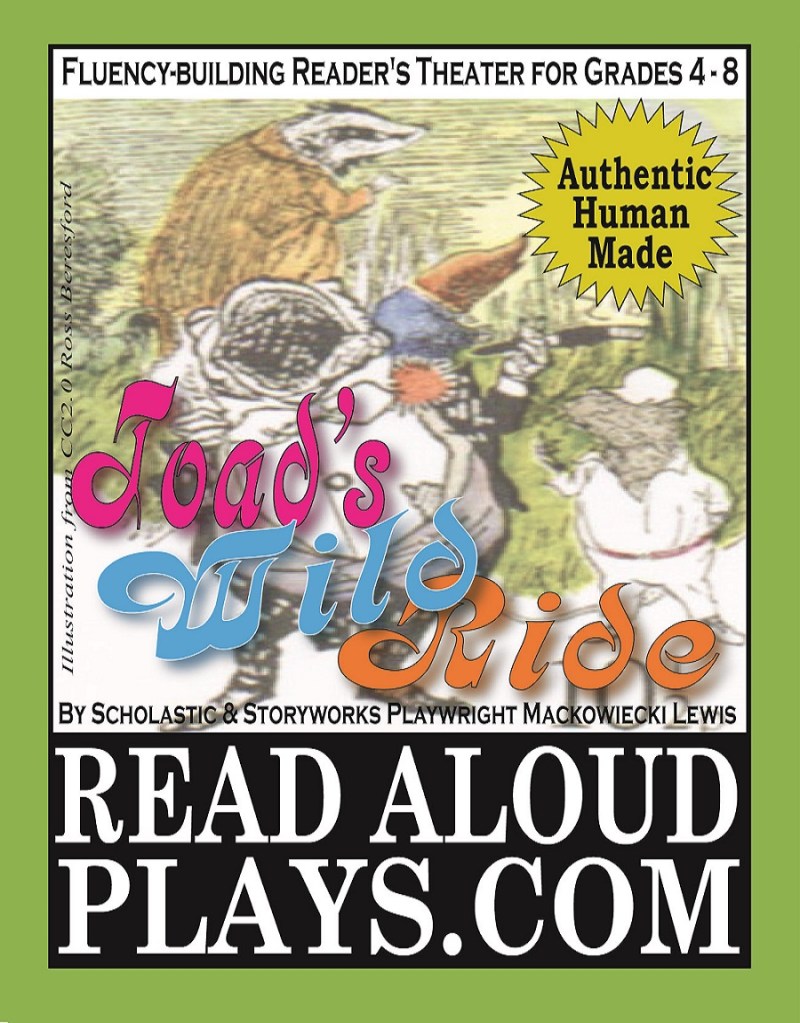
If you’re school is anything like mine, you’re probably gearing up for standardized testing. For many of us and our kids, it’s the bane of our existence. So, my proposal to you is to use what little time remains in your schedule to have some fun staging a play! It can be as simple as an in-class reader’s theater presentation or as complex as a full stage production (start now for an end-of-the-school year performance!). Whatever the case, at ReadAloudPlays.com we have gobs of plays perfectly suited for spring, including our latest release, Toad’s Wild Ride.

We’ve narrowed Wind in the Willows down to its best, most humorous elements. It shows how Mr. Toad becomes infatuated with motor cars, how his friends attempt to “cure” him, and how he goes on a maniacal drive through the village. Yes, Scene 7 resembles the Disneyland ride! The whole play is full of pratfalls, subtle humor, and grand entrances, making it as kid-friendly as it gets. Enjoy Mole’s innocence, Badger’s stodginess, and Otter’s “charisma,” but don’t forget Ratty and Toad! The play includes stage directions, making it ideal for a full production.

BADGER: Then you don’t promise to never touch a motor-car again?

TOAD:  Certainly not! In fact, I promise that the very first motor car I see, poop-poop, off I go!

Baseball season is underway, so many of your male students—who statistically are more likely to be reluctant readers—will jump at the chance to be in a baseball play.  How Jackie Saved the World depicts the circumstances around Jackie Robinson breaking the “color barrier.” As your students portray Jackie, Pee Wee, and others, a radio announcer calls a more modern game between Derek Jeter’s Yankees and Ken Griffey’s Mariners, gently contrasting the two eras. A peanut vendor and the hot dog man lend narration as they walk through the audience hawking ballpark snacks.

HOT DOG MAN: Despite all that pressure, Jackie led the Dodgers to the World Series and was named Rookie of the Year.  Some said it was the toughest season any ball player has ever endured. Last chance for hot dogs!

PEANUT VENDOR: No doubt the reason today’s game is so exciting is because Jackie had the courage to turn the other cheek. Peanuts! Get your peanuts here!

ANNOUNCER: We’re in the top of the ninth. Two outs and two on and the score tied two to two. The Yankees are taking no chances. With Ken Griffey, Jr. up to bat, they’ve brought in their closer, Mariano Rivera.  Here’s the pitch. . .

Perfect for Earth Day, Nature Talks Back “follows” the madcap adventures of three conifers named Otto, Bill, and Luther as they deal with bark beetle scares, woodpeckers, and centipedes. The story uses campy humor to convey scientific (and non-politicized) facts about the environment.

BILL: It’s not a termite is it? Oh, I hate termites!

LUTHER: No, I don’t think it’s a termite.

BILL: Phew. You had me worried for a minute.

OTTO: Too big for a termite. Looks like some kind of beetle. Does it look like some kind of beetle to you, Luther?

BILL (alarmed): A beetle? Is it a bark beetle?!  Oh no. It’s a bark beetle, isn’t it? I just know it! Get it off of me! Get it off of me!

If maniacal drives, spring training, and talking trees don’t entice you, we also have Peter Rabbit (it seems too young for 5th and 6th graders, but they love doing it—especially when they get to perform it for youngers), Winnie the Pooh (and Tigger too!), and on a more serious note, Juneteenth: Freedom for the First Time. Plus we have dozens more: all original, all human-made, and all with teacher notes, writing prompts, comprehension activities, and the license to print a full class set every year for use in one’s own classroom. Other sites charge dramatically more (no pun intended) for plays with far less originality and pizazz!

Plays teach kids to read purposefully and thoughtfully rather than merely for speed. They always have developmentally-appropriate parts for both your advanced readers and your most reluctant ones. And once parts are assigned, you don’t have to prompt kids to chime in. Best of all, plays are fun.  They’re the perfect antidote for spring fever and those test-taking blues.

Happy directing!

There’s Still Time to Commemorate Black History Month

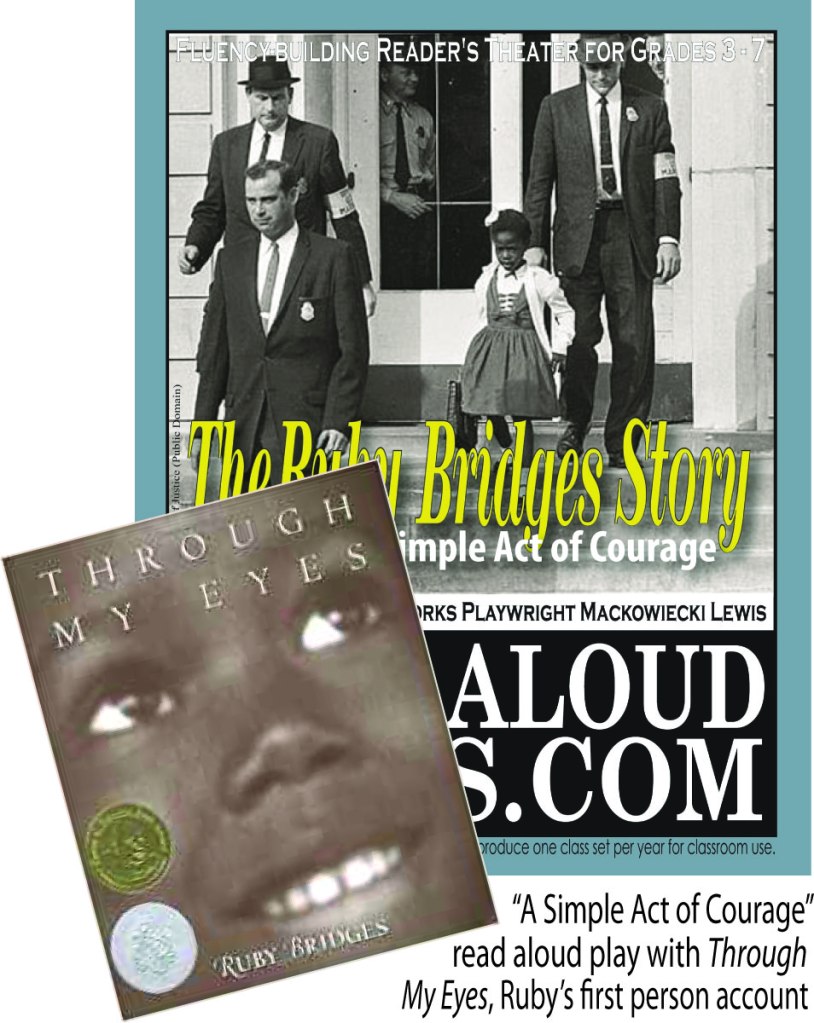
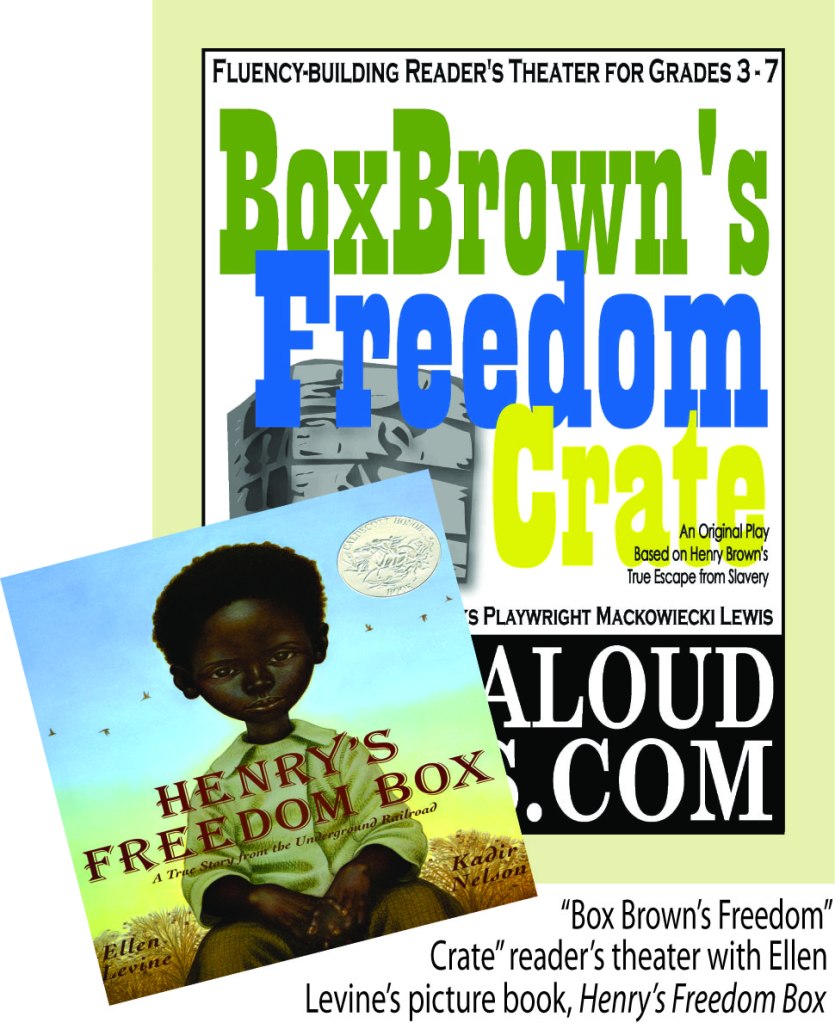
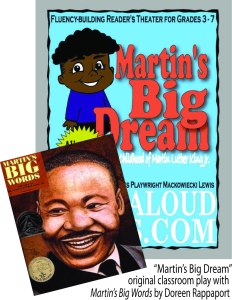
Here are nine compelling paired texts with which to recognize black history month. All the plays are based on the given event–not it’s paired text (in most cases the play was published before the given book). That means each pairing represents distinctly unique points of view (Literature CCSS #6), making for livelier discussions and quality comparisons (CCSS Lit #7). And because these plays are based on real events, they’ll also satisfy CCSS Informational Text #6. Each includes a comprehension activity, too, assuring your students will satisfy numerous other standards as well. And because almost all my plays were originally commission by and published in Scholastic’s Storyworks and Scope magazines, they’ve been professionally vetted, making them the best reader’s theater available. Just click on the image to preview or purchase on my TeachersPayTeachers storefront. Also be sure to check out these recorded performances of “Martin’s Big Dream” and “Ruby Bridges: A Simple Act of Courage” by The Palace Youth Theater. Happy directing!

Help for Spring Fever in the Classroom

Trees and flowers aren’t the only things blossoming right now. Your students, having spent much of the year under your tutelage, have grown and matured and are nearly ready to advance to the next grade—or at least they believe they are. They’re probably getting a bit stir-crazy, too, ready for something more than the same old routine.  Perhaps, too, they’re having the life sucked out of them by standardized tests. It sounds like a good time to liven things up with some truly fun reader’s theater or class plays.  Here are a few of my favorite antidotes for Spring Fever:

Perfect for Earth Day, Nature Talks Back “follows” the madcap adventures of three conifers names Otto, Bill, and Luther as they deal with bark beetle scares, woodpeckers, and centipedes. The story uses campy humor to convey scientific facts about how trees communicate to fend off danger, about misconceptions around what constitutes a “pest,” and about the danger pesticides are to pollinators.

HONEYBEE: Cough, choke. . . has somebody…cough wheeze . . . been using . . . sputter . . . bug spray?

KID (sheepishly): It was just a couple squirts.

HONEYBEE: Cough, wheeze . . . Good thing I only caught a whiff of it. It sent me into a loop-de-loop!

Nature Talks Back is written in four “acts,” which can be presented by a single cast or as four mini-plays.  When my students presented it on stage, they used cardboard sheets to create two-dimensional evergreen trees with cutouts for their faces. Because the trees themselves don’t move, it was a kick teaching kids how to act with their facial expressions.  But even of you don’t have time for a full presentation, NTB makes for a great podcast presentation or just a simple classroom reading on April 22nd!

How Jackie Saved the World is another great play for Spring. Our Jackie Robinson play depicts the circumstances around Jackie breaking the “color barrier” in the major leagues. As your students portray Jackie, Pee Wee, and others, a radio announcer calls a more modern game between Derek Jeter’s Yankees and Ken Griffey’s Mariners, which gently contrast the two eras. A peanut vendor and the hot dog man lend narration as they walk through the crowd–your audience.

HOT DOG MAN: Despite all that pressure, Jackie led the Dodgers to the World Series and was named Rookie of the Year.  Some said it was the toughest season any ball player has ever endured. Last chance for hot dogs!

PEANUT VENDOR: No doubt the reason today’s game is so exciting is because Jackie had the courage to turn the other cheek. Peanuts! Get your peanuts here!

ANNOUNCER: We’re in the top of the ninth. Two outs and two on and the score tied two to two. The Yankees are taking no chances. With Ken Griffey, Jr. up to bat, they’ve brought in their closer, Mariano Rivera.  Here’s the pitch. . .

Baseball season is underway all over the globe, so many of your male students—who statistically are more likely to be reluctant readers—will jump at the chance to be in a baseball play.

And then there’s Pooh.  Who doesn’t love a Winnie-the-Pooh story? Our RT set includes the best of A.A. Milne’s 1926 collection, all familiar tales such as Winnie-the-Pooh and the Honey Tree:

BEES: Buzz.

CHRISTOPHER ROBIN: Perhaps they think that you’re after their honey.

POOH: It may be that. You never can tell with bees.

BEES: Buzz. Buzz.

POOH: Christopher Robin, have you an umbrella?

CHRISTOPHER ROBIN: I think so.

POOH: I wish you would get it, and walk up and down with it, and look up at me every now and then, and say ‘Tut-tut, it looks like rain.’ I think, if you did that, it would help with the deception we are using on the bees.

Well-suited to reader’s theater or full stage production in third grade and up, these are great for emphasizing delivery and enunciation: nervous Piglet, droll Pooh, gloomy Eeyore, and temperamental Rabbit, for example. The set includes five short plays, each with just a handful of characters. You can split your elementary-aged class into five groups and have each group present one of the plays, or have older students stage a presentation for younger grades.

Of course, we have many other plays with “fun” themes. The Pied Piper, Goldilocks, Barbed Wire, The Nose, Rikki Tikki Tavi, Peter Rabbit, and How the Elephant Got its Trunk are all wonderfully silly yet still build reading fluency while teaching important lessons.  And don’t forget, when you buy one of our plays, you’re not merely buying a set of worksheets; you’re getting an original piece of literature—a professionally written play and the rights to use it year after year. It’s like getting a full class set of your favorite novel along with the other stuff most TpT products provide.  

You’ll find all our plays on our TpT storefront.

Happy directing!

Plays and Paired Texts for Black History Month

Here are ten compelling paired texts with which to recognize black history month while meeting numerous Language Arts standards. All the plays are based on the given event–not it’s paired text (in most cases the play was published before the given book). That means each pairing represents distinctly unique points of view (Literature CCSS #6), making for livelier discussions and quality comparisons (CCSS Lit #7). And because these plays are based on real events, they’ll also satisfy CCSS Informational Text #6. Each includes a comprehension activity, too, assuring your students will satisfy numerous other standards as well. And because almost all my plays were originally commission by and published in Scholastic’s Storyworks and Scope magazines, they’ve been professionally vetted, making them the best reader’s theater available. Only six of the ten are shown here–just click on the image to preview or purchase on my Etsy or TeachersPayTeachers storefront. Also be sure to check out these recorded performances of “Martin’s Big Dream” and “Ruby Bridges: A Simple Act of Courage” by The Palace Youth Theater. Happy directing!
Trees, Bees, and Centipedes . . .

The clocks have all sprung forward, the turkey vultures have returned, and the sprouts are beginning to pop. Spring has arrived! So tell that groundhog to make way for some fun plays celebrating the season, including my newest script, Nature Talks Back. It’s actually four coordinated skits designed to give younger students insight in to trees, bees, and centipedes. Its ecology and conservation themes include that trees communicate, that some perceived pests are considered beneficial insects, and that honeybees are super-important pollinators.  The stories center around three oddball forest trees named Luther, Otto, and Bill and their hysterical encounters with a host of pests.    

It’s aimed specifically at kids in upper 2nd through 4th grade, but it’s also suitable for grade 5 and up for reader’s theater, podcast, or stage— especially when performed for younger kids. (My fifth graders love it and are presently preparing a full production!)

Consider pairing Nature Talks Back with some of my other spring-oriented plays. Peter Rabbit is also aimed at younger students. Use it with 2nd and 3rd graders, or have older students perform it for primary-aged kids. Rikki Tikki Tavi, Kipling’s much-loved story about the heroic mongoose has some spring-time flair, a singing bird, and an important theme about courage. It too can be presented alongside How the Elephant Got Its Trunk, another classic Kipling tale from The Jungle Books.  And don’t forget that baseball season is upon us, so it’s a great time for my entertaining and socially important play about Jackie Robinson.

Happy directing!
Ten Plays for Black History Month

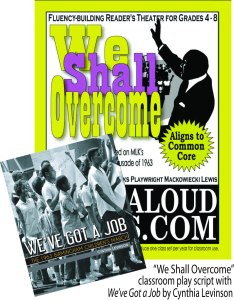
February is Black History Month. While I encourage you to acknowledge it with some dedicated activities, I’m also reminded that black history is American history; it need not be limited to a single month! The end of the Civil War, Jackie Robinson’s breaking of baseball’s color barrier, and MLK’s “I Have a Dream” speech certainly rank among some of the most significant moments in American history. With that in mind, here are ten great paired texts with which to recognize Black History Month while also meeting numerous standards. All the plays are based on the given event–not it’s paired text (in most cases the play was published before the given book). That means each pairing represents distinctly unique points of view. Each includes a comprehension activity, too, and all were originally commission by or published in Scholastic’s Storyworks and Scope magazines, so they’ve been professionally vetted, making them the best reader’s theater available. Clicking on an image will take you to either my Etsy or TpT stores. You can also download free previews of each play on my Black History & Civil Rights page, and you’ll find FREE Google Docs versions of the comprehension quizzes on TpT. Happy directing!

Zoom-Aloud Plays!

Like nearly all of us, I’ve had to adjust my teaching methods to suit the current circumstances. Initially, using reader’s theater seemed out-of-the-question, but as I’ve acclimated to all this remote instruction, I’ve discovered RT is more useful than ever.

Zoom has become something of a necessary evil: managing a bunch of lonely fifth graders online is worse than herding cats—it’s more like wrangling squirrels! Video “instruction” can quickly descend into a free-for-all of pets, bedhead, baby sisters, motion sickness, and worst of all, academic drudgery. Thank goodness for RT! Just like in the classroom, I’ve found that I can rope in all my squirrels with a good “Zoom Aloud Play,” and you can too! Here’s how:

1. Divide you class into small groups and assign each group a different play.

2. Post each play in Google Classroom or whatever secure environment you’re using (to protect copyright, make sure it isn’t accessible by the general public).

3. On Monday, have the kids read the play independently. I suggest casting parts based on your knowledge of their reading ability. Unlike the classroom where you can work one-on-one with a struggling reader, you’re unlikely to have either the access or the time.

4. On Tuesday or Wednesday, schedule a Zoom “play practice” with each of your groups. You can share your screen so that the script is viewable for those who don’t have hardcopies or who are unable to have two tabs open simultaneously. Have the kids continue to practice on their own as “homework reading.” (Homework, what a funny concept these days!)

5. Schedule a second Zoom session later in the week or the for week following. In this session the kids “perform” the play. You can even have them put together simple costumes. Be sure to record the session for play back on your webpage for parents and the rest of the class. If you’re using Zoom, you no doubt have already discovered the tan to do so.

In the regular classroom I usually take three weeks or longer to thoroughly prepare a play for a performance, so I’m learning to limit my expectations a bit. What’s important, though, is that my students are reading, my Zoom sessions are productive, and I’m back to happily directing!

For your first sessions, I suggest trying some light-hearted content such as The Tale of Peter Rabbit, How the Elephant Got Its Trunk, or Rikki Tikki Tavi. We may have missed Opening Day, but my Jackie Robinson play is fun any time of year, as is my play about the first moon landing. These and many more great scripts are available on my TpT storefront—and almost all of them were originally published by Scholastic, so you know they meet the highest standards. So don’t let the shut-down slow you down. Get re-inspired with some “Zoomer’s Theater.”

Happy directing!
Important Moments in American History

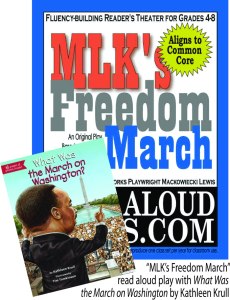
February is Black History Month. While I encourage you to acknowledge it with some dedicated activities, I’m also reminded that black history is American history; it need not be limited to a single month! The end of the Civil War, Jackie Robinson’s breaking of baseball’s color barrier, and MLK’s “I Have a Dream” speech certainly rank among some of the most significant moments in American history. With that in mind, here are ten great paired texts with which to recognize those great moments while meeting numerous Language Arts standards. All the plays are based on the given event–not it’s paired text (in most cases the play was published before the given book). That means each pairing represents distinctly unique points of view (Literature CCSS #6), making for livelier discussions and quality comparisons (CCSS Lit #7). And because these plays are based on real events, they’ll also satisfy CCSS Informational Text #6. Each includes a comprehension activity, too, assuring your students will satisfy numerous other standards as well. And because almost all my plays were originally commission by and published in Scholastic’s Storyworks and Scope magazines, they’ve been professionally vetted, making them the best reader’s theater on the market. Just click on the image to preview or purchase on my TeachersPayTeachers storefront. Happy directing!

10 Compelling Paired Texts for Black History Month

Here are ten great paired texts with which to recognize black history month while meeting numerous Language Arts standards. All the plays are based on the given event–not it’s paired text (in most cases the play was published before the given book). That means each pairing represents distinctly unique points of view (Literature CCSS #6), making for livelier discussions and quality comparisons (CCSS Lit #7). And because these plays are based on real events, they’ll also satisfy CCSS Informational Text #6. Each includes a comprehension activity, too, assuring your students will satisfy numerous other standards as well. And because almost all my plays were originally commission by and published in Scholastic’s Storyworks and Scope magazines, they’ve been professionally vetted, making them the best reader’s theater on the market. Just click on the image to preview or purchase on my TeachersPayTeachers storefront. Happy directing!

And the Oscar for Best Comedic Performance Goes to…

Yup, the last weeks of the school year can be rough. The end is near, and the kids (and teachers) all know it. What to do? Well, this time of year is a great time to let your students funnel all that extra energy and excitement into some dramatic roles. There’s no reason to assess anything. You can take your hands off the reins, let the kids direct, and just sit back and enjoy their giggles, forgotten lines, and silly grins.

Here are six play scripts that’ll keep your kids engaged until the very end (and there are dozens more at my TpT storefront):
Fly Me to the Moon Reader's Theater Script Jackie Robinson Reader's Theater Script Cyclops reader's theater scriptFly Me to the Moon re-enacts the Apollo moon landing including such famous lines as “The Eagle has landed” and “One small step….” The story is told from the perspective of a young girl who dreams of the stars while following the event via television—itself a feat of innovation. In my classroom, we made an old-fashioned television set out of a cardboard box (complete with tin foil rabbit ears) and stuck a kid inside it to play Walter Cronkite. It’s not a comedy—in fact, it’s a historically-accurate bit of drama—but it’ll have everyone laughing while simultaneously learning a bit of history.

It’s baseball season! Jackie Robinson’s contribution to the civil rights struggle is profound, but why read about it in a text book? In this play, vendor at a modern day Yankee’s game interact with the audience, telling Jackie’s story while hawking hot dogs and flinging bags of peanuts (I like to use real bags). It’s another important bit of history told in a fun way.

There’s a monster and kids get eaten. What could be better? Cyclops: The Monster in the Cave depicts Homer’s classic in all its vomitous glory. Your students will have a blast with this one.

Peter Rabbit reader's theater The Newsies reader's theater script Poe reader's theater script Over the years, few plays have rivaled my Peter Rabbit adaption for gut busting guffaws. It’s not necessarily supposed to be that way, but fifth graders have a natural aptitude for slapstick. These days, thanks to the motion picture, your kids may want to make some adaptions of their own. Should be a kick!

The Newsies tells the story of a young immigrant girl who goes to work selling newspapers just before the 1899 New York City newsboy strike in which kids stood up to millionaire publishers William Randolph Hearst and Joseph Pulitzer. In this play, kids get to talk in a heavy Bronx dialect, stage a protest, and throw newspapers over the side of the Brooklyn Bridge! Sounds jus’ like da end a da school year, don’t it?

Penelope Ann Poe’s Amazing Cell Phone is a modernized version of Edgar Allan Poe’s “The Tell-Tale Heart.” In this version, the protagonist is driven to madness by her best friend’s annoying cell phone. After smashing it to smithereens, she hides it in the depths of her desks only to later be driven to confess by the phone’s perturbing and inexplicable ringtone. It’s my best-selling play, but not everyone has liked it. “Too Weird,” said one reviewer. Well of course it is, it’s Poe! And that makes it ideal for the chaos of late May and early June!

Happy directing!