What’s Hindering Your Low Readers?

Perhaps many of you have figured this stuff out long ago. Me, after nearly 25 years of teaching, I recently had a couple of instructional epiphanies.

Click here to visit Lauren Tarshis' author pageThe first one was when one of my 5th graders showed me a picture of her mother. “This was at the visitation center,” she said. “The only time I get to see my mom is when we go to the visitation center.” A day later we were on our way to the local science museum when another student pointed out the window and piped up, “I think that’s the safe house we stayed at one time.” Later that same day my admin handed me my latest set of Oral Reading Fluency scores showing both of those students near the bottom. As I looked over the rest of the data, I suddenly realized all my lowest performing students are victims of childhood trauma: violence, tempestuous divorce, drugs, homelessness… Then, taking a look at my top performers, I realized nearly all are from healthy, financial stable, intact families. Thinking back over years of high and low test scores, the correlation is obvious. Early-childhood trauma and neglect may be the most significant factor contributing to academic failure. Politicians who ignore it are insincere in their efforts to “improve schools.”

If you’re like me, you’re constantly wrestling with how to help these kids. What works? We’re not going to undo the trauma or erase their memories. When it comes to reading, however, I’ve landed on three things that appear to hook them, three things that seem to motivate even these reluctant readers to put some “miles on the tongue.”

The first, naturally, is Read Aloud Plays. I write and promote read aloud plays not merely because I want to sell you a script, but because they’re exceptionally effective. I don’t need to belabor the point here. If you want to know more about reader’s theater, including the brain research that supports it, check out my free download entitled, “Why Use Drama?”

Roald Dahl books are also compelling for this group of kids, though admittedly this may be as much about my own enthusiasm for Matilda and The Witches as it is the books themselves. I have so much fun reading aloud sections of Boy or having small groups read Fantastic Mr. Fox, even my most reluctant readers catch the Dahl bug.

But the best thing I’ve discovered lately is the I Survived series. These books are written by my editor at Storyworks, Lauren Tarshis, so it surprises me that it’s taken me so long to start using them in class. This year, having finally amassed enough copies, I was able to assign all my students the task of reading one during silent reading sessions. Yeah, I know: SSR is often a waste of time; many students—especially the struggling ones—only pretend to read. Consequently, I use an approach I call “Directed Silent Reading.” It works with any age-appropriate books, but because these I Survived books have consistent themes, high-interest plots, and conquerable reading levels, they’re particularly fruitful. So much so that even my lowest performing students are begging for more.

I begin by telling my students they’re only going to read for a minute. At the end of the minute, I ask the kids to “turn and talk” to a neighbor about something they found interesting from their minute (or two) of reading. After they’ve had a couple minutes to share, I then ask for three or four volunteers to share out with the class. As the students hear their classmates tell about Hurricane Katrina or Pearl Harbor, the enthusiasm becomes contagious. We repeat the process, this time for three or four minutes of reading, and then again for eight to ten more. You can vary the questioning, too. “Be prepared to tell us something you know about your main character,” or “Provide some details about the story’s setting” are other “go to” questions. By the end of the session, all my kiddos have read for 20 minutes, discussed what they’ve read, and have invested enough in the story that they’ve committed to it. You don’t get such enthusiasm or commitment from homework reading, traditional SSR, or even oral reading, especially not from struggling readers.

There are no easy answers when it comes to overcoming the childhood trauma suffered by our lowest-performing students. But by using plays, Roald Dahl books, the I Survived series, and Directed Silent Reading, perhaps we can help them create a survival story of their own.

Happy directing.

Ten Plays for Black History Month

MLK Plays Preview3 700x900The Daring Escape of Henry “Box” Brown is making a reappearance in the January issue of Scholastic’s Storyworks magazine. In addition to a new look with original illustrations, it means Storyworks subscribers have access to a host of top-notch CCSs comprehension activities via Scholastic’s web-based library. Pretty sweet. Coincidentally, the TpT version also just went through an update that adds a couple of comprehension activities and improved formatting, so you’re in luck either way.

But “Box” isn’t the only reader’s theater title suitable for Black History Month or MLK Day celebrations. In fact, I have a wide assortment. You can quickly preview four of them with my newest product: MLK Plays Free Preview Pack. It includes summaries and the first couple of pages of four MLK reader’s theater scripts including Martin’s Big Dream (The Childhood of Martin Luther King, Jr.), MLK’s Freedom March (lovely historical fiction set against the March on Washington where King delivered his most famous speech), In the Jailhouse with Dr. King (another potent work of historical fiction set during the Bus Boycott), and Gonna Let it Shine (non-fiction about the “Bloody Sunday” events in Selma, Alabama). You can download the free PDF preview at TpT.

But there’s still more. Click on the Read Aloud Plays tab to uncover wonderful reader’s theater about Jackie Robinson, Claudette Colvin, the Greensboro Four, and others. In all cases, $3 gives the original purchaser reproduction rights to copy a full class set each year for use in his or her own classroom. It even includes school performance rights!

In my classroom, my 76 fifth graders will be learning and presenting six of these plays over the next two months. It’s going to make for a memorable Black History Month. Join us. Celebrate the legacy of Dr. King with engaging reader’s theater from ReadAloudPlays.com.

Happy directing!

A Good Time to Say Thanks.

This week I just want to say THANK YOU to all you FANTASTIC teachers who have used Read Aloud Plays in class. I hope they’ve brought you and your students a ton of enjoyment and value. Thank you also for all your positive comments. With 38 fifth graders demanding my attention every day, I simply don’t have enough time to respond to many of them, but here are a few recent ones I think are especially fruitful.

"Twice Toward Justice" play, one of many Civil Rights plays first appearing in StoryworksYour plays are wonderful and they make the original texts more approachable to my students! Thank you! ~ Laura M. (regarding The Monkey’s Paw gothic masterpiece)

I think we can all relate to the challenges of reading a piece of Victorian literature. Why subject yourself to the yawns of middle school readers when you can first wake them up with a read aloud play?

I added songs in between each of the scenes and used this for our Black History Month performance! The children enjoyed it, and learned a lot in the process. Thank you! ~ Linsey P. (Jackie Robinson black history play)

Two of my plays—“We Shall Overcome” and “Gonna Let in Shine”—have the songs built in to the play, but several others are easily adapted. Black History Month is just around the corner, so take Lindsey’s advice and consider staging a Civil Rights musical.

I like how it’s short and to the point. After reading the novel, the 6th grade wants to make a movie and we’re using that script. Thanks! ~ Barbara Ann M. (Ebenezer Scrooge: A Christmas Carol play)

Thank you! Because the majority of my plays were first published in classroom magazines including Scope and Storyworks, they’re specifically designed to be short and to the point. My goal is to capture the essence of the original story while limiting the play to about fifteen minutes in length. Still, I encourage teachers and students to edit and adapt. A few years ago my 5th graders also used this script to make a movie, but they added several short scenes, modernized the setting, and changed several lines to suit what they wanted to portray. I consider that 16 minute movie (which can be viewed here, if you’re interested) as one of the highlights of my career.

Lewis never disappoints. This will be terrific as part of my Spooktober unit for theater class. ~ Lu J. (Hawthorne’s The Birthmark Gothic Reader’s Theater)

What a wonderful compliment! Thank you. And I love the idea of a Spooktober theater event. I’m going to try that next year!

Great resource and student engaging. You can practice RT daily to work on fluency and comprehension. Thank you! ~ Heather W. (Lewis & Clark and Bird Girl: Sacagawea play )

Fluency practice is really the academic justification for reader’s theater, isn’t it? But I think the foundation is that most kids love it. Simply put, Read Aloud Plays make school fun. Admittedly, my plays are geared to intermediate and lower middle school, but when you can find good material, even jaded upper middle school and high school kids enjoy RT.

Excellent play. This tied in perfectly with my Civil Rights unit. ~ Dayan S. (Montgomery Bus Boycott MLK “Twice Toward Justice” Play)

Thank you. I’m particularly proud of my civil rights plays. My editors at Storyworks recently asked me to work on a new one for this spring. To create a consistent “feel,” I re-read some of the old ones. I think the “Twice Toward Justice” play is indeed powerful, but I also rediscovered what I think is a real gem in the play entitled “MLK’s Freedom March.” I highly recommend it.

Next month, I’ll be releasing on TpT my very first Civil Rights play. “I Have a Dream: the Childhood of Martin Luther King, Jr” first appeared in Storyworks sixteen years ago. How fortunate I am that my editors liked it so much. They’ve been feeding me much-loved Black History assignments ever since.

Our high school graciously offered to perform this for my middle school class. To prepare in a jiffy, we did this reader’s theater and the kids loved it – especially the ghost noises. Turns out the HS play was very ‘stylized’ and there is NO WAY my kids would have known what was happening if they hadn’t had this resource as a basis to get the underlying plot. This was absolutely perfect. Many thanks. ~ Michelle C. (Ebenezer Scrooge: A Christmas Carol play)

I love this. Haven’t we all at some point shared a story, taken our students to a performance, or watched a movie that was beyond the developmental level of our students? How nice it is to have a Read Aloud Play to introduce kids to the story or historical event before hitting them with the original text or text book account.

Thanks again, and cheers to a new year of Read Aloud Plays! I have a lot of great items planned for 2016, so stay with me, won’t you?

Happy directing!

No Santa Hats Allowed!

Gabriel Grub holiday playA couple of my fifth grade girls showed up at school today wearing Santa hats. “Santa hats?” I said. “We haven’t even had Thanksgiving yet!” They giggled and told me they didn’t care, to which the Scrooge in me growled , “No Christmas stuff until after Black Friday!” Of course, three hours later they were still wearing them.

It reminded me that Christmas really is just around the corner, and a great way to celebrate it is with a trio of holiday plays. You can pick up a class set of Ebenezer Scrooge for just three bucks at my TeachersPayTeachers store. This play originally appeared in the Nov/Dec 1998 issue of Storyworks and has been republished in several other Scholastic venues. It’s a succinct version developmentally-suited to upper elementary kids. Another holiday classic is O. Henry’s Gift of the Magi. It’s magi cover scope 700x984appeared in Storyworks, Scope, and Scholastic News, and today is available in my book, Read Aloud Plays: Classic Short Stories. You can often snag a PDF for just a few bucks at Teacher Express and download it immediately.

Before devising Scrooge, Charles Dickens was experimenting with the same theme in Gabriel Grub. Grub is a foul-tempered gravedigger who on Christmas Eve gets haunted by a troop of maniacal goblins. The goblins put him on trial and find him guilty of being without the Christmas spirit. It’s wildly funny and eerily spooky at the same time. Suitable for 5th through 8th graders, it’s a great play for that last chaotic day before vacation.

Especially if a few of those goblins are wearing Santa hats.

Happy directing!

Girl. Fighter. Hero.

Sybil Cover_ScopeWomen soldiers? It’s not so unusual in 2015, but back in the 18th century, the very idea would have drawn guffaws from even the most liberal-minded colonist. “A ridiculous notion,” one patriot leader was known to have said. And yet, History provides numerous examples of women performing acts of heroism throughout the American Revolution itself. Lydia Darragh, for example, is considered one of America’s first spies. Then there’s Deborah Sampson. She disguised herself as a man and enlisted in the Continental Army under the name Robert Shurtliff. Twice wounded, she performed surgery on herself to avoid detection. Another heroin was Sybil Ludington, the 16-year-old girl who rode forty miles on horseback through the Hudson Highlands (on a stormy night, no less!) to muster the militia in defense of Danbury. She’s known as “The Female Paul Revere,” and according to Martha Lamb’s 1880 “The History of the City of New York,” George Washington himself personally thanked her for her stalwart effort. Her story is captured in my latest play, “Girl, Fighter, Hero,” which appears in the November/December issue of Scholastic’s Scope magazine. Although it’s available exclusively to Scope subscribers, you can still get it by clicking here.

Whether you use Sybil’s story or not, a kick-in-the-pants way to get kids excited about your American Revolution unit is to build it around a trio of Read Aloud Plays. Start with a FREE download of “Betsy Ross: Fact or Fiction.” It first appeared in Storyworks back in 1999, and then in my book, Symbols of America. It challenges students to examine the facts associated with the first U.S. flag and draw their own conclusions. It’s FREE on my TpT storefront until November 1st. Free. I’m convinced you’ll love it and want to then grab “The Secret Soldier,” a historically-accurate depiction of America’s first female fighter, and “Eagles Over the Battlefield,” a dramatic yet subtly humorous play about how the eagle came to be an American symbol (as opposed to the turkey, the turkey vulture, and the groundhog). Eagles, by the way, is part of a BOGO deal with “A Bell for the Statehouse,” which relives that infamous crack in The Liberty Bell.Cyclops Cover_SW

As with all my plays, these were all carefully-researched, fact-checked by Scholastic editors, and best of all, kid-tested by my own students.

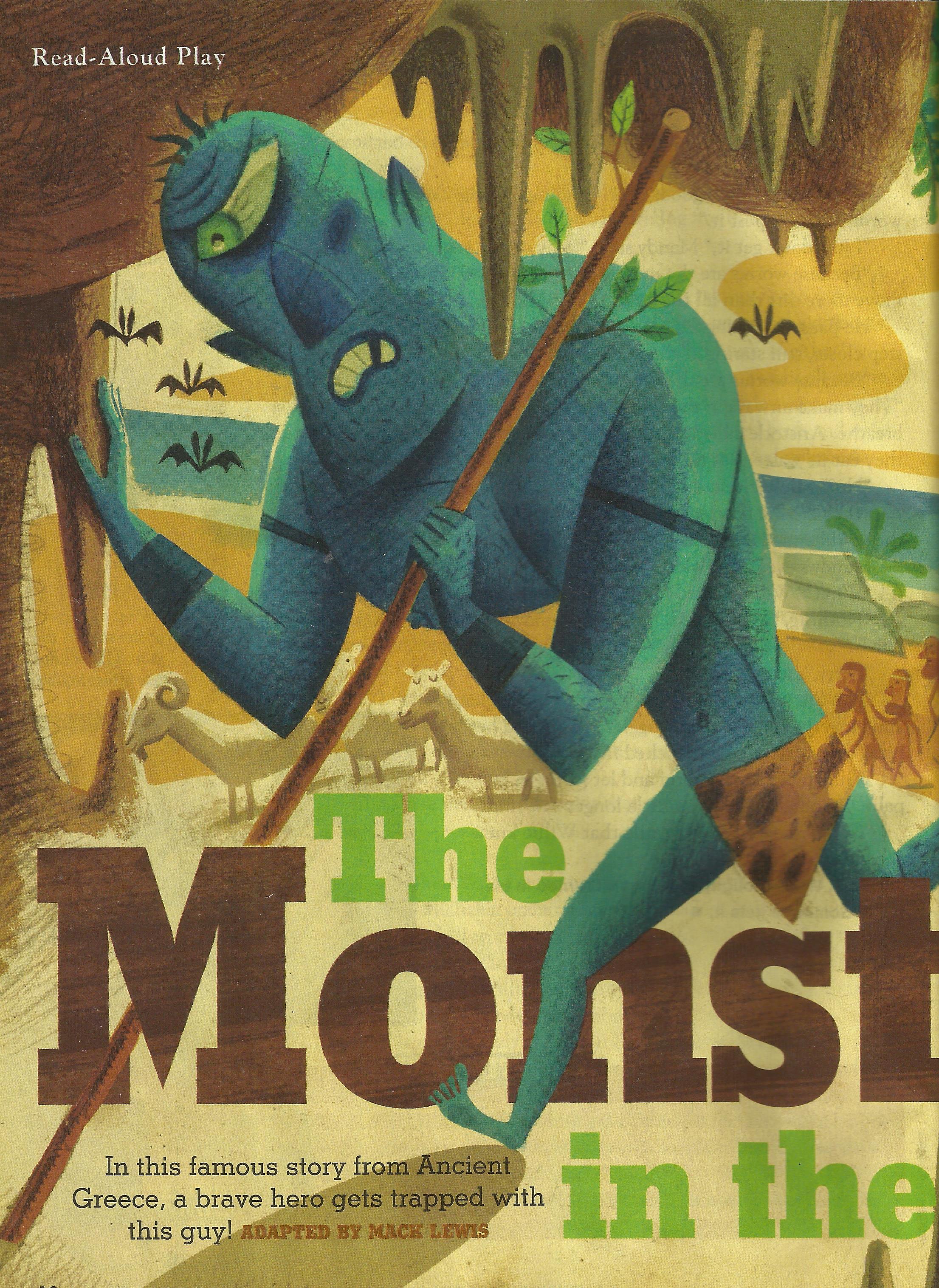
One added note this week is that my play “Cyclops: The Monster in the Cave,” is making an encore appearance, this time in Storyworks. It’s been freshly revised by editor-extraordinaire Lauren Tarshis (author of the I Survived series). Check out the new artwork by Sebastia Serra, too! If you’re not yet a Storyworks subscriber, you should be, but you can also grab the original version of Cyclops off my website.

Happy directing!

You Fancy Me Mad?

Harry_Clarke_The_Tell-Tale_HeartFairies waving candied wands… Goblins drooling chocolate malt… Halloween has such a bizarre place in our classrooms. In my school it’s been informally “banned,” though the kinders still get to parade through the school in their costumes, and the rest of the student body gets to have an afternoon “party” that presumably has nothing to do with ghouls and ghosts. Personally, I like “Monte Carlo Day,” a party in which kids set-up, run, and risk candy tokens at a variety of “probability games” such as Roulette, 21, and the Shell Game. The kids still get their candy fix, but at least there’s a bit of math involved.

An even better approach to Halloween is to replace your parades and parties with a collection of play performances. Kids still get to dress up, you can serve treats at the performance, and it’s not only academically valid, but a fine way to satisfy standards. A trio of plays takes a few weeks to prepare and an afternoon to perform. You can also invite other classes to attend, thereby helping your colleagues with their Halloween alternatives. Though Halloween lands on a Saturday this year, a set of plays will make Friday the 30th a huge hit for all involved!

I have a number of Read Aloud Play titles that are perfect for Halloween. The Birth-mark, which is a classic short-story by Nathaniel Hawthorne, tells the story of a mad scientist who, in his quest to make his already beautiful bride “perfect,” kills her instead. The Monkey’s Paw is W.W. Jacobs’ classic Gothic tale about getting three wishes. The disturbing result will stay with your students long after Halloween has passed. The well-known Legend of Sleepy Hollow is available in my book, Read Aloud Plays: Classic Short Stories (you can purchase and download it instantly at Scholastic Teacher Express). Pair it with YouTubeThe Birthmark scope cover page segments from the original Disney flick. You’ll also find Poe’s The Tell-Tale Heart in the same book, which can be paired with my modernized version, Penelope Ann Poe’s Amazing Cell Phone. (At least one of my reader’s has commented that it’s “too strange,” which I think makes it a lot of fun for Halloween.) Finally, A Piece of String has a ghostly conclusion and Cyclops has a ferocious monster. All of these plays were originally published in Scholastic classroom magazines such as Scope and Storyworks, so you know they’re up to snuff, and they all come with reproduction and performance rights.

Ready to give it a try but unsure how to start? Download my free guide to teaching with plays. It’ll give you tips and ideas on how to use plays to make your language arts block the best section of the day. But get to it right away…those ghouls and goblins are already knocking at your door.

Happy Halloween and happy directing!

Letter Grades: Who Needs em?

The Bellringer (PD-1776)How do you grade a play?

I read an article recently about the merits of “gradelessness” in the classroom. It suggested that the assigning of letter grades to children is neither healthy nor effective. The premise works like this: if “Rafael” works hard on a writing task and shows progress compared to previous work, yet still lacks certain skills, will giving him a C-minus motivate him to improve? Or, is it better if we applaud Rafael for his effort and growth, show him where he did well, and give him specific things to work on? In other words, can a teacher forsake grades while still raising standards and providing effective evaluation?

Yes, and Read Aloud Plays provides an exceptional medium to do exactly that.

Plays provide an avenue to teach your students how to give and receive constructive feedback. Here’s how: Lead your students to define appropriate standards before you begin a play, post those standards, and consistently revisit them as you rehearse.

During practices, ask your students, “What are we doing well?” and “What do we need to work on?” “Maureen spoke with character and personality,” might be a comment you’ll hear. “Paulie lost her spot; she needs to follow along better,” is another.

Early in the year, teach your students to say, “Some of us…” as in “Some of us need to practice more at home so we’re better prepared.” As the year progresses, graduate to more specific statements such as “Charles, you have a really pleasant voice, but you need to speak up more so we can all hear it.” By using this approach, students will be not only be able to provide valuable feedback to their peers, they’ll also synthesize evaluative factors which they will naturally apply to their own performance, all without the negative emotional charge of a grade. As students become proficient at providing constructive criticism, consider applying it to other subject matter as well, such as writing, art, and presentations.

There may be perfectly good reasons to assign grades under some circumstances. You may also be faced with mandates requiring grades, but even in those cases, by teaching students to give and receive feedback, you can de-emphasize the grade and focus instead on developing the given skill through constructive criticism.

Revolution Cover 700x894These days when trolls roam the internet slamming people and businesses with nasty and often unjustified reviews, it’s especially important for students to learn the ethics of giving constructive criticism.

Whatever the case, as you kick-off a new school year, spend some time contemplating your approach to grading and consider using Read Aloud Plays to teach your students to develop their constructive feedback skills. If you’re already using Read Aloud Plays, leave a comment to let us know how you’re assessing play performances.

Speaking of plays, I’ve just released two new ones packaged together for the price of one. Revolutionary War Plays comes with two exclusive plays, comprehension activities, and additional supplementary material. Originally published in my book Read Aloud Plays: Symbols of America (Scholastic), “Eagles Over the Battlefield” tells the story of the bald eagle becoming the emblem of the United States, and “A Bell for the Statehouse,” reveals the history of the The Liberty Bell. Both are fun, easy, and ideal for trying out some ungraded constructive feedback.

Happy directing!

Old Favorites

Click on the cover to preview or purchase!Imagine saying the Pledge of Allegiance to a bright yellow flag featuring a coiled rattlesnake! The history of the flag of the United States is a compelling story, but historians are divided as to the facts. Did Betsy Ross really create the first flag? This play, which was originally published in my book, Read Aloud Plays: Symbols of America and later reprinted in the January 2002 issue of Scholastic’s Storyworks magazine, encourages readers to become history sleuths. It includes the play script, a short reading supplement, a bubble quiz, a comprehension activity built around William Canby’s 1870 treatise on the matter, answer keys, and extension activities.

Betsy Ross: Fact or Fiction? is the first of several old but new plays destined for TeachersPayTeachers this season. Having recently re-acquired full publishing rights to the plays in my book, Symbols of America, I’ll be packaging up all these old favorites for easy downloading on TpT.

As with all my plays, the Symbols collection is suitable for reader’s theater or full stage production. You can use the plays to build fluency and to satisfy a variety of Common Core standards in Literature and Informational Text. Best of all, the original purchaser is licensed to print one class set per year for use in his or her own classroom.

To preview or purchase Betsy Ross, click here. Be sure to check back often for “old but new plays” about MLK, Mount Rushmore, the War of 1812, World War Two, and more.

Happy directing!

Prevent Zombies: Teach the Arts!

Is standardized testing turning us into zombies? In my school we’ve taken to referring to our state-of-the-art music room as the “Musicless Room.” Oh, it still says “Music” on the door, but after elementary music was cut a few years ago, it’s since been used as a computer lab, a professional development site, a Title I room, and this coming year, a regular ed classroom. Hence the name.

Way back in 2008, President Obama criticized No Child Left Behind legislation because its overemphasis on core subjects contributed to the loss of arts education. “Studies in Chicago have demonstrated that test scores improved faster for students enrolled in low-income schools that link arts across the curriculum than scores for students in schools lacking such programs,” read the President’s official statement on the Arts. Unfortunately, Obama’s Race to the Top initiative, the Common Core, and the Smarter-Balanced test all seem to have heightened the emphasis on testing and, as a result, further undermined the Arts.

But there’s hope! If you need help convincing your administrator to allow more time for the Arts, including the use of Read Aloud Plays, here are ten studies compiled by the staff writers at OnlineColleges.net that show a strong connection between arts education and academics:

1. A 2002 report by the Arts Education Partnership revealed that schoolchildren exposed to drama, music and dance are often more proficient at reading, writing, and math.

2. The 2006 Solomon R. Guggenheim Museum study on art education showed a link between arts education and improved literacy skills.

3. In 2007, Ellen Winner and Lois Hetland published a study stating the arts don’t actually improve academic performance, but it shouldn’t matter.

4. A 2005 report by the Rand Corporation called “A Portrait of the Visual Arts” argues that art education does more than just give students a creative outlet. It can actually help connect them to the larger world, ultimately improving community cohesion.

5. Teachers and students alike benefit from schools that have strong art climates, a 1999 study called “Learning In and Through the Arts” demonstrated.

6. The Center for Arts Education published a report in 2009 that suggests arts education may improve graduation rates.

7. A 2011 study called “Reinvesting in Arts Education” found that integrating arts with other subjects can help raise achievement levels.

8. A study of Missouri public schools in 2010 found that greater arts education led to fewer disciplinary infractions and higher attendance, graduation rates and test scores.

9. In “Neuroeducation: Learning, Arts and the Brain,” Johns Hopkins researchers shared findings showing that arts education can help rewire the brain in positive ways.

10. A 2009 survey, part of the “Nation’s Report Card: Arts 2008″ report, found that access to arts education opportunities hasn’t changed much in a decade.

Of course, all these studies really do is show that one can prove just about anything with a study. Just as these ten support arts education, there are numerous others that suggest there’s no correlation at all. This New York Times article does a pretty succinct job of debunking any notion that the Arts lead to improved scores in reading, writing, and math.

But so what? Whether or not the Arts contributes to better test scores shouldn’t be the question. I, for one, believe classroom activities that emphasize creativity build more well-rounded people and consequently better prepare students for professional life. While there are no doubt plenty of jobs out there that require workers to never deviate from a scripted set of instructions, there are also plenty of professions that value creative thinking, which is really what the Arts are all about. It was creative thinking that brought us Facebook, Starbucks, Dave Matthews Live at Red Rocks, and the device on which you’re reading this blog. If we want our schools to produce the next generation of worker drones and zombie-like consumers, then sure, let’s keep on “racing to the,” er, “top.” But if we want our schools to produce engineers, entrepreneurs, and the people who will solve the world’s problems, then for cryin’ out loud, let’s toss aside the textbooks and scripted programs and restore the Arts to our classrooms.

One easy method of embedding the Arts in the classroom while still fulfilling the Common Core requirements is to include Read Aloud Plays in your instruction (“drama” is referenced 47 times in the Common Core). For around three bucks you get performance rights (assuming you represent a school) and reproduction rights so that you can copy a full classroom set every year. Also, many of the plays come with supplemental activities or questioning strategies. For a fairly complete list of available titles, navigate through the tabs (at left if on a computer) or below (if on a mobile device).

Thank you for inspiring the next generation of creative thinkers and decision-makers!

Happy directing!

Why You Should End the Year with Algebra!

The Little RascalsI think much of what I know about teaching, about kids, about life itself, I learned from Spanky and Our Gang.

Like many of us here near the end of the school year, exhaustion has just about got the best of me. The wide-variety of year-end responsibilities and activities coupled with the cumulative day-to-day stress of the job itself has become a bit overwhelming. It has me looking for some fun but easy lessons to wrap up the last few weeks of school. It got me thinking that I’d like to share with my students some Little Rascals episodes, so I went looking for them on YouTube. If you’re not familiar with the Little Rascals, it’s the depression-era film shorts featuring the antics of impoverished kids such as Spanky, Alfalfa, Darla, and Stymie (and a mule named Algebra). I grew up watching “Spanky and Our Gang” on Channel 42 out of San Francisco—beamed to my home in Oregon via the relatively new innovation called cable-tv.

Sure enough, YouTube has a wide variety of clips and as I watched a few, my wife suggested that my love for kids and my destiny to become a teacher may have roots in the Little Rascals. The more I think about this, the more I believe it. There’s no doubt I admired the ingenuity and resiliency displayed by these kids. There were rarely any adults on the show. The kids had to solve complex problems and overcome difficulties without the assistance, guidance, or even supervision of grown-ups. I think this “can-do” attitude has helped me forge my way through life. And there’s no doubt I enjoyed the innocence and sweetness of all these kids. Yes, I think “Our Gang” had a profound impact on my career choices, as well as my penchant for using plays in class.

I have particularly strong recollections of the Our Gang “Follies,” in which the kids built a make-shift theater in a barn and staged a vaudeville show. Although these were not among my favorite episodes, I’m certain they influenced my teaching. In 1998, when I built a stage inside my classroom, I sewed together a heap of scrap fabric to make curtains that, not surprisingly, looked a lot like those that parted for Alfalfa’s performance of “I’m in the Mood for Love” or Darla’s tap and baton-twirling routine. I’m still using those curtains today, and I think about the Little Rascals every time I put them up for a play.

I intend on ending the year with an algebra lesson (that is, a segment of Little Rascals featuring Algebra the Mule), but another good activity with which to fill these last days of schools is reader’s theater. I believe read aloud plays are most beneficial when they’re read repetitively, when kids read and re-read the same text over and over again as they practice for an eventual performance. However, this time of year, there’s nothing wrong with giving kids a set of scripts and letting them wing it. Give them a session or two to utilize their “Spanky-esque Can Do Attitude” and then watch the follies unfold. To help you along, here’s a free PDF of my play based on O.Henry’s depression-era story, A Retrieved Reformation (expired), but you should also try Peter Rabbit, Penelope Ann Poe’s Amazing Cell Phone, A Tell-Tale Heart, and Fly Me to the Moon, all of which are available on my TeachersPayTeachers page, as well as The Nose, Rikki Tikki Tavi, and The Open Window, from my book: Read Aloud Plays: Classic Short Stories. Finally, Read Aloud Plays: Symbols of America contains Argument at Mount Rushmore, As American as Apple Pie, and Eagles Over the Battlefield, each of which make for fun, impromptu entertainment that beats a real algebra lesson any day.

Happy directing!