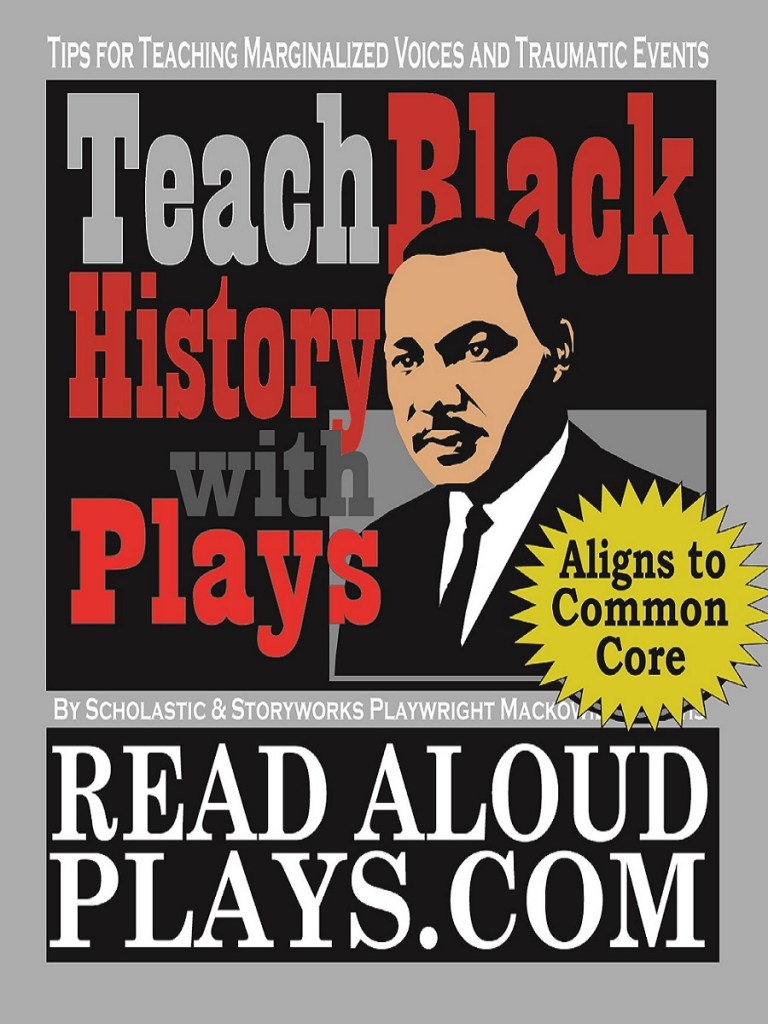
MLK Day is January 20th, so it’s a great time to use some exceptional reader’s theater to teach about this icon of American history. My play, Martin’s Big Dream, tells about how an incident in the sandlot during King’s childhood helped inspire his mission. It’s my top play ever. It’s been published in Storyworks, Scope, Scholastic News, Instructor Magazine, in various textbooks, and in the book, Read Aloud Plays: Symbols of America. It’s also been professionally performed by the Palace Youth Theater and other organizations. You can pair your use with PYT’s performance by visiting here.
Of course, all of these plays are also great picks for Black History Month in February, and now is the time to get started if you want a first-rate presentation. Focusing on one or more of the young heroines of the Civil Rights Movement might inspire some of your female students to greatness, so consider our scripts about Ruby Bridges, Sheyanne Webb, and Claudette Colvin.
We also have plays about Box Brown, the man who escaped slavery by mailing himself in a crate, about baseball great Jackie Robinson, and about the author, Richard Wright.
President’s Day is February 17th. Presidents’ Day Dream looks at the Presidency from a different viewpoint. When the play’s lead character day dreams about being president, she’s met in her “dream” by various former presidents. Each speaks frankly about the challenges and hardships of the job while pointing out the qualities it takes to be a good leader. It’s an easy one to perform.
Another one for February is Argument at Mount Rushmore. It imagines the sixty-foot tall faces on Rushmore “discussing” the merits and accomplishments of each of their presidencies. Though built on a humorous platform, it’s a historically-accurate portrayal of the gracious Washington, the witty Lincoln, and the always-enthusiastic Roosevelt. As for the sometimes over-looked and often under-appreciated Jefferson, well, let’s just say he gets a bit bent out of shape—just as you might be if you miss the chance to snag some of these timely play scripts.
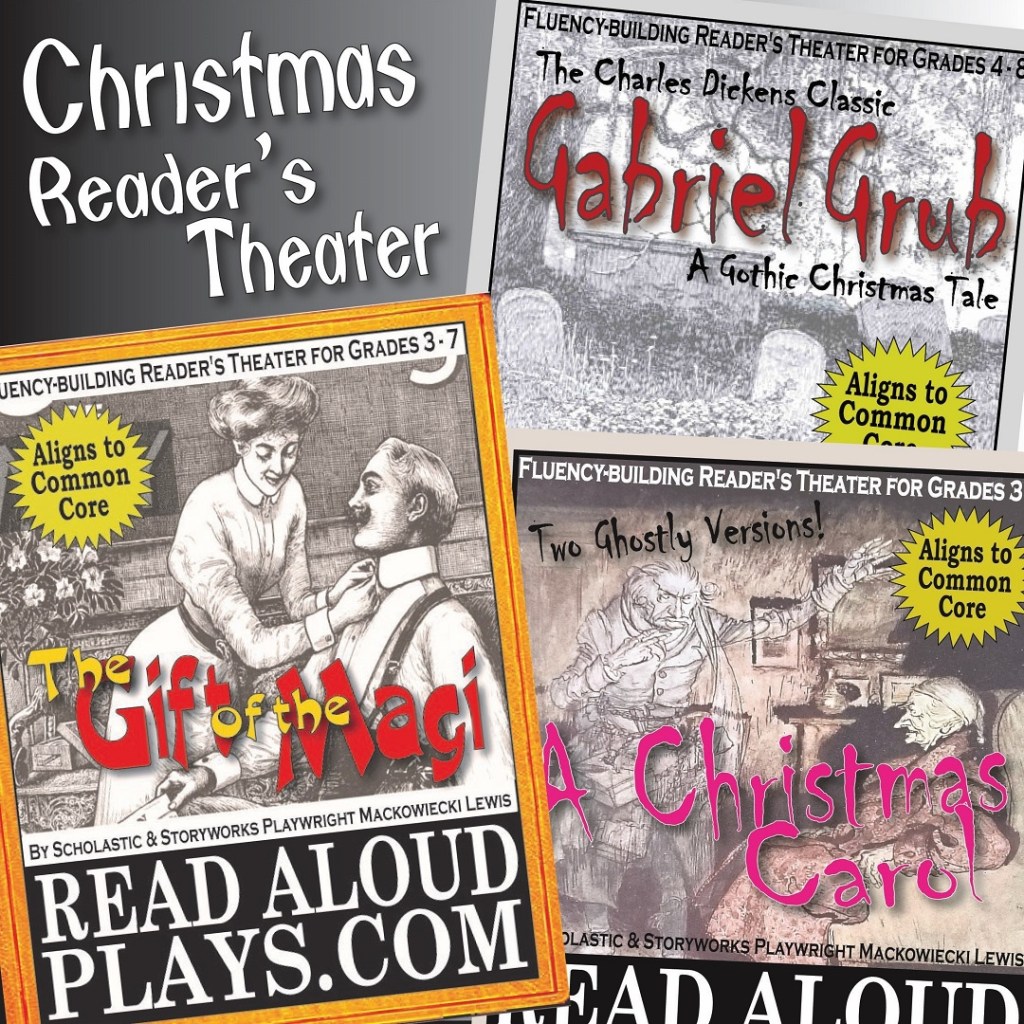
We all know it. During the weeks leading up to Christmas, it can be a challenge to keep the kids engaged. My remedy has always been to stage some classroom plays or readers theater, which leads me to our awesome collection of Christmas themed titles that’ll keep even your grinchiest elf content.
But Santa isn’t going to throw coal at you if your Christmas plays aren’t Christmas plays. Take a look at what my 5th graders did with Hans in Luck, a Brothers Grimm tale that hasn’t a thing to do with wassailing or bread pudding. They used the 1906 illustrations to create a “digital comic book” while simultaneously practicing for a live stage presentation just ahead of the winter break. I can tell you the actors themselves don’t care that the play isn’t about St. Nick. They’re thrilled to be donning costumes regardless whether or not anyone gets to wear a fat suit and a beard. And you can bet my colleagues are happy to commit some otherwise giddy class time to come watch— whether the Ghost of Christmas Present will be there or not.
Ah, but who has time to throw together an entire show now? If that’s the case, grab some scripts and just do some classroom readings! Try splitting the class into two to four groups and give each one a play. Use class time to have the kids practice them until they can read them with fluency and character, and then have them present them to the class as traditional reader’s theater—merely standing up front and reading aloud.
Both my parents served in the military. My mom had a short stint as a WAAC in DC before landing in the secretarial pool at the White House. She eventually had a temporary assignment working for Matthew Connelly, Harry Truman’s executive secretary. She liked to tell a story about sneaking around the White House in hopes of catching a glimpse of the presidential swimming pool, only to be caught by a guard and sent back to her post. Despite her brush with security, she was eventually offered a permanent position. Regretfully, she turned it down because the bus commute from her quarters in Virginia was too long. Her days in the Army Air Corps, she would later tell me, were the best years of her life. (Pictured: My Mom at the Fort Belvoir Motion Picture Lab)
My dad, meanwhile, served in both World War II and Korea. I’m told his experiences were vast and extreme, that he piloted a plane, that he commanded a POW camp, that he was at the disastrous Battle of Kasserine. But he himself never spoke of any of it. Not a word. For him it was far too painful—as it is for many veterans. I wish I knew more about my dad’s service. (Pictured: My dad in Korea.)
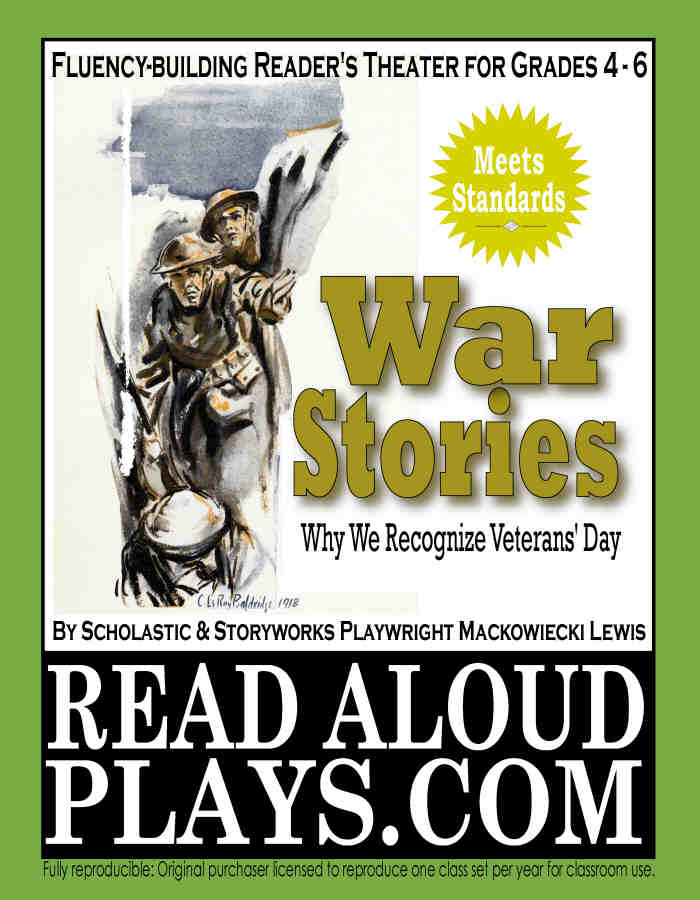
It was with them in mind that I crafted “War Stories” for Scholastic several years ago. It speaks to the pain of war, the sacrifice of those who’ve served, and the meaning of Veterans’ Day. It also speaks to the importance of recording those memories for posterity, no matter how painful. I encourage you to share it with your students in grades four and up in commemoration of the holiday on November 11.
Thank you, “Adventures in Fifth and Life,” M.M., Summer B., Renae W., Liz M., Shala K., Brittany W., Lee C., and Angela H. for your recent positive reviews of my plays!
Back a hundred years ago, the idea of ghoulishness was captured in short stories rather than comic books. Writers like Poe, Shelley, and Stevenson creeped out their audiences with dark tales of superstition, mystery, and insanity—and the Gothic themes they created have been permeating literature, television, and cinema ever since. Case in point, for the last couple of years I’ve been not-quite-binge watching episodes of Dark Shadows, the Gothic TV show about Barnabas Collins—arguably the world’s second-most famous vampire. (Step aside, Edward.) The show’s witches, werewolves, and headless dudes had me mesmerized when it originally aired back in the 1960’s. Now, viewing the rather campy soap through adult eyes, I’m recognizing that all its creepiness came from classic short stories like The Cask of Amontillado, Frankenstein, and the Headless Horseman. They’re all in there! Go figure!
Your students know these themes, too. They’ve seen them on the Simpsons and Family Guy, in Goosebumps and Marvel Comics. But do they know from whence they come? Though the archaic language and complex structures of these classic tales present barriers for middle grade readers, you can make them more accessible by pairing them with reader’s theater. And what better time to do it than Halloween?
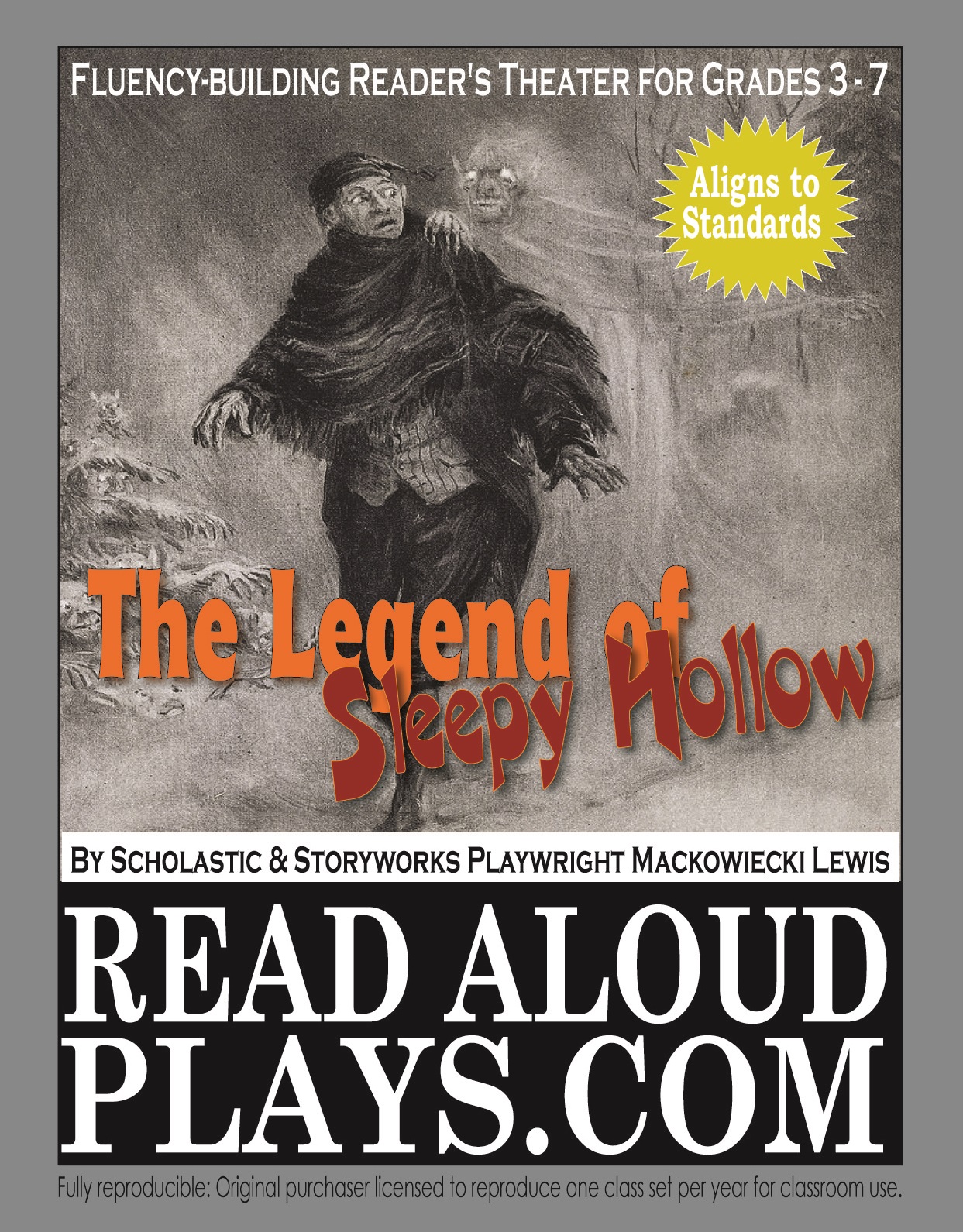
So what if your students are mesmerized by Venom and Doctor Octopus! There are plenty of mangled monsters and the criminally insane in W.W. Jacob’s classic, The Monkey’s Paw, Poe’s The Tell-Tale Heart, and Hawthorne’s The Birthmark. They’ll also find that familiar ol’ headless horseman in Sleepy Hollow, and a hapless ghost in Twain’s A Ghost Story. No, your kids won’t find them Pennywise-creepy or Slenderman-scary, but chemical concoctions, mad scientists, and sinister psychopaths make them very nearly as engaging.
All these plays are available on my TeachersPayTeachers storefront. They’re critically-acclaimed. They’re cheap. And they each come with a comprehension exercise. Suitable for reader’s theater, podcast radio drama, or full stage production, they’re perfect for fifth graders and up— but get started early to have them well-rehearsed by Halloween.
Thank you “Back at Work,” Rebecca Schwartz., Les Cain, Misha Carlstedt, Carolyn Finch, Jocelyne Matos, Bobbie Kukal, Antonio Costa, Lori Ivy, and Lynn Silvey for your lovely recent reviews of my products.
You probably know the Brothers Grimm for stories like Rapunzel and the Frog Prince, but there are scores of others that Disney hasn’t yet sanitized and “princessified.” We’ve adapted two of them as readers theater plays—and we think they’re perfect for Back-to-School.
The first is The Mouse, the Bird, and the Sausage. In typical Brothers Grimm fashion, it’s a cringe-worthy story about contentment, cooperation, and friendship. In the original, the three “roommates” ruin their happy life together when they’re cajoled into altering their routine. The result is Sausage gets eaten, Mouse gets boiled, and Bird drowns. It may be Grimm, but it’s also a bit too gruesome for the classroom!
While our version is no less cringey, we’ve managed to save all their lives while having a blast doing it! All five animal roles demand students willing to sell out on stage: Sausage’s Italian bravado, Mouse’s “death” scene, Bird’s over-baked remorse, Crow’s creepiness, and Dog’s indifference. We’ve tossed in optional “walk-up” music for each of the characters, too, which will help make this play an even bigger hit with your kids!
The second play has none of the gore the Grimm Brothers are known for. Instead, Hans in Luck is a cautionary tale about financial wisdom and good judgment . . . Hans has neither. After having worked seven years as an indentured servant, he’s given a lump of silver “as big as his head,” which he takes and then travels home. He soon tires of lugging it around, so he trades it for a horse, which he eventually trades for a cow, and then a pig, and so on until he has nothing left. All the while, Hans sees himself as incredibly fortunate, which perhaps he is. From his simplistic perspective, arriving home to find his grandmother still living proves he’s the luckiest man alive! Your students will enjoy uncovering the story’s numerous morals about trust, innocence, luck, foolishness, positivity, and money. We’ve added a few other surprises, too, making it another great character-building play to start your school year.
And, if Grimm tales don’t float your boat, at ReadAloudPlays.com we have many other plays to choose from. All come with a comprehension activity, key, teacher notes, and public school performance rights.
Thank you, Felicia A., Annette H., Sarah D., Lynn S., Shawn L., and Janet T. for your recent positive reviews!
Trees and flowers aren’t the only things blossoming right now. Your students, having spent much of the year under your tutelage, have grown and matured and are nearly ready to advance to the next grade—or at least they believe they are. They’re probably getting a bit stir-crazy, too, ready for something more than the same old routine. Perhaps, too, they’re having the life sucked out of them by standardized tests. It sounds like a good time to liven things up with some truly fun reader’s theater or class plays. Here are a few of my favorite antidotes for Spring Fever:
Perfect for Earth Day, Nature Talks Back“follows” the madcap adventures of three conifers names Otto, Bill, and Luther as they deal with bark beetle scares, woodpeckers, and centipedes. The story uses campy humor to convey scientific facts about how trees communicate to fend off danger, about misconceptions around what constitutes a “pest,” and about the danger pesticides are to pollinators.
HONEYBEE:Cough, choke. . . has somebody…cough wheeze . . . been using . . . sputter . . . bug spray?
KID(sheepishly): It was just a couple squirts.
HONEYBEE:Cough, wheeze . . . Good thing I only caught a whiff of it. It sent me into a loop-de-loop!
Nature Talks Back is written in four “acts,” which can be presented by a single cast or as four mini-plays. When my students presented it on stage, they used cardboard sheets to create two-dimensional evergreen trees with cutouts for their faces. Because the trees themselves don’t move, it was a kick teaching kids how to act with their facial expressions. But even of you don’t have time for a full presentation, NTB makes for a great podcast presentation or just a simple classroom reading on April 22nd!
How Jackie Saved the World is another great play for Spring. Our Jackie Robinson play depicts the circumstances around Jackie breaking the “color barrier” in the major leagues. As your students portray Jackie, Pee Wee, and others, a radio announcer calls a more modern game between Derek Jeter’s Yankees and Ken Griffey’s Mariners, which gently contrast the two eras. A peanut vendor and the hot dog man lend narration as they walk through the crowd–your audience.
HOT DOG MAN: Despite all that pressure, Jackie led the Dodgers to the World Series and was named Rookie of the Year. Some said it was the toughest season any ball player has ever endured. Last chance for hot dogs!
PEANUT VENDOR: No doubt the reason today’s game is so exciting is because Jackie had the courage to turn the other cheek. Peanuts! Get your peanuts here!
ANNOUNCER: We’re in the top of the ninth. Two outs and two on and the score tied two to two. The Yankees are taking no chances. With Ken Griffey, Jr. up to bat, they’ve brought in their closer, Mariano Rivera. Here’s the pitch. . .
Baseball season is underway all over the globe, so many of your male students—who statistically are more likely to be reluctant readers—will jump at the chance to be in a baseball play.
And then there’s Pooh. Who doesn’t love aWinnie-the-Pooh story? Our RT set includes the best of A.A. Milne’s 1926 collection, all familiar tales such as Winnie-the-Pooh and the Honey Tree:
BEES: Buzz.
CHRISTOPHER ROBIN: Perhaps they think that you’re after their honey.
POOH: It may be that. You never can tell with bees.
BEES: Buzz. Buzz.
POOH: Christopher Robin, have you an umbrella?
CHRISTOPHER ROBIN: I think so.
POOH: I wish you would get it, and walk up and down with it, and look up at me every now and then, and say ‘Tut-tut, it looks like rain.’ I think, if you did that, it would help with the deception we are using on the bees.
Well-suited to reader’s theater or full stage production in third grade and up, these are great for emphasizing delivery and enunciation: nervous Piglet, droll Pooh, gloomy Eeyore, and temperamental Rabbit, for example. The set includes five short plays, each with just a handful of characters. You can split your elementary-aged class into five groups and have each group present one of the plays, or have older students stage a presentation for younger grades.
Of course, we have many other plays with “fun” themes. The Pied Piper, Goldilocks, Barbed Wire, The Nose, Rikki Tikki Tavi, Peter Rabbit, and How the Elephant Got its Trunk are all wonderfully silly yet still build reading fluency while teaching important lessons. And don’t forget, when you buy one of our plays, you’re not merely buying a set of worksheets; you’re getting an original piece of literature—a professionally written play and the rights to use it year after year. It’s like getting a full class set of your favorite novel along with the other stuff most TpT products provide.
Following the George Floyd protests, heightened concern about cultural sensitivity and traumatic events led TeachersPayTeachers to ban pretty much any reader’s theater or history lesson in which students were challenged to see the event through the eyes of a minority figure. Though well-intended (after all, it’s pretty obvious we shouldn’t be simulating slave auctions in class), TpT’s policy essentially silenced Ruby Bridges, Claudette Colvin, Sheyann Webb, MLK, and other heroes of the Civil Rights Movement. The basis behind the ban was that today’s children shouldn’t be forced to relive the verbal abuse Ruby experienced, or the emotional abuse felt by Sacagawea, or the violence Sheyann witnessed. Never mind that all good literature and historical accounts requires the reader to see it from such a perspective. For example, if Claudette Colvin’s story shouldn’t be shared via my play, “The Girl Who Got Arrested,” it also shouldn’t be shared using Phllip Hoose’s National Book Award-winning biography, Twice Toward Justice.
Yet it must be shared. It’s by seeing Claudette’s story through her eyes that it becomes more than just a blurb and a date in a history book. Claudette’s first-hand account is the primary source that makes the event relevant today.
When TpT deactivated all my plays, I sought help from a friend who serves as the director of the local university’s Center for Cultural Diversity, as well as from Dr. Geneva Craig, someone who actually experienced the tear gas in Selma. These are crazy times, they both lamented, but they helped me re-evaluate my content to make sure I was indeed being sensitive. I made a handful of subtle changes and then re-posted my plays on TpT.
Only to have them deactivated all over again.
I tried re-posting them as JPEG sheets so that TpT’s content bots couldn’t recognize the text. I removed words like “drama” and “scripts” from my headings and changed “reader’s theater” to RT. To further disguise them, I rebranded them as “Paired Texts.” Nothing worked. TpT deactivated them every time. Ironically, it was during this time that The Palace Youth Theater in New Hampshire, with the help of its local BLM chapter, enacted two of the plays TpT had just banned.
Fortunately, less-reactionary ideals have prevailed and the new ownership at TpT has since reversed the censorship. I suspect they recognize that educators have school district policies, parent input, and professional training to guide us as to the appropriateness of material. We don’t need TpT to do it for us.
Though I lost hundreds of favorable reviews and thousands of clicks, I’m pleased to say that all my civil rights and American history plays are back on TpT. But given the “crazy times” in which we live, I think it’s important for educators to consider how to appropriately use reader’s theater to teach marginalized voices and traumatic events. Here are a few tips:
Community – Consult with the cultural community associated with the events depicted, bringing in guest speakers where appropriate. If you have students from that particular marginalized culture, seek input from their families before introducing the play.
Sensitivity – Characters in a play should not do anything demeaning toward their culture. While every story—whether in a play format or otherwise—has to have conflict, violent acts should only be referenced by narrators or other characters rather than explicitly acted out. If unsure about how a scene plays out, change it. If you’re still unsure how the content will be received, consider using it only for a discussion-based classroom reading or podcast rather than enacting it “on stage.”
Casting – Don’t let race be the basis for casting parts. Dr. King said he dreamed of a day when we would all be “color blind.” A reader’s theater performance is a good place to practice it.
Policy – It’s important to check your school board’s policy before embarking on any content that might be controversial. Some districts restrict subject matter not explicitly identified within a given grade level’s standards.
Paired Texts – It’s a good idea to pair reader’s theater content with professionally-published texts. For example, read Ruby Bridge’s book, Through My Eyes while working on the play, A Simple Act of Courage. Not only does the text serve as a vetting agent, it provides material to compare and contrast.
Discussion – No book, play, or video should stand alone. By discussing the content and events depicted, you facilitate understanding. Discussion should happen when introducing a play, while reading specific scenes, and after presenting. Utilizing expert guests enhances those discussions.
Repetition – One of the best reasons to use RT is that if there’s to be a presentation or performance, kids are willing to read plays repetitively. Even a simple reading in front of the class is enough to get kids to read and re-read a script multiple times. The brain science behind repetitive reading suggests students build their fluency at a far greater rate. It holds true with the students’ grasp on the historical events depicted and as well as their ability to empathize with marginalized voices.
Thank you for teaching Black history. Happy directing!
If you’re like me, you put a bow on the holidays and then breathed a sigh of relief as you headed home for the break. But here you are heading back to class and MLK Day is already upon you! You have no time to lose when it comes to planning your MLK Day and Black History Month activities! So, let’s get right to the point of this post: ReadAloudPlays.com specializes in Black History Month and MLK plays.
In 2021, despite all the Covid-related restrictions, the folks at the Palace Theatre in New Hampshire selected a couple of my plays to enact for Black History Month. I’ve posted the video here so that you can take a look. Whether or not these two plays inspire you to download any of my material, I hope you’ll still share the video with your students. Consider having them watch the production and then read the plays. Or, simply have them follow along with the script while viewing.
The two plays shown are Martin’s Big Dream, which reveals how incidents from King’s childhood inspired his work, and A Simple Act of Courage, which shares the role Ruby Bridges played in integrating America’s schools. They’re both available in my TpT and Etsy stores.
You’ll also find numerous other plays told from the perspective of Civil Right icons like Jackie Robinson, Claudette Colvin, and Sheyann Webb. One of the hallmarks of a quality historical play for kids is that the story is told through the eyes of a child witnessing the events firsthand. These plays all meet that standard.
A favorite of mine is MLK’s Freedom March, which is told through the eyes of eleven-year-old Lucy. Her grandmother is dying of cancer, her father is worried about losing his job, and her brother is fired up about The March for Jobs and Freedom, the iconic event where Dr. King delivered his “I Have a Dream” speech. It’s a powerful play with multidimensional characters backed by King’s awe-inspiring speech.
If you don’t know where else to start, download my free products, Tips for Teaching Marginalized Voices and Traumatic Eventsand Reader’s Theater Teaching Tips, which outlines best practice when using plays. Be sure to also download the full previews of my plays deemed sensitive or potentially controversial. When unsure about a text, consider using it for traditional reader’s theater, podcast, or a discussion-based in-class reading rather than a stage production. In such cases, the important content still gets taught without running the risk of someone being offended by a “reenactment” of a traumatic event.
Thank you for continuing Dr. King’s work, and happy directing!