Banned Books, Banned Plays

Censorship always begins with good intentions.

Following the George Floyd protests, heightened concern about cultural sensitivity and traumatic events led TeachersPayTeachers to ban pretty much any reader’s theater or history lesson in which students were challenged to see the event through the eyes of a minority figure. Though well-intended (after all, it’s pretty obvious we shouldn’t be simulating slave auctions in class), TpT’s policy essentially silenced Ruby Bridges, Claudette Colvin, Sheyann Webb, MLK, and other heroes of the Civil Rights Movement. The basis behind the ban was that today’s children shouldn’t be forced to relive the verbal abuse Ruby experienced, or the emotional abuse felt by Sacagawea, or the violence Sheyann witnessed. Never mind that all good literature and historical accounts requires the reader to see it from such a perspective. For example, if Claudette Colvin’s story shouldn’t be shared via my play, “The Girl Who Got Arrested,” it also shouldn’t be shared using Phllip Hoose’s National Book Award-winning biography, Twice Toward Justice.

Yet it must be shared. It’s by seeing Claudette’s story through her eyes that it becomes more than just a blurb and a date in a history book. Claudette’s first-hand account is the primary source that makes the event relevant today.

When TpT deactivated all my plays, I sought help from a friend who serves as the director of the local university’s Center for Cultural Diversity, as well as from Dr. Geneva Craig, someone who actually experienced the tear gas in Selma. These are crazy times, they both lamented, but they helped me re-evaluate my content to make sure I was indeed being sensitive. I made a handful of subtle changes and then re-posted my plays on TpT.

Only to have them deactivated all over again.  

I tried re-posting them as JPEG sheets so that TpT’s content bots couldn’t recognize the text. I removed words like “drama” and “scripts” from my headings and changed “reader’s theater” to RT. To further disguise them, I rebranded them as “Paired Texts.” Nothing worked. TpT deactivated them every time. Ironically, it was during this time that The Palace Youth Theater in New Hampshire, with the help of its local BLM chapter, enacted two of the plays TpT had just banned.  

Fortunately, less-reactionary ideals have prevailed and the new ownership at TpT has since reversed the censorship. I suspect they recognize that educators have school district policies, parent input, and professional training to guide us as to the appropriateness of material. We don’t need TpT to do it for us.

Though I lost hundreds of favorable reviews and thousands of clicks, I’m pleased to say that all my civil rights and American history plays are back on TpT. But given the “crazy times” in which we live, I think it’s important for educators to consider how to appropriately use reader’s theater to teach marginalized voices and traumatic events. Here are a few tips:

Community – Consult with the cultural community associated with the events depicted, bringing in guest speakers where appropriate. If you have students from that particular marginalized culture, seek input from their families before introducing the play.

Sensitivity – Characters in a play should not do anything demeaning toward their culture. While every story—whether in a play format or otherwise—has to have conflict, violent acts should only be referenced by narrators or other characters rather than explicitly acted out. If unsure about how a scene plays out, change it. If you’re still unsure how the content will be received, consider using it only for a discussion-based classroom reading or podcast rather than enacting it “on stage.”

Casting – Don’t let race be the basis for casting parts. Dr. King said he dreamed of a day when we would all be “color blind.” A reader’s theater performance is a good place to practice it.

Policy – It’s important to check your school board’s policy before embarking on any content that might be controversial. Some districts restrict subject matter not explicitly identified within a given grade level’s standards.   

Paired Texts – It’s a good idea to pair reader’s theater content with professionally-published texts. For example, read Ruby Bridge’s book, Through My Eyes while working on the play, A Simple Act of Courage. Not only does the text serve as a vetting agent, it provides material to compare and contrast.

Discussion – No book, play, or video should stand alone. By discussing the content and events depicted, you facilitate understanding. Discussion should happen when introducing a play, while reading specific scenes, and after presenting. Utilizing expert guests enhances those discussions.

Repetition – One of the best reasons to use RT is that if there’s to be a presentation or performance, kids are willing to read plays repetitively. Even a simple reading in front of the class is enough to get kids to read and re-read a script multiple times. The brain science behind repetitive reading suggests students build their fluency at a far greater rate. It holds true with the students’ grasp on the historical events depicted and as well as their ability to empathize with marginalized voices.

Thank you for teaching Black history. Happy directing!
MLK Day Inspiration

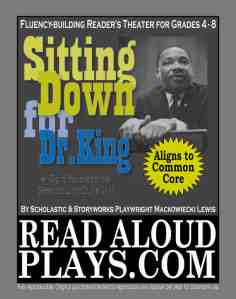
Click on the cover to preview at TpT!I’ve been fortunate to have forged a lasting relationship with Scholastic publishers, particularly the wonderful editors at Storyworks and Scope magazines. Through my work with them I’ve developed a reputation for writing compelling reader’s theater about Martin Luther King and African-American history in general. Somehow, I’ve been able to accurately represent the historical events and, more importantly, convey the spirit of Dr. King’s work through such plays as “Sitting Down for Dr. King.” With MLK Day upon us, and given that February is Black History Month, I want to encourage you to give some of my reader’s theater scripts a try.

I’m particularly proud of “Sitting Down.” I remember struggling over it when I was writing it back in 2002.There I was, bouncing one bad idea after another off my laptop screen, regretting having accepted the contract at all, when I realized how very simple my task was in comparison to the mammoth challenge undertaken by Dr. King. Soon thereafter I crafted the fictional story of “David,” a twelve-year-old white kid frustrated that these African-American college students were getting in the way of his birthday shortcake at the Woolworths. “Sitting Down” has since appeared in three different Scholastic venues including Storyworks, a text book series, and a leveled reading set, but I’m proud of it because it has a powerful ending that I believe Dr. King would have respected.

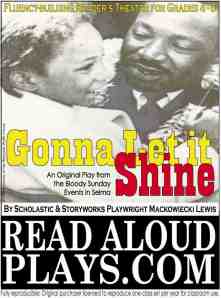
Click on the cover to preview or purchase!I think my play, “Gonna Let it Shine” also conveys the spirit of Dr. King’s work. It’s based upon the true story of Sheyann Webb, who was just eight years old when she braved tear gas and posse men while marching alongside Dr. King. She became known as “Dr. King’s Youngest Freedom Fighter,” and her story is the subject of the Disney movie, “Selma, Lord, Selma.” The play originally appeared in Storyworks under the title “Pigtails & Protests.” In the process of re-writing it for release on TeachersPayTeachers, I had the privilege to talk with Sheyann herself, who is today–some fifty years later–a public speaker and Civil Rights advocate. It was surreal to speak with someone who in my writing was still just a child. It was inspiring to connect with someone who not only knew Dr. King and numerous other heroes of the Movement, but was in fact a Civil Rights hero in her own right.

We Shall Overcome” tells the story of the Birmingham Children’s Crusade. That’s the event where students, some nearly young as Sheyann, were attacked by police dogs and knocked to the ground by blasts from fire hoses. News coverage of their sacrifice swayed worldwide public opinion in favor of desegregation.

The Girl Who Got Arrested,” meanwhile, tells the true story of Claudette Colvin, the first person to be hauled off a city bus and tried in court for defying Montgomery’s segregated busing law. Her story is depicted in the book, “Twice Toward Justice.” I certainly don’t want to diminish the work of Rosa Parks, but in my humble opinion, Claudette’s story is far more compelling.

One of my “under sung” plays is “MLK’s Freedom March.” It’s a work of historical fiction about a girl named Lucy who helps her ailing grandmother get to Washington to hear MLK’s “I Have a Dream” speech. There’s also “In the Jailhouse with Dr. King,” about a troubled teenage who turns it around when he witnesses King’s calm demeanor in the face of violence during the Bus Boycott. These and other plays capture the essence of MLK’s work. Consider celebrating MLK Day and/or Black History Month in your classroom by picking any three, dividing your class into three groups, practicing for a couple weeks, and then presenting them with opportunity for discussion in between. In so doing, you’ll be giving your students a strong foundation in MLK history, and perhaps the inspiration to make history themselves.

Happy Directing!

Selma Movie, Selma Play

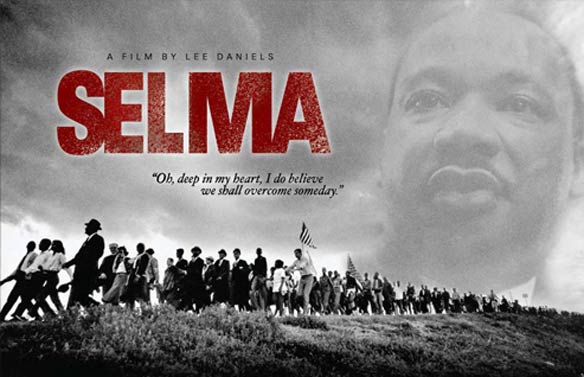
Selma, Oprah Winfrey's new movie about MLKBuzz about Oprah Winfrey’s new movie Selma is shining a light on the Selma to Montgomery March. The film, which depicts the 1965 events in Alabama, drew standing ovations at its screening in New York. Says film critic Roger Friedman, “Watching ‘Selma’ you really feel like all the plays, movies, TV shows, songs– every theater piece about King– all of it culminates in this film.” (Click here to see the trailer.)

Selma was the site of protests over voting rights. African-Americans there and in neighboring counties were routinely denied the right to vote through the use of poll taxes, threats of retribution, proficiency tests, and other manipulations. Today, that all sounds pretty vanilla, but make no mistake, Selma was a terrifyingly murderous place.

Dr. King, Hosea Williams, James Bevel, and other civil rights leaders organized a march to the state capital where they hoped to confront then-Governor George Wallace. But when the marchers arrived at the Edmund Pettus Bridge on the outskirts of town, state troopers—including many on horseback—violently attacked the marchers with clubs and tear gas. It became known as Bloody Sunday. International news coverage of the violence led directly to the signing of the Voting Rights Act, a turning point in the civil rights struggle.Click on the cover to preview or purchase

The movie’s release date (Christmas Day) is timed to take advantage of the annual focus on MLK Day in January and Black History Month in February. But this is an important bit of history regardless of one’s race. We live in an era of voter apathy, a time when we tend to take our right to vote for granted. If our students have any hope of changing the world, one would think they’ll need to reclaim the voting booth. Our kids need to know this story both for what it means to America’s history and for what it means for America’s future. “There’s a lump in your throat at the end of ‘Selma,’” says Friedman. Kids need to experience that lump in the throat.

I don’t know what the movie will be rated, but due to its mature content, I doubt any of us will ever be able to share it in our elementary or middle school classrooms. But you can take advantage of the interest in the film by using the read aloud play, Gonna Let it Shine. It depicts the Selma campaign from the perspective of Sheyann Webb, who was eight at the time. Sheyann, along with her friend Rachel West, became known as “Dr. King’s youngest freedom fighters.” Sheyann was there at the rallies, at the funerals, and on the bridge. She experienced the sting of teargas. She ran from Sheriff Clark’s posse. Her story is a great way to introduce students to the civil rights struggle and to help them appreciate their future voting rights.

The play is available at TeachersPayTeachers and ReadAloudPlays.com. Happy directing!