Using Readers Theater to Honor Veterans

It’s Time for Halloween Plays!

Back a hundred years ago, ghoulishness was captured in short stories rather than comic books. Writers like Poe, Shelley, and Stevenson creeped out their audiences with dark tales of superstition, mystery, and insanity. The Gothic themes they created have been permeating literature, television, and cinema ever since. 

So what if your students are mesmerized by Venom and Doctor Octopus? There are plenty of mangled monsters and the criminally insane in W.W. Jacob’s classic, The Monkey’s Paw, Poe’s The Tell-Tale Heart, and Hawthorne’s The Birthmark. They’ll also find that familiar ol’ headless horseman in Sleepy Hollow, and a hapless ghost in Twain’s A Ghost Story.  No, your kids won’t find my version of Rappaccini’s Daughter Pennywise-creepy or Slenderman-scary, but its chemical concoctions and mad scientists make it very nearly as engaging. Most certainly, it’s a key to unlocking the original’s subtleties and complexities.    

Your students know these themes. They’ve seen them on the Simpsons and Family Guy, in Goosebumps and Marvel Comics. But do they know from whence they come?  Though the archaic language and complex structures of these classic tales present barriers for most middle grade readers, you can make the stories more accessible by pairing them with reader’s theater. And what better a time to do it than Halloween?

All these plays are available on my TeachersPayTeachers and Etsy storefronts. They’re critically-acclaimed. They’re inexpensive. They each come with a comprehension exercise. We’ve also put our three most popular spooky scripts in a splendid Halloween bundle, making them even less expensive! Suitable for reader’s theater, podcast radio drama, or full stage production, they’re perfect for fifth graders and up (plus strong 4th graders)—but get started early to have them well-rehearsed by Halloween.

Happy directing!

Six Awesome Ways to Do RT!

Click on the image to check out one of our mini-guides to using readers theater in the classroom, or download the complete guide by clicking here. Happy directing!

What Makes a Readers Theater Script Magical?

It’s time to give the competition some attention. For the last 15 years, ReadAloudPlays.com has been a “secondary market” for all the scripts I’ve published at Scholastic. Writing and staging of these plays has been and will continue to be a passion. The webpage and TpT store, on the other hand, have always been kind of a sideline gig. Now, as I head into retirement from daily classroom instruction, my intent is to push RAP to the forefront of the reader’s theater marketplace. I’m adding new collections (see image), adjusting how performance rights are purchased, and delving more thoroughly into social media and SEO marketing.

Still, wanting to be competitive, I’ve done a bit of scouting, and I’m convinced ReadAloudPlays.com remains the best value in reader’s theater anywhere—not only because we’re less expensive, but also, dare I say, because there’s something magical about our scripts.

I was a mainstay at Storyworks and Scope for 20 years. My editors there frequently told me what made my scripts special:

One, they said my scripts always hit the right reading level and age group. Though a play should push a reader’s vocabulary a bit, a play written for 3rd graders shouldn’t require an eighth grade reading level. Nor should a play for 6th graders sound like something from Daniel Tiger. Amateurs often miss these marks.

Two, because I test nearly all my scripts on students (and will continue to do so in retirement), my scripts appeal to their interests. Working directly with kids all these years has given me a knack for understanding what riles ‘em up. (Visit the DailyPlatypus.org to see for yourself.)

Third, there’s a bit of magic in every play. I’m able to add just the right touches to tug at their emotions or tickle their funny bone. The mayor’s telephone conversations in The Pied Piper, that Goldilocks is a home dec influencer, the strange gibberish spoken by the elves in Shoemaker, or that Otter wears goggles and a snorkel in Toad’s Wild Ride are the Sriracha and glitter that take the plays to the next level.

As for the competition, I encourage you to judge for yourself. ReadingAtoZ.com has a handful of plays, but the site requires an annual fee of $135. You could buy 30 of my plays for that price, each with the license to print a full class set.

ScriptsforSchools.com sells plays for $14.95 and up, teacher packets are $45, and collections run $100.

Readerstheater.com— Has a ton of short plays—some really short. They’re professionally bound, but most are $7 per student, meaning a single play for 7 actors runs $49. No duplication license is included.

Weebly is a great resource for RT—and much of it is free—but there’s trouble afoot. Many of the plays there are copyright violations. For example, unless the author of Miss Nelson is Missing granted copyright (which is unlikely) the play should not exist, nor can it be legally performed for an audience. Another example is when a teacher inadvertently posts a copyright-protected script for their students. When one of our plays shows up on Weebly, our only recourse is to contact the school and file a copyright complaint. It’s awkward for all of us. (We REALLY appreciate teachers who respect copyright.)

PioneerDrama.com is one of the big boys of RT, but they charge big boy prices. Scripts run $10 per student and performance rights are $75 per performance.

And of course there are a variety of other sites with free and paid play scripts, but in our opinion, they usually lack the “magic” of a script from ReadAloudPlays.com.

Finally, there’s AI. That’s right. I know teachers are going to Gemini or ChatGPT and asking them to create a play from a given story. To see what damage AI will cause, I too gave it a try. What I got back was a very short and very bland script with way too much narration (a sure sign of amateurism). No magic there. Asking artificial intelligence to create a script is like asking the microwave to cook all five courses of your Thanksgiving dinner. Yuck. No salt. No pepper. Definitely no Sriracha.

So, as you embark on another school year, take advantage of all the magical, perfectly-seasoned, original, and inexpensive plays from ReadAloudPlays.com. You’ll find all of them on our Tpt storefront. And if you like our plays, please share our link, leave us 5 star reviews, follow us on TpT, and look for us on Instagram, Bluesky, and Facebook.

Thanks, and happy directing!

The Antidote for Spring Fever and the Test Taking Blues

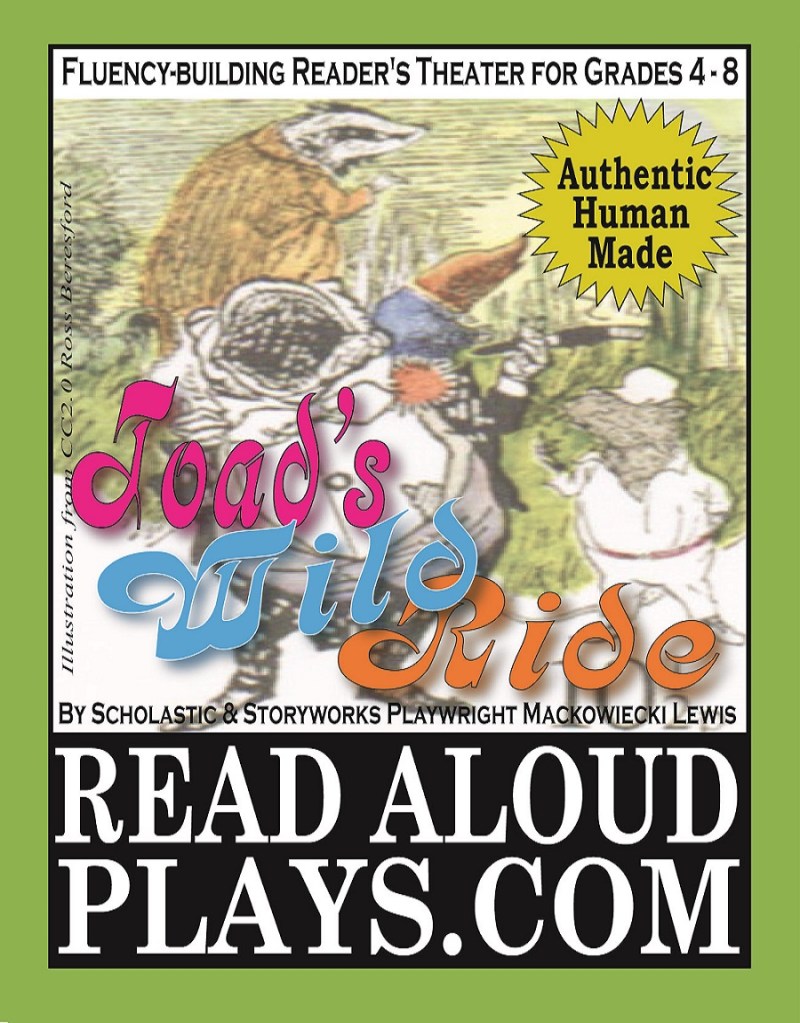
If you’re school is anything like mine, you’re probably gearing up for standardized testing. For many of us and our kids, it’s the bane of our existence. So, my proposal to you is to use what little time remains in your schedule to have some fun staging a play! It can be as simple as an in-class reader’s theater presentation or as complex as a full stage production (start now for an end-of-the-school year performance!). Whatever the case, at ReadAloudPlays.com we have gobs of plays perfectly suited for spring, including our latest release, Toad’s Wild Ride.

We’ve narrowed Wind in the Willows down to its best, most humorous elements. It shows how Mr. Toad becomes infatuated with motor cars, how his friends attempt to “cure” him, and how he goes on a maniacal drive through the village. Yes, Scene 7 resembles the Disneyland ride! The whole play is full of pratfalls, subtle humor, and grand entrances, making it as kid-friendly as it gets. Enjoy Mole’s innocence, Badger’s stodginess, and Otter’s “charisma,” but don’t forget Ratty and Toad! The play includes stage directions, making it ideal for a full production.

BADGER: Then you don’t promise to never touch a motor-car again?

TOAD:  Certainly not! In fact, I promise that the very first motor car I see, poop-poop, off I go!

Baseball season is underway, so many of your male students—who statistically are more likely to be reluctant readers—will jump at the chance to be in a baseball play.  How Jackie Saved the World depicts the circumstances around Jackie Robinson breaking the “color barrier.” As your students portray Jackie, Pee Wee, and others, a radio announcer calls a more modern game between Derek Jeter’s Yankees and Ken Griffey’s Mariners, gently contrasting the two eras. A peanut vendor and the hot dog man lend narration as they walk through the audience hawking ballpark snacks.

HOT DOG MAN: Despite all that pressure, Jackie led the Dodgers to the World Series and was named Rookie of the Year.  Some said it was the toughest season any ball player has ever endured. Last chance for hot dogs!

PEANUT VENDOR: No doubt the reason today’s game is so exciting is because Jackie had the courage to turn the other cheek. Peanuts! Get your peanuts here!

ANNOUNCER: We’re in the top of the ninth. Two outs and two on and the score tied two to two. The Yankees are taking no chances. With Ken Griffey, Jr. up to bat, they’ve brought in their closer, Mariano Rivera.  Here’s the pitch. . .

Perfect for Earth Day, Nature Talks Back “follows” the madcap adventures of three conifers named Otto, Bill, and Luther as they deal with bark beetle scares, woodpeckers, and centipedes. The story uses campy humor to convey scientific (and non-politicized) facts about the environment.

BILL: It’s not a termite is it? Oh, I hate termites!

LUTHER: No, I don’t think it’s a termite.

BILL: Phew. You had me worried for a minute.

OTTO: Too big for a termite. Looks like some kind of beetle. Does it look like some kind of beetle to you, Luther?

BILL (alarmed): A beetle? Is it a bark beetle?!  Oh no. It’s a bark beetle, isn’t it? I just know it! Get it off of me! Get it off of me!

If maniacal drives, spring training, and talking trees don’t entice you, we also have Peter Rabbit (it seems too young for 5th and 6th graders, but they love doing it—especially when they get to perform it for youngers), Winnie the Pooh (and Tigger too!), and on a more serious note, Juneteenth: Freedom for the First Time. Plus we have dozens more: all original, all human-made, and all with teacher notes, writing prompts, comprehension activities, and the license to print a full class set every year for use in one’s own classroom. Other sites charge dramatically more (no pun intended) for plays with far less originality and pizazz!

Plays teach kids to read purposefully and thoughtfully rather than merely for speed. They always have developmentally-appropriate parts for both your advanced readers and your most reluctant ones. And once parts are assigned, you don’t have to prompt kids to chime in. Best of all, plays are fun.  They’re the perfect antidote for spring fever and those test-taking blues.

Happy directing!

MLK Day and Black History Month Activities

If you’re like me, you put a bow on the holidays and then breathed a sigh of relief as you headed home for the two week break. But here you are back in class and MLK Day is already upon you!  You have no time to lose when it comes to planning your MLK Day and Black History Month activities!  So, let’s get right to the point of this post: ReadAloudPlays.com specializes in Black History Month and MLK plays.

In 2021, despite all the Covid-related restrictions, the folks at the Palace Youth Theatre in New Hampshire selected a couple of my plays to enact for Black History Month. I’ve posted the video here so that you can take a look. Just click on the image. Whether or not these two plays inspire you to download any of my material, I hope you’ll still share the video with your students. Consider having them watch the production and then read the plays. Or, simply have them follow along with the script while viewing.

The two plays shown are Martin’s Big Dream, which reveals how incidents from King’s childhood inspired his work, and A Simple Act of Courage, which shares the role Ruby Bridges played in integrating America’s schools. They’re both available in my TpT and Etsy stores.

You’ll also find numerous other plays told from the perspective of Civil Right icons like Jackie Robinson, Claudette Colvin, and Sheyann Webb. One of the hallmarks of a quality historical play for kids is that the story is told through the eyes of a child witnessing the events firsthand. These plays all meet that standard. 

A favorite of mine is MLK’s Freedom March, which is told through the eyes of  eleven-year-old Lucy. Her grandmother is dying of cancer, her father is worried about losing his job, and her brother is fired up about The March for Jobs and Freedom, the iconic event where Dr. King delivered his “I Have a Dream” speech. It’s a powerful play with multidimensional characters backed by King’s awe-inspiring speech.

If you don’t know where else to start, download my free product, Tips for Teaching Marginalized Voices and Traumatic Events.  

Thank you for continuing Dr. King’s work, and happy directing!

A Special Pooh Event!

Back in the days of the big three networks, a television special like Charlie Brown, Winnie-the-Pooh, or the Little Drummer Boy was a once-a-year event. I remember being mesmerized by those now-old Pooh specials of the 1960’s and 70’s. They introduced us to memorable stories such as Pooh and the Honey Tree and memorable characters such as Eeyore and Tigger. Though releasing my set of Pooh adaptations may not be the kind of event that’ll gather the family in front of the Zenith on a Sunday evening, I none-the-less think it’s still kind of special.

My adaptations include the five best stories from Milne’s 1926 work. I’ve packaged them as five individual “mini-plays.” Each play has just five or six cast members, which means they’re great for small groups. My fifth graders are having a blast with them, and I’m enjoying hearing their interpretations of Milne’s clearly-defined characters. In our case, each small group is staging two plays with the intent of gathering first and second grade kids “in front of the Zenith” some afternoon after winter break. I think your kids will love them too.

A.A. Milne published the original set of Pooh adventures way back in 1926, but even though they’re now in the Public Domain, recreating them as reader’s theater isn’t as straight-forward as it might seem. Disney, for example, still owns the copyright to everything post-1926. That includes Tigger, Pooh’s red shirt, and even the un-hyphenated version of Pooh’s name. Still, these five plays represent the best of Milne’s original work. They’re suitable for third grade and up (a strong group of second graders can probably handle them too), but they promote fluency in upper grades too. They come with comprehension activities, and they’re printed in my kid-friendly, easy-to-read format. Look for Pooh on my TeachersPayTeachers storefront.

Thank you for using Read Aloud Plays! Happy directing!

Trees, Bees, and Centipedes . . .

The clocks have all sprung forward, the turkey vultures have returned, and the sprouts are beginning to pop. Spring has arrived! So tell that groundhog to make way for some fun plays celebrating the season, including my newest script, Nature Talks Back. It’s actually four coordinated skits designed to give younger students insight in to trees, bees, and centipedes. Its ecology and conservation themes include that trees communicate, that some perceived pests are considered beneficial insects, and that honeybees are super-important pollinators.  The stories center around three oddball forest trees named Luther, Otto, and Bill and their hysterical encounters with a host of pests.    

It’s aimed specifically at kids in upper 2nd through 4th grade, but it’s also suitable for grade 5 and up for reader’s theater, podcast, or stage— especially when performed for younger kids. (My fifth graders love it and are presently preparing a full production!)

Consider pairing Nature Talks Back with some of my other spring-oriented plays. Peter Rabbit is also aimed at younger students. Use it with 2nd and 3rd graders, or have older students perform it for primary-aged kids. Rikki Tikki Tavi, Kipling’s much-loved story about the heroic mongoose has some spring-time flair, a singing bird, and an important theme about courage. It too can be presented alongside How the Elephant Got Its Trunk, another classic Kipling tale from The Jungle Books.  And don’t forget that baseball season is upon us, so it’s a great time for my entertaining and socially important play about Jackie Robinson.

Happy directing!

How to Create that Interactive Vibe

I’ve heard many teachers lament that this online instruction deal isn’t what they signed-up for, yet here we are. What we miss most is that teacher-to-student interaction. That being the case, allow me to review a couple interactive activities that worked well in the spring.

“Zoom-Aloud” Plays

The Legend of Sleepy HollowThere’s still a place for reader’s theater in your remote instruction. During the spring, I had a lot of fun interacting with my kids using “Zoomer’s Theater.” I assigned parts to each of my “active” students, had them practice independently, and then met regularly via Zoom for rehearsals. The goal of each play was to eventually record them as “performances.” Granted, absenteeism and broadband speed caused glitches that required some patience, but in the end, I found I got a lot of favorable mileage out of each play. Not only did students tend to be more engaged than with regular reading assignments, they were usually willing to read and re-read their play repetitively, which not only improved their fluency, but filled hours of instruction time. Plus, unlike regular reading assignments, when I was done I had a sharable product: a performance that could be posted on my webpage or sent to parents.

This fall, I plan on keeping my expectations low for the first set of plays, but I think once my students see how they work and how much fun they are, the second set should be dynamite. I also think I’ll try having kids show up to their final Zoom session in costume, too. That should be a hoot! Note: it doesn’t matter whether you’re using Zoom or some other meeting platform. The only requirement is that you have some way to record and share your final session, even if just the audio.

I want to encourage you to give it a try, too. In grades 3 through 6 or maybe 7, start out with something simple. My Peter Rabbit play, Argument at Mount Rushmore, and Two Plays from the American Revolution are ideal. For October, try something more elaborate, such as any of my “Halloween plays” including my newest posting, The Legend of Sleepy Hollow. Pair it with The Birth-mark, The Monkey’s Paw, or The Tell-Tale Heart.

Almost all my plays were previously published in Scholastic classroom magazines such as Storyworks and Scope, so you know they meet the highest standards. Most also come with Common Core-based comprehension activities that have been digitized for online instruction.

Super Sentences

Super Sentences & Perfect ParagraphsPerhaps the most productive and rewarding element of my instruction in the spring was my Super Sentences program. It’s a straight-forward way to teach and practice writing on a daily basis, it doesn’t overwhelm kids, it’s fun, and it’s well-suited to Google Classroom. By the end of the spring, my students were spending 45 minutes in a live Classroom stream nearly every day, and each of these sessions produced more than 300 back and forth comments–student-to-student feedback about writing. To get the details, check out this post from last spring, then take a look at Super Sentences and Perfect Paragraphs on my TeachersPayTeachers store.

Happy directing (and interacting)!

How to Create a Library Culture

Historic library checkout cardOne of the greatest things my mother ever did for me was regularly take me to the public library when I was a kid. I don’t recall any exact schedule or regular routine, but I’m guessing every two weeks or so—perhaps more during the summer. On these days my mom would drag my little sister Karen and me away from whatever mud puddle or walnut tree we were in, and we’d all slither into her Ford Falcon and head off to the main branch downtown.

Karen was my best friend growing up, but at the library we mined different tracts. So engaged was I by our library outings that I have no recollection whatsoever of Karen even being present, though I know she was. I sought Daniel Boone and Davy Crocket novelizations, wildlife fiction, and sports biographies, always coming home with a stack of books to conquer before the next visit. I also Dewey-decimaled my way into the architecture section upstairs, pouring over books about drafting and design. When my mom bought me a drafting set one Christmas, I became a master with a t-square and determined to become an architect myself. I got side-tracked during the adolescence of high school, but I’ve used those drafting and design skills in many endeavors. Such was the power of those public library visits.

Click on the library card to preview this play at TpTThe library remains a significant aspect of my lifestyle today. It befuddles me when I see letters to the editor decrying the latest library bond. The writers of these letters want our libraries to charge user fees. They begrudge the $127.45 in annual taxes they pay to maintain our library system. Clearly, these folks never developed that library culture. Perhaps their mothers never took them to the library when they were young.

These days I find myself missing those childhood trips to the library. Perhaps that’s what inspired me to produce my latest Read Aloud Play, The Library Card. I originally wrote this script for Storyworks, where it appeared in October of 2001. It tells the story of African-American author Richard Wright’s relationship with the library. Wright wrote numerous books of significance during the middle of the 20th-century including Native Son and the semi-autobiographical Black Boy. The play is based on an incident from Wright’s youth in which he was denied access to the public library due to his race. The racism theme is obvious, making it an ideal fit for Black History Month, but make no mistake, this play is ultimately about the love of reading and the significance of libraries. With any luck, students who act-out this play will quit taking their access to the library for granted. Should you give the play a run, you might also consider pairing it with a trip to your local public library where you can help kids apply for their own library cards. It’s also worth noting that the story was popularized in William Miller’s inspiring picture book, “Richard Wright and the Library Card,” which makes for another ideal pairing.

Well, I’m off to the library. More plays are coming soon. Happy directing!