Earth Day + Arbor Day

Nature Talks Back is a great play with which to celebrate Earth Day and Arbor Day while teaching your kids about trees, bees, and centipedes. The play’s ecology and conservation themes include that trees communicate, that some perceived pests are considered beneficial insects, and that honeybees are super-important pollinators.  The stories center around three oddball conifers named Luther, Otto, and Bill and their hysterical encounters with a host of pests.   

It’s aimed specifically at kids in upper 2nd through 4th grade, but it’s also suitable for grade 5 and up for reader’s theater, podcast, or stage— especially when performed for younger kids. (My fifth graders loved preparing a full production!) No time for a big show? Use it instead as in-class reading! It’s a fun way to teach about nature on Earth Day and Arbor Day!

Consider pairing Nature Talks Back with some of my other spring-oriented plays. Peter Rabbit is also aimed at younger students. Use it with 2nd and 3rd graders, or have older students perform it for primary-aged kids.  Rikki Tikki Tavi, Kipling’s much-loved story about the heroic mongoose has some spring-time flair, a singing bird, and an important theme about courage. It too can be presented alongside How the Elephant Got Its Trunk, another classic Kipling tale from The Jungle Books.  And don’t forget that baseball season is upon us, so it’s a great time for my entertaining and socially important play about Jackie Robinson.

Happy directing!

The Antidote for Spring Fever and the Test Taking Blues

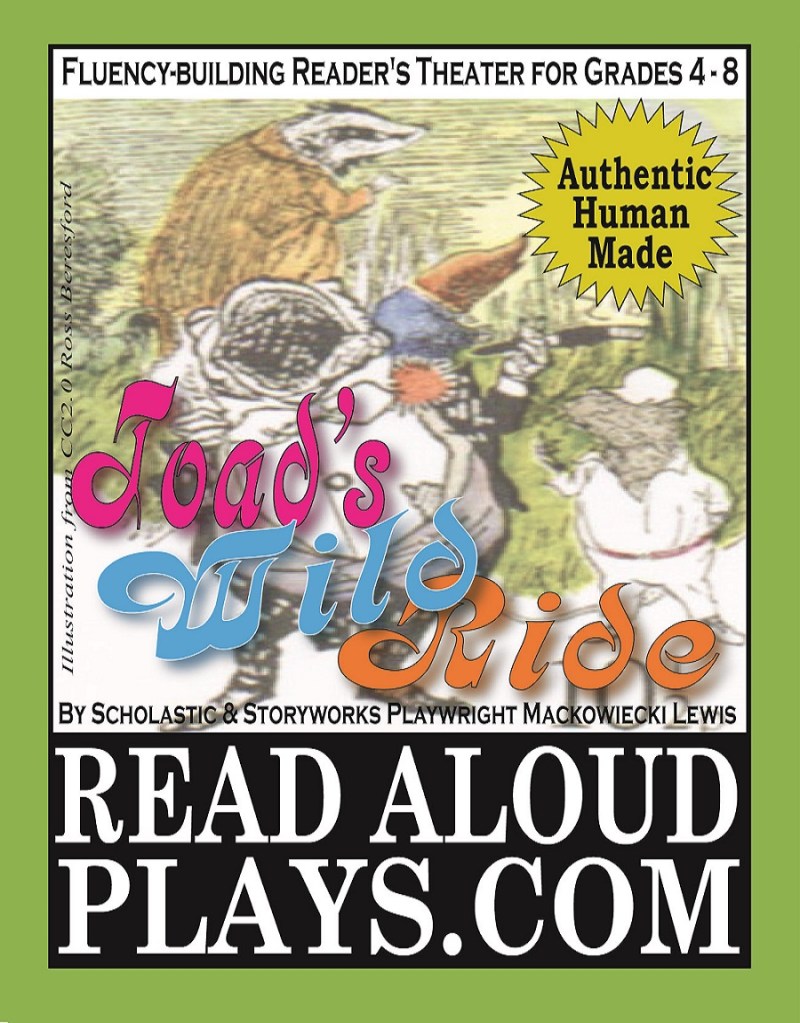
If you’re school is anything like mine, you’re probably gearing up for standardized testing. For many of us and our kids, it’s the bane of our existence. So, my proposal to you is to use what little time remains in your schedule to have some fun staging a play! It can be as simple as an in-class reader’s theater presentation or as complex as a full stage production (start now for an end-of-the-school year performance!). Whatever the case, at ReadAloudPlays.com we have gobs of plays perfectly suited for spring, including our latest release, Toad’s Wild Ride.

We’ve narrowed Wind in the Willows down to its best, most humorous elements. It shows how Mr. Toad becomes infatuated with motor cars, how his friends attempt to “cure” him, and how he goes on a maniacal drive through the village. Yes, Scene 7 resembles the Disneyland ride! The whole play is full of pratfalls, subtle humor, and grand entrances, making it as kid-friendly as it gets. Enjoy Mole’s innocence, Badger’s stodginess, and Otter’s “charisma,” but don’t forget Ratty and Toad! The play includes stage directions, making it ideal for a full production.

BADGER: Then you don’t promise to never touch a motor-car again?

TOAD:  Certainly not! In fact, I promise that the very first motor car I see, poop-poop, off I go!

Baseball season is underway, so many of your male students—who statistically are more likely to be reluctant readers—will jump at the chance to be in a baseball play.  How Jackie Saved the World depicts the circumstances around Jackie Robinson breaking the “color barrier.” As your students portray Jackie, Pee Wee, and others, a radio announcer calls a more modern game between Derek Jeter’s Yankees and Ken Griffey’s Mariners, gently contrasting the two eras. A peanut vendor and the hot dog man lend narration as they walk through the audience hawking ballpark snacks.

HOT DOG MAN: Despite all that pressure, Jackie led the Dodgers to the World Series and was named Rookie of the Year.  Some said it was the toughest season any ball player has ever endured. Last chance for hot dogs!

PEANUT VENDOR: No doubt the reason today’s game is so exciting is because Jackie had the courage to turn the other cheek. Peanuts! Get your peanuts here!

ANNOUNCER: We’re in the top of the ninth. Two outs and two on and the score tied two to two. The Yankees are taking no chances. With Ken Griffey, Jr. up to bat, they’ve brought in their closer, Mariano Rivera.  Here’s the pitch. . .

Perfect for Earth Day, Nature Talks Back “follows” the madcap adventures of three conifers named Otto, Bill, and Luther as they deal with bark beetle scares, woodpeckers, and centipedes. The story uses campy humor to convey scientific (and non-politicized) facts about the environment.

BILL: It’s not a termite is it? Oh, I hate termites!

LUTHER: No, I don’t think it’s a termite.

BILL: Phew. You had me worried for a minute.

OTTO: Too big for a termite. Looks like some kind of beetle. Does it look like some kind of beetle to you, Luther?

BILL (alarmed): A beetle? Is it a bark beetle?!  Oh no. It’s a bark beetle, isn’t it? I just know it! Get it off of me! Get it off of me!

If maniacal drives, spring training, and talking trees don’t entice you, we also have Peter Rabbit (it seems too young for 5th and 6th graders, but they love doing it—especially when they get to perform it for youngers), Winnie the Pooh (and Tigger too!), and on a more serious note, Juneteenth: Freedom for the First Time. Plus we have dozens more: all original, all human-made, and all with teacher notes, writing prompts, comprehension activities, and the license to print a full class set every year for use in one’s own classroom. Other sites charge dramatically more (no pun intended) for plays with far less originality and pizazz!

Plays teach kids to read purposefully and thoughtfully rather than merely for speed. They always have developmentally-appropriate parts for both your advanced readers and your most reluctant ones. And once parts are assigned, you don’t have to prompt kids to chime in. Best of all, plays are fun.  They’re the perfect antidote for spring fever and those test-taking blues.

Happy directing!

Help for Spring Fever in the Classroom

Trees and flowers aren’t the only things blossoming right now. Your students, having spent much of the year under your tutelage, have grown and matured and are nearly ready to advance to the next grade—or at least they believe they are. They’re probably getting a bit stir-crazy, too, ready for something more than the same old routine.  Perhaps, too, they’re having the life sucked out of them by standardized tests. It sounds like a good time to liven things up with some truly fun reader’s theater or class plays.  Here are a few of my favorite antidotes for Spring Fever:

Perfect for Earth Day, Nature Talks Back “follows” the madcap adventures of three conifers names Otto, Bill, and Luther as they deal with bark beetle scares, woodpeckers, and centipedes. The story uses campy humor to convey scientific facts about how trees communicate to fend off danger, about misconceptions around what constitutes a “pest,” and about the danger pesticides are to pollinators.

HONEYBEE: Cough, choke. . . has somebody…cough wheeze . . . been using . . . sputter . . . bug spray?

KID (sheepishly): It was just a couple squirts.

HONEYBEE: Cough, wheeze . . . Good thing I only caught a whiff of it. It sent me into a loop-de-loop!

Nature Talks Back is written in four “acts,” which can be presented by a single cast or as four mini-plays.  When my students presented it on stage, they used cardboard sheets to create two-dimensional evergreen trees with cutouts for their faces. Because the trees themselves don’t move, it was a kick teaching kids how to act with their facial expressions.  But even of you don’t have time for a full presentation, NTB makes for a great podcast presentation or just a simple classroom reading on April 22nd!

How Jackie Saved the World is another great play for Spring. Our Jackie Robinson play depicts the circumstances around Jackie breaking the “color barrier” in the major leagues. As your students portray Jackie, Pee Wee, and others, a radio announcer calls a more modern game between Derek Jeter’s Yankees and Ken Griffey’s Mariners, which gently contrast the two eras. A peanut vendor and the hot dog man lend narration as they walk through the crowd–your audience.

HOT DOG MAN: Despite all that pressure, Jackie led the Dodgers to the World Series and was named Rookie of the Year.  Some said it was the toughest season any ball player has ever endured. Last chance for hot dogs!

PEANUT VENDOR: No doubt the reason today’s game is so exciting is because Jackie had the courage to turn the other cheek. Peanuts! Get your peanuts here!

ANNOUNCER: We’re in the top of the ninth. Two outs and two on and the score tied two to two. The Yankees are taking no chances. With Ken Griffey, Jr. up to bat, they’ve brought in their closer, Mariano Rivera.  Here’s the pitch. . .

Baseball season is underway all over the globe, so many of your male students—who statistically are more likely to be reluctant readers—will jump at the chance to be in a baseball play.

And then there’s Pooh.  Who doesn’t love a Winnie-the-Pooh story? Our RT set includes the best of A.A. Milne’s 1926 collection, all familiar tales such as Winnie-the-Pooh and the Honey Tree:

BEES: Buzz.

CHRISTOPHER ROBIN: Perhaps they think that you’re after their honey.

POOH: It may be that. You never can tell with bees.

BEES: Buzz. Buzz.

POOH: Christopher Robin, have you an umbrella?

CHRISTOPHER ROBIN: I think so.

POOH: I wish you would get it, and walk up and down with it, and look up at me every now and then, and say ‘Tut-tut, it looks like rain.’ I think, if you did that, it would help with the deception we are using on the bees.

Well-suited to reader’s theater or full stage production in third grade and up, these are great for emphasizing delivery and enunciation: nervous Piglet, droll Pooh, gloomy Eeyore, and temperamental Rabbit, for example. The set includes five short plays, each with just a handful of characters. You can split your elementary-aged class into five groups and have each group present one of the plays, or have older students stage a presentation for younger grades.

Of course, we have many other plays with “fun” themes. The Pied Piper, Goldilocks, Barbed Wire, The Nose, Rikki Tikki Tavi, Peter Rabbit, and How the Elephant Got its Trunk are all wonderfully silly yet still build reading fluency while teaching important lessons.  And don’t forget, when you buy one of our plays, you’re not merely buying a set of worksheets; you’re getting an original piece of literature—a professionally written play and the rights to use it year after year. It’s like getting a full class set of your favorite novel along with the other stuff most TpT products provide.  

You’ll find all our plays on our TpT storefront.

Happy directing!