The weeks between Thanksgiving and Christmas vacation can be real doozies. While thoughts of sugar plums may not derail that lesson you’ve been planning on verb gerunds, knowing there are new gaming systems, cell phones, and hover boards under the tree certainly will. There’s no doubt about it: this time of year the kids are all a twitter, prompting many a teacher to set aside serious content in favor of coloring pages featuring Rudolph, Frosty, or an occasional dreidel. But it needn’t be so. This is a great time to stage a play! In so doing your students will get some quality fluency practice, partake in some interesting literary discussions, and, depending on how far you want to take it, occupy themselves with meaningful work creating sets, props, and costumes. Andgiven thatChristmas will be upon you in a flash, now is the time to get started, especially if you’re following our repetitive reading approach. Here are five classroom reader’s theater scripts ideal for the next few weeks.
The Gift of the Magi—A young couple trades their most precious possessions to celebrate Christmas in O. Henry’s famous story!
Gabriel Grub –When the gravedigger shows an unrepentant disdain for Christmas, he’s put on trial in an underworld court room full of goblins. It’s Dickens’ spookiest Christmas story!
The Shoemaker and the Christmas Elves—Facing ruin, the shoemaker is saved by a Christmas miracle in this Grimm Brothers classic with our unique conclusion.
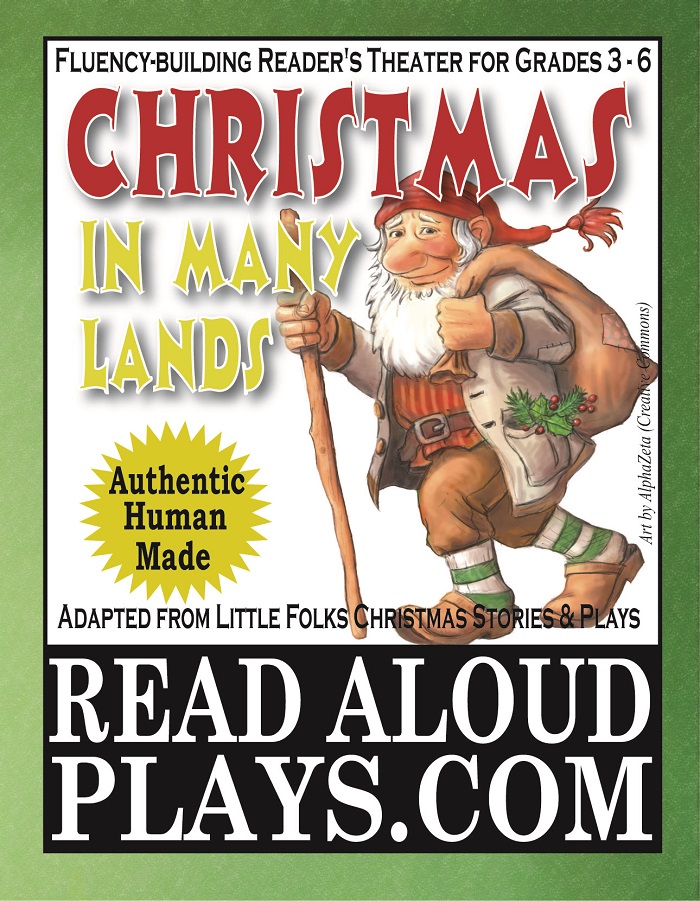
Christmas in Many Lands— Gnomes and reindeer, trees and piñatas . . . it seems like Christmas everywhere is different yet somehow still the same! Our newest and most adorable little Christmas play about Christmas around the world.
Whether a single play or one of our money-saving bundles, these will be the highlight of your holiday teaching season! Check them out in our TpT store. Happy directing and Merry Christmas!
We’ve posted four new bundle collections, which offer big savings over single plays. Check them out on our TpT storefront!
Fairy Tales Slightly Twisted–Kids absolutely love performing these plays! Two unique versions of Goldilocks, a wonderful Brothers Grimm tale, and some hysterical Pied Piper action! Perfect for Back-to-School! All include the license to duplicate a full class set, school day performance rights, and comprehension activities. Click on the image to preview or purchase!
Weird Tales for Halloween — a collection of our most popular plays: Sleepy Hollow, The Monkey’s Paw, and a crazy version of Poe’s Tell Tale Heart. Buy now for Halloween!
The American Revolution Bundle — Five exciting reader’s theater scripts covering the American Revolution including The Secret Soldier, one of our most requested plays, and four others. Check our Eagles Over the Battlefield–a kid favorite for sure!
The Explorers Pack — Three reader’s theater scripts covering three eras. Divide the class into thirds and challenge each to present one of the three, then have all your students complete the standards-based compare and contrast activity. Teach history, reading fluency, and reading comprehension while getting your students excited about learning!
Nature Talks Back is a great play with which to celebrate Earth Day and Arbor Day while teaching your kids about trees, bees, and centipedes. The play’s ecology and conservation themes include that trees communicate, that some perceived pests are considered beneficial insects, and that honeybees are super-important pollinators. The stories center around three oddball conifers named Luther, Otto, and Bill and their hysterical encounters with a host of pests.
It’s aimed specifically at kids in upper 2nd through 4th grade, but it’s also suitable for grade 5 and up for reader’s theater, podcast, or stage— especially when performed for younger kids. (My fifth graders loved preparing a full production!) No time for a big show? Use it instead as in-class reading! It’s a fun way to teach about nature on Earth Day and Arbor Day!
Consider pairing Nature Talks Back with some of my other spring-oriented plays. Peter Rabbit is also aimed at younger students. Use it with 2nd and 3rd graders, or have older students perform it for primary-aged kids. Rikki Tikki Tavi, Kipling’s much-loved story about the heroic mongoose has some spring-time flair, a singing bird, and an important theme about courage. It too can be presented alongside How the Elephant Got Its Trunk, another classic Kipling tale from The Jungle Books. And don’t forget that baseball season is upon us, so it’s a great time for my entertaining and socially important play about Jackie Robinson.
Here are five classroom plays about the American Revolution. Each is politically-neutral, based on well-researched historical accounts, and vetted by professional editors at Scholastic. The first three (four if you count the Liberty Bell) feature strong females, making them perfect for Women’s History Month.
The Secret Soldier tells the story of Deborah Samson, the perseverant young woman who disguised herself as a man in order to enlist in the Continental Army. History remembers her as America’s “first woman soldier.”
Betsy Ross has a lot of doubters these days. This play exploring the creation of America’s first flag, encourages readers to approach history scientifically: to research the facts themselves before drawing conclusions.
Girl, Fighter, Herotells the story of Sybil Ludington, the young woman often called “the female Paul Revere.” Sybil rode 40 miles on a stormy night to muster the militia during the American Revolution battle near Danbury.
Eagles Over the Battlefieldintroduces students to our national emblem, the American bald eagle. This work of historical fiction imagines how the Founding Fathers might have debated the symbol’s selection, especially given Ben Franklin’s tongue-in-cheek disdain for the eagle.
Finally,A Bell for the Statehouse , which comes as a 2 for 1 with Eagles, reveals how the Liberty Bell came to be a national symbol after being sheltered away with other “patriot leaders” in the basement of a church.
All five plays are dramatic, compelling, and fun for kids to present on stage or perform as reader’s theater.
Thank you, Rachel Scott, M. M., Aram Alexander Barboa-Reidy, Alejandra Alejandra Peña, Laura Franklin, Michelle Gribble, Daniel B. Bennett, William Samples, and Jennifer Theis for your recent 5-star reviews!
We all know it. During the weeks leading up to Christmas, it can be a challenge to keep the kids engaged. My remedy has always been to stage some classroom plays or readers theater, which leads me to our awesome collection of Christmas themed titles that’ll keep even your grinchiest elf content.
But Santa isn’t going to throw coal at you if your Christmas plays aren’t Christmas plays. Take a look at what my 5th graders did with Hans in Luck, a Brothers Grimm tale that hasn’t a thing to do with wassailing or bread pudding. They used the 1906 illustrations to create a “digital comic book” while simultaneously practicing for a live stage presentation just ahead of the winter break. I can tell you the actors themselves don’t care that the play isn’t about St. Nick. They’re thrilled to be donning costumes regardless whether or not anyone gets to wear a fat suit and a beard. And you can bet my colleagues are happy to commit some otherwise giddy class time to come watch— whether the Ghost of Christmas Present will be there or not.
Ah, but who has time to throw together an entire show now? If that’s the case, grab some scripts and just do some classroom readings! Try splitting the class into two to four groups and give each one a play. Use class time to have the kids practice them until they can read them with fluency and character, and then have them present them to the class as traditional reader’s theater—merely standing up front and reading aloud.
Both my parents served in the military. My mom had a short stint as a WAAC in DC before landing in the secretarial pool at the White House. She eventually had a temporary assignment working for Matthew Connelly, Harry Truman’s executive secretary. She liked to tell a story about sneaking around the White House in hopes of catching a glimpse of the presidential swimming pool, only to be caught by a guard and sent back to her post. Despite her brush with security, she was eventually offered a permanent position. Regretfully, she turned it down because the bus commute from her quarters in Virginia was too long. Her days in the Army Air Corps, she would later tell me, were the best years of her life. (Pictured: My Mom at the Fort Belvoir Motion Picture Lab)
My dad, meanwhile, served in both World War II and Korea. I’m told his experiences were vast and extreme, that he piloted a plane, that he commanded a POW camp, that he was at the disastrous Battle of Kasserine. But he himself never spoke of any of it. Not a word. For him it was far too painful—as it is for many veterans. I wish I knew more about my dad’s service. (Pictured: My dad in Korea.)
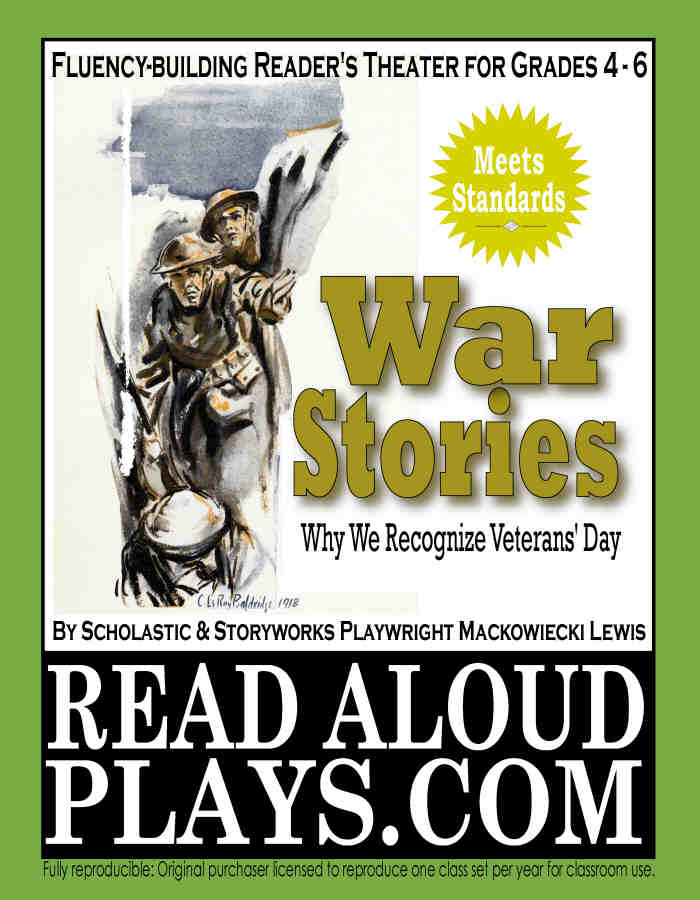
It was with them in mind that I crafted “War Stories” for Scholastic several years ago. It speaks to the pain of war, the sacrifice of those who’ve served, and the meaning of Veterans’ Day. It also speaks to the importance of recording those memories for posterity, no matter how painful. I encourage you to share it with your students in grades four and up in commemoration of the holiday on November 11.
Thank you, “Adventures in Fifth and Life,” M.M., Summer B., Renae W., Liz M., Shala K., Brittany W., Lee C., and Angela H. for your recent positive reviews of my plays!
You probably know the Brothers Grimm for stories like Rapunzel and the Frog Prince, but there are scores of others that Disney hasn’t yet sanitized and “princessified.” We’ve adapted two of them as readers theater plays—and we think they’re perfect for Back-to-School.
The first is The Mouse, the Bird, and the Sausage. In typical Brothers Grimm fashion, it’s a cringe-worthy story about contentment, cooperation, and friendship. In the original, the three “roommates” ruin their happy life together when they’re cajoled into altering their routine. The result is Sausage gets eaten, Mouse gets boiled, and Bird drowns. It may be Grimm, but it’s also a bit too gruesome for the classroom!
While our version is no less cringey, we’ve managed to save all their lives while having a blast doing it! All five animal roles demand students willing to sell out on stage: Sausage’s Italian bravado, Mouse’s “death” scene, Bird’s over-baked remorse, Crow’s creepiness, and Dog’s indifference. We’ve tossed in optional “walk-up” music for each of the characters, too, which will help make this play an even bigger hit with your kids!
The second play has none of the gore the Grimm Brothers are known for. Instead, Hans in Luck is a cautionary tale about financial wisdom and good judgment . . . Hans has neither. After having worked seven years as an indentured servant, he’s given a lump of silver “as big as his head,” which he takes and then travels home. He soon tires of lugging it around, so he trades it for a horse, which he eventually trades for a cow, and then a pig, and so on until he has nothing left. All the while, Hans sees himself as incredibly fortunate, which perhaps he is. From his simplistic perspective, arriving home to find his grandmother still living proves he’s the luckiest man alive! Your students will enjoy uncovering the story’s numerous morals about trust, innocence, luck, foolishness, positivity, and money. We’ve added a few other surprises, too, making it another great character-building play to start your school year.
And, if Grimm tales don’t float your boat, at ReadAloudPlays.com we have many other plays to choose from. All come with a comprehension activity, key, teacher notes, and public school performance rights.
Thank you, Felicia A., Annette H., Sarah D., Lynn S., Shawn L., and Janet T. for your recent positive reviews!
Following the George Floyd protests, heightened concern about cultural sensitivity and traumatic events led TeachersPayTeachers to ban pretty much any reader’s theater or history lesson in which students were challenged to see the event through the eyes of a minority figure. Though well-intended (after all, it’s pretty obvious we shouldn’t be simulating slave auctions in class), TpT’s policy essentially silenced Ruby Bridges, Claudette Colvin, Sheyann Webb, MLK, and other heroes of the Civil Rights Movement. The basis behind the ban was that today’s children shouldn’t be forced to relive the verbal abuse Ruby experienced, or the emotional abuse felt by Sacagawea, or the violence Sheyann witnessed. Never mind that all good literature and historical accounts requires the reader to see it from such a perspective. For example, if Claudette Colvin’s story shouldn’t be shared via my play, “The Girl Who Got Arrested,” it also shouldn’t be shared using Phllip Hoose’s National Book Award-winning biography, Twice Toward Justice.
Yet it must be shared. It’s by seeing Claudette’s story through her eyes that it becomes more than just a blurb and a date in a history book. Claudette’s first-hand account is the primary source that makes the event relevant today.
When TpT deactivated all my plays, I sought help from a friend who serves as the director of the local university’s Center for Cultural Diversity, as well as from Dr. Geneva Craig, someone who actually experienced the tear gas in Selma. These are crazy times, they both lamented, but they helped me re-evaluate my content to make sure I was indeed being sensitive. I made a handful of subtle changes and then re-posted my plays on TpT.
Only to have them deactivated all over again.
I tried re-posting them as JPEG sheets so that TpT’s content bots couldn’t recognize the text. I removed words like “drama” and “scripts” from my headings and changed “reader’s theater” to RT. To further disguise them, I rebranded them as “Paired Texts.” Nothing worked. TpT deactivated them every time. Ironically, it was during this time that The Palace Youth Theater in New Hampshire, with the help of its local BLM chapter, enacted two of the plays TpT had just banned.
Fortunately, less-reactionary ideals have prevailed and the new ownership at TpT has since reversed the censorship. I suspect they recognize that educators have school district policies, parent input, and professional training to guide us as to the appropriateness of material. We don’t need TpT to do it for us.
Though I lost hundreds of favorable reviews and thousands of clicks, I’m pleased to say that all my civil rights and American history plays are back on TpT. But given the “crazy times” in which we live, I think it’s important for educators to consider how to appropriately use reader’s theater to teach marginalized voices and traumatic events. Here are a few tips:
Community – Consult with the cultural community associated with the events depicted, bringing in guest speakers where appropriate. If you have students from that particular marginalized culture, seek input from their families before introducing the play.
Sensitivity – Characters in a play should not do anything demeaning toward their culture. While every story—whether in a play format or otherwise—has to have conflict, violent acts should only be referenced by narrators or other characters rather than explicitly acted out. If unsure about how a scene plays out, change it. If you’re still unsure how the content will be received, consider using it only for a discussion-based classroom reading or podcast rather than enacting it “on stage.”
Casting – Don’t let race be the basis for casting parts. Dr. King said he dreamed of a day when we would all be “color blind.” A reader’s theater performance is a good place to practice it.
Policy – It’s important to check your school board’s policy before embarking on any content that might be controversial. Some districts restrict subject matter not explicitly identified within a given grade level’s standards.
Paired Texts – It’s a good idea to pair reader’s theater content with professionally-published texts. For example, read Ruby Bridge’s book, Through My Eyes while working on the play, A Simple Act of Courage. Not only does the text serve as a vetting agent, it provides material to compare and contrast.
Discussion – No book, play, or video should stand alone. By discussing the content and events depicted, you facilitate understanding. Discussion should happen when introducing a play, while reading specific scenes, and after presenting. Utilizing expert guests enhances those discussions.
Repetition – One of the best reasons to use RT is that if there’s to be a presentation or performance, kids are willing to read plays repetitively. Even a simple reading in front of the class is enough to get kids to read and re-read a script multiple times. The brain science behind repetitive reading suggests students build their fluency at a far greater rate. It holds true with the students’ grasp on the historical events depicted and as well as their ability to empathize with marginalized voices.
Thank you for teaching Black history. Happy directing!
If you’re like me, you put a bow on the holidays and then breathed a sigh of relief as you headed home for the break. But here you are heading back to class and MLK Day is already upon you! You have no time to lose when it comes to planning your MLK Day and Black History Month activities! So, let’s get right to the point of this post: ReadAloudPlays.com specializes in Black History Month and MLK plays.
In 2021, despite all the Covid-related restrictions, the folks at the Palace Theatre in New Hampshire selected a couple of my plays to enact for Black History Month. I’ve posted the video here so that you can take a look. Whether or not these two plays inspire you to download any of my material, I hope you’ll still share the video with your students. Consider having them watch the production and then read the plays. Or, simply have them follow along with the script while viewing.
The two plays shown are Martin’s Big Dream, which reveals how incidents from King’s childhood inspired his work, and A Simple Act of Courage, which shares the role Ruby Bridges played in integrating America’s schools. They’re both available in my TpT and Etsy stores.
You’ll also find numerous other plays told from the perspective of Civil Right icons like Jackie Robinson, Claudette Colvin, and Sheyann Webb. One of the hallmarks of a quality historical play for kids is that the story is told through the eyes of a child witnessing the events firsthand. These plays all meet that standard.
A favorite of mine is MLK’s Freedom March, which is told through the eyes of eleven-year-old Lucy. Her grandmother is dying of cancer, her father is worried about losing his job, and her brother is fired up about The March for Jobs and Freedom, the iconic event where Dr. King delivered his “I Have a Dream” speech. It’s a powerful play with multidimensional characters backed by King’s awe-inspiring speech.
If you don’t know where else to start, download my free products, Tips for Teaching Marginalized Voices and Traumatic Eventsand Reader’s Theater Teaching Tips, which outlines best practice when using plays. Be sure to also download the full previews of my plays deemed sensitive or potentially controversial. When unsure about a text, consider using it for traditional reader’s theater, podcast, or a discussion-based in-class reading rather than a stage production. In such cases, the important content still gets taught without running the risk of someone being offended by a “reenactment” of a traumatic event.
Thank you for continuing Dr. King’s work, and happy directing!