Help Save Our Stage!

Yeah, we know. There’s a ton of research proving reader’s theater is a powerful resource for building fluency. But that doesn’t mean directing a full-blown theater production is easy. Quite the opposite, in fact. Teaching is a tough gig on its own, so it’s no surprise few teachers want to take on a challenge like theater arts. Since retiring, the stage at my school has gone dark. It seems more likely to become a storage room than a theater hub. Cobwebs are already growing over the sound console. Moths are chewing through the curtains. Okay, maybe I’m laying it on a bit thick, but you know how things go in schools: when something isn’t getting used regularly, it tends to get scavenged or it disappears altogether. The idea that the stage might become a black hole is one of many reasons I’m attempting to put together an after-school drama club for our elementary kids.

But I need your help.  We need funds for supervision, set building materials, and costuming supplies. Our goal is to raise $1500, so I’m asking you to consider kicking five or ten bucks our way via our GoFundMe campaign. Our PTO has agreed to match donations, so your support will have double the impact toward our musical production of Toad’s Wild Ride, a madcap slapstick play resembling the Disneyland ride as much as Kenneth Graham’s Wind in the Willows classic novel. But it will also give us reason to dust off the soundboard, replace lighting, and claw back our on-stage territory, thus establishing the foundation for continuing the program in future years.   

You can click on the Performances tab to see the kind of productions we’ve pulled off in the past: The Newsies, Br’er Rabbit, A Christmas Carol, The Pied Piper, among many others. With a bit of love from all of you, you’ll be able to see Toad’s Wild Ride there this spring. If you’re able to contribute to our GoFundMe, click here. I realize many of you may be begging for funds for your own production, so whether or not a full blown show is in our future or on your own to do list, I encourage you to nonetheless remain committed to using readers theater. Even a simple class reading of scripts like Toad will be immensely rewarding.

Thanks, and happy directing!

Here’s Help for that Holiday Chaos!

The weeks between Thanksgiving and Christmas vacation can be real doozies. While thoughts of sugar plums may not derail that lesson you’ve been planning on verb gerunds, knowing there are new gaming systems, cell phones, and hover boards under the tree certainly will. There’s no doubt about it: this time of year the kids are all a twitter, prompting many a teacher to set aside serious content in favor of coloring pages featuring Rudolph, Frosty, or an occasional dreidel. But it needn’t be so. This is a great time to stage a play!  In so doing your students will get some quality fluency practice, partake in some interesting literary discussions, and, depending on how far you want to take it, occupy themselves with meaningful work creating sets, props, and costumes. And given that Christmas will be upon you in a flash, now is the time to get started, especially if you’re following our repetitive reading approach. Here are five classroom reader’s theater scripts ideal for the next few weeks.

A Christmas Carol—Our best-selling script! Scrooge in two forms!

The Gift of the Magi—A young couple trades their most precious possessions to celebrate Christmas in O. Henry’s famous story!

Gabriel Grub –When the gravedigger shows an unrepentant disdain for Christmas, he’s put on trial in an  underworld court room full of goblins. It’s Dickens’ spookiest Christmas story!  

The Shoemaker and the Christmas Elves—Facing ruin, the shoemaker is saved by a Christmas miracle in this Grimm Brothers classic with our unique conclusion.

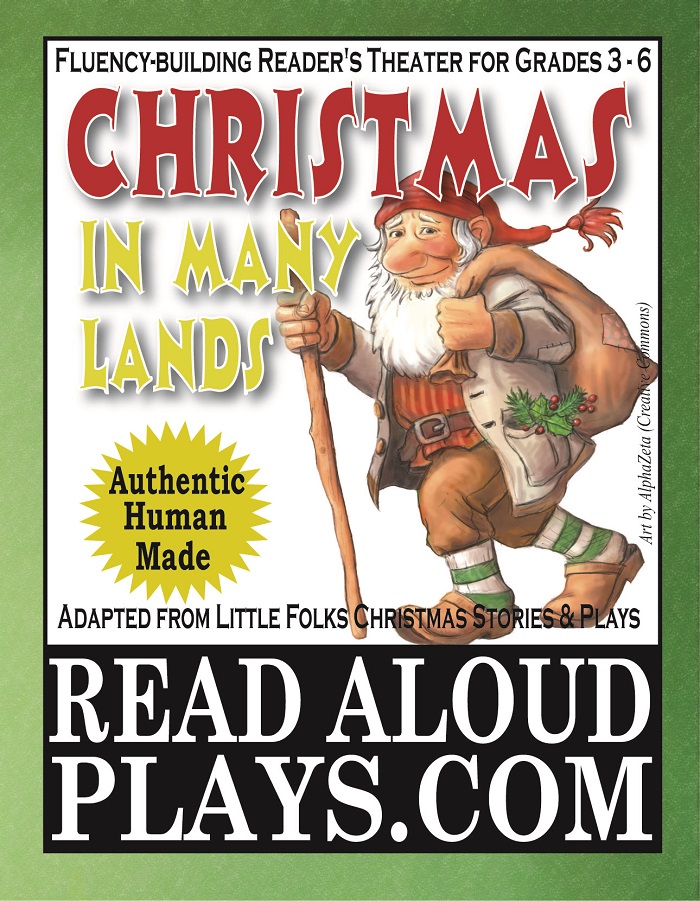
Christmas in Many Lands— Gnomes and reindeer, trees and piñatas . . . it seems like Christmas everywhere is different yet somehow still the same! Our newest and most adorable little Christmas play about Christmas around the world.   

Whether a single play or one of our money-saving bundles, these will be the highlight of your holiday teaching season! Check them out in our TpT store.  Happy directing and Merry Christmas!  

Using Readers Theater to Honor Veterans

It’s Time for Halloween Plays!

Back a hundred years ago, ghoulishness was captured in short stories rather than comic books. Writers like Poe, Shelley, and Stevenson creeped out their audiences with dark tales of superstition, mystery, and insanity. The Gothic themes they created have been permeating literature, television, and cinema ever since. 

So what if your students are mesmerized by Venom and Doctor Octopus? There are plenty of mangled monsters and the criminally insane in W.W. Jacob’s classic, The Monkey’s Paw, Poe’s The Tell-Tale Heart, and Hawthorne’s The Birthmark. They’ll also find that familiar ol’ headless horseman in Sleepy Hollow, and a hapless ghost in Twain’s A Ghost Story.  No, your kids won’t find my version of Rappaccini’s Daughter Pennywise-creepy or Slenderman-scary, but its chemical concoctions and mad scientists make it very nearly as engaging. Most certainly, it’s a key to unlocking the original’s subtleties and complexities.    

Your students know these themes. They’ve seen them on the Simpsons and Family Guy, in Goosebumps and Marvel Comics. But do they know from whence they come?  Though the archaic language and complex structures of these classic tales present barriers for most middle grade readers, you can make the stories more accessible by pairing them with reader’s theater. And what better a time to do it than Halloween?

All these plays are available on my TeachersPayTeachers and Etsy storefronts. They’re critically-acclaimed. They’re inexpensive. They each come with a comprehension exercise. We’ve also put our three most popular spooky scripts in a splendid Halloween bundle, making them even less expensive! Suitable for reader’s theater, podcast radio drama, or full stage production, they’re perfect for fifth graders and up (plus strong 4th graders)—but get started early to have them well-rehearsed by Halloween.

Happy directing!

Six Awesome Ways to Do RT!

Click on the image to check out one of our mini-guides to using readers theater in the classroom, or download the complete guide by clicking here. Happy directing!

Readers Theater Quick Start Guide

Click on the image to download our free Readers Theater quick-start guide.

Save $ with New Readers Theater Bundles!

We’ve posted four new bundle collections, which offer big savings over single plays. Check them out on our TpT storefront!

Fairy Tales Slightly Twisted–Kids absolutely love performing these plays! Two unique versions of Goldilocks, a wonderful Brothers Grimm tale, and some hysterical Pied Piper action! Perfect for Back-to-School! All include the license to duplicate a full class set, school day performance rights, and comprehension activities. Click on the image to preview or purchase!

Weird Tales for Halloween — a collection of our most popular plays: Sleepy Hollow, The Monkey’s Paw, and a crazy version of Poe’s Tell Tale Heart. Buy now for Halloween!

The American Revolution Bundle — Five exciting reader’s theater scripts covering the American Revolution including The Secret Soldier, one of our most requested plays, and four others. Check our Eagles Over the Battlefield–a kid favorite for sure!

The Explorers Pack — Three reader’s theater scripts covering three eras. Divide the class into thirds and challenge each to present one of the three, then have all your students complete the standards-based compare and contrast activity. Teach history, reading fluency, and reading comprehension while getting your students excited about learning!

Happy directing!

What Makes a Readers Theater Script Magical?

It’s time to give the competition some attention. For the last 15 years, ReadAloudPlays.com has been a “secondary market” for all the scripts I’ve published at Scholastic. Writing and staging of these plays has been and will continue to be a passion. The webpage and TpT store, on the other hand, have always been kind of a sideline gig. Now, as I head into retirement from daily classroom instruction, my intent is to push RAP to the forefront of the reader’s theater marketplace. I’m adding new collections (see image), adjusting how performance rights are purchased, and delving more thoroughly into social media and SEO marketing.

Still, wanting to be competitive, I’ve done a bit of scouting, and I’m convinced ReadAloudPlays.com remains the best value in reader’s theater anywhere—not only because we’re less expensive, but also, dare I say, because there’s something magical about our scripts.

I was a mainstay at Storyworks and Scope for 20 years. My editors there frequently told me what made my scripts special:

One, they said my scripts always hit the right reading level and age group. Though a play should push a reader’s vocabulary a bit, a play written for 3rd graders shouldn’t require an eighth grade reading level. Nor should a play for 6th graders sound like something from Daniel Tiger. Amateurs often miss these marks.

Two, because I test nearly all my scripts on students (and will continue to do so in retirement), my scripts appeal to their interests. Working directly with kids all these years has given me a knack for understanding what riles ‘em up. (Visit the DailyPlatypus.org to see for yourself.)

Third, there’s a bit of magic in every play. I’m able to add just the right touches to tug at their emotions or tickle their funny bone. The mayor’s telephone conversations in The Pied Piper, that Goldilocks is a home dec influencer, the strange gibberish spoken by the elves in Shoemaker, or that Otter wears goggles and a snorkel in Toad’s Wild Ride are the Sriracha and glitter that take the plays to the next level.

As for the competition, I encourage you to judge for yourself. ReadingAtoZ.com has a handful of plays, but the site requires an annual fee of $135. You could buy 30 of my plays for that price, each with the license to print a full class set.

ScriptsforSchools.com sells plays for $14.95 and up, teacher packets are $45, and collections run $100.

Readerstheater.com— Has a ton of short plays—some really short. They’re professionally bound, but most are $7 per student, meaning a single play for 7 actors runs $49. No duplication license is included.

Weebly is a great resource for RT—and much of it is free—but there’s trouble afoot. Many of the plays there are copyright violations. For example, unless the author of Miss Nelson is Missing granted copyright (which is unlikely) the play should not exist, nor can it be legally performed for an audience. Another example is when a teacher inadvertently posts a copyright-protected script for their students. When one of our plays shows up on Weebly, our only recourse is to contact the school and file a copyright complaint. It’s awkward for all of us. (We REALLY appreciate teachers who respect copyright.)

PioneerDrama.com is one of the big boys of RT, but they charge big boy prices. Scripts run $10 per student and performance rights are $75 per performance.

And of course there are a variety of other sites with free and paid play scripts, but in our opinion, they usually lack the “magic” of a script from ReadAloudPlays.com.

Finally, there’s AI. That’s right. I know teachers are going to Gemini or ChatGPT and asking them to create a play from a given story. To see what damage AI will cause, I too gave it a try. What I got back was a very short and very bland script with way too much narration (a sure sign of amateurism). No magic there. Asking artificial intelligence to create a script is like asking the microwave to cook all five courses of your Thanksgiving dinner. Yuck. No salt. No pepper. Definitely no Sriracha.

So, as you embark on another school year, take advantage of all the magical, perfectly-seasoned, original, and inexpensive plays from ReadAloudPlays.com. You’ll find all of them on our Tpt storefront. And if you like our plays, please share our link, leave us 5 star reviews, follow us on TpT, and look for us on Instagram, Bluesky, and Facebook.

Thanks, and happy directing!

Earth Day + Arbor Day

Nature Talks Back is a great play with which to celebrate Earth Day and Arbor Day while teaching your kids about trees, bees, and centipedes. The play’s ecology and conservation themes include that trees communicate, that some perceived pests are considered beneficial insects, and that honeybees are super-important pollinators.  The stories center around three oddball conifers named Luther, Otto, and Bill and their hysterical encounters with a host of pests.   

It’s aimed specifically at kids in upper 2nd through 4th grade, but it’s also suitable for grade 5 and up for reader’s theater, podcast, or stage— especially when performed for younger kids. (My fifth graders loved preparing a full production!) No time for a big show? Use it instead as in-class reading! It’s a fun way to teach about nature on Earth Day and Arbor Day!

Consider pairing Nature Talks Back with some of my other spring-oriented plays. Peter Rabbit is also aimed at younger students. Use it with 2nd and 3rd graders, or have older students perform it for primary-aged kids.  Rikki Tikki Tavi, Kipling’s much-loved story about the heroic mongoose has some spring-time flair, a singing bird, and an important theme about courage. It too can be presented alongside How the Elephant Got Its Trunk, another classic Kipling tale from The Jungle Books.  And don’t forget that baseball season is upon us, so it’s a great time for my entertaining and socially important play about Jackie Robinson.

Happy directing!

The Antidote for Spring Fever and the Test Taking Blues

If you’re school is anything like mine, you’re probably gearing up for standardized testing. For many of us and our kids, it’s the bane of our existence. So, my proposal to you is to use what little time remains in your schedule to have some fun staging a play! It can be as simple as an in-class reader’s theater presentation or as complex as a full stage production (start now for an end-of-the-school year performance!). Whatever the case, at ReadAloudPlays.com we have gobs of plays perfectly suited for spring, including our latest release, Toad’s Wild Ride.

We’ve narrowed Wind in the Willows down to its best, most humorous elements. It shows how Mr. Toad becomes infatuated with motor cars, how his friends attempt to “cure” him, and how he goes on a maniacal drive through the village. Yes, Scene 7 resembles the Disneyland ride! The whole play is full of pratfalls, subtle humor, and grand entrances, making it as kid-friendly as it gets. Enjoy Mole’s innocence, Badger’s stodginess, and Otter’s “charisma,” but don’t forget Ratty and Toad! The play includes stage directions, making it ideal for a full production.

BADGER: Then you don’t promise to never touch a motor-car again?

TOAD:  Certainly not! In fact, I promise that the very first motor car I see, poop-poop, off I go!

Baseball season is underway, so many of your male students—who statistically are more likely to be reluctant readers—will jump at the chance to be in a baseball play.  How Jackie Saved the World depicts the circumstances around Jackie Robinson breaking the “color barrier.” As your students portray Jackie, Pee Wee, and others, a radio announcer calls a more modern game between Derek Jeter’s Yankees and Ken Griffey’s Mariners, gently contrasting the two eras. A peanut vendor and the hot dog man lend narration as they walk through the audience hawking ballpark snacks.

HOT DOG MAN: Despite all that pressure, Jackie led the Dodgers to the World Series and was named Rookie of the Year.  Some said it was the toughest season any ball player has ever endured. Last chance for hot dogs!

PEANUT VENDOR: No doubt the reason today’s game is so exciting is because Jackie had the courage to turn the other cheek. Peanuts! Get your peanuts here!

ANNOUNCER: We’re in the top of the ninth. Two outs and two on and the score tied two to two. The Yankees are taking no chances. With Ken Griffey, Jr. up to bat, they’ve brought in their closer, Mariano Rivera.  Here’s the pitch. . .

Perfect for Earth Day, Nature Talks Back “follows” the madcap adventures of three conifers named Otto, Bill, and Luther as they deal with bark beetle scares, woodpeckers, and centipedes. The story uses campy humor to convey scientific (and non-politicized) facts about the environment.

BILL: It’s not a termite is it? Oh, I hate termites!

LUTHER: No, I don’t think it’s a termite.

BILL: Phew. You had me worried for a minute.

OTTO: Too big for a termite. Looks like some kind of beetle. Does it look like some kind of beetle to you, Luther?

BILL (alarmed): A beetle? Is it a bark beetle?!  Oh no. It’s a bark beetle, isn’t it? I just know it! Get it off of me! Get it off of me!

If maniacal drives, spring training, and talking trees don’t entice you, we also have Peter Rabbit (it seems too young for 5th and 6th graders, but they love doing it—especially when they get to perform it for youngers), Winnie the Pooh (and Tigger too!), and on a more serious note, Juneteenth: Freedom for the First Time. Plus we have dozens more: all original, all human-made, and all with teacher notes, writing prompts, comprehension activities, and the license to print a full class set every year for use in one’s own classroom. Other sites charge dramatically more (no pun intended) for plays with far less originality and pizazz!

Plays teach kids to read purposefully and thoughtfully rather than merely for speed. They always have developmentally-appropriate parts for both your advanced readers and your most reluctant ones. And once parts are assigned, you don’t have to prompt kids to chime in. Best of all, plays are fun.  They’re the perfect antidote for spring fever and those test-taking blues.

Happy directing!