
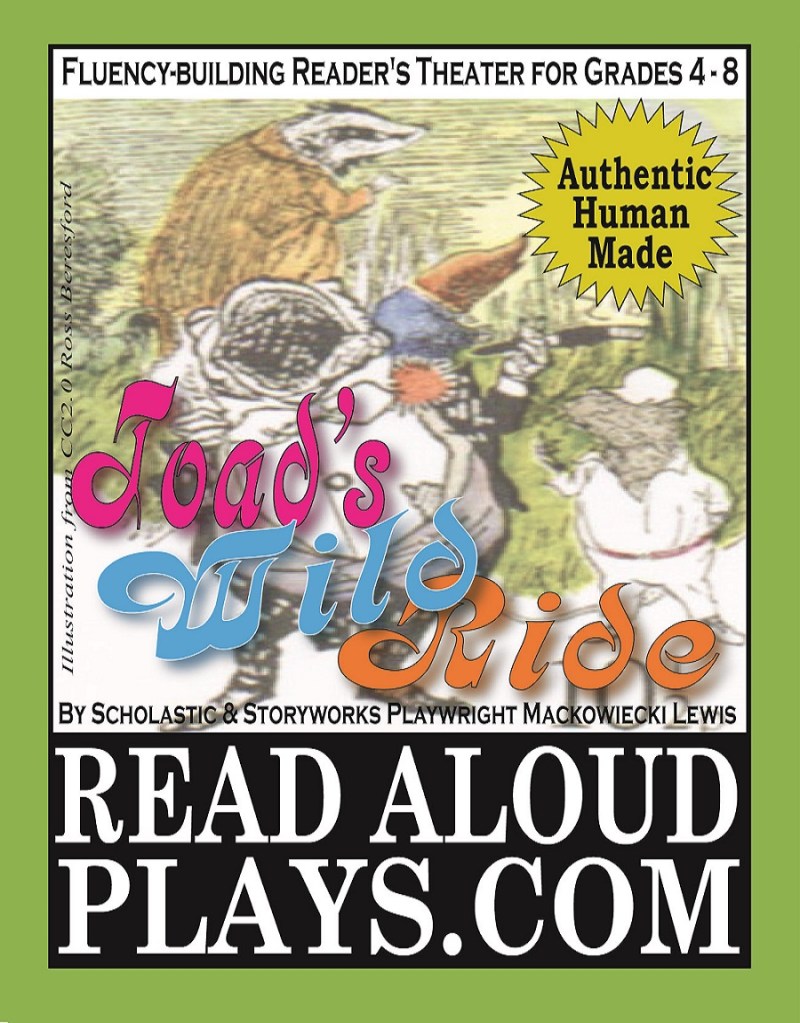
If you’re school is anything like mine, you’re probably gearing up for standardized testing. For many of us and our kids, it’s the bane of our existence. So, my proposal to you is to use what little time remains in your schedule to have some fun staging a play! It can be as simple as an in-class reader’s theater presentation or as complex as a full stage production (start now for an end-of-the-school year performance!). Whatever the case, at ReadAloudPlays.com we have gobs of plays perfectly suited for spring, including our latest release, Toad’s Wild Ride.
We’ve narrowed Wind in the Willows down to its best, most humorous elements. It shows how Mr. Toad becomes infatuated with motor cars, how his friends attempt to “cure” him, and how he goes on a maniacal drive through the village. Yes, Scene 7 resembles the Disneyland ride! The whole play is full of pratfalls, subtle humor, and grand entrances, making it as kid-friendly as it gets. Enjoy Mole’s innocence, Badger’s stodginess, and Otter’s “charisma,” but don’t forget Ratty and Toad! The play includes stage directions, making it ideal for a full production.
BADGER: Then you don’t promise to never touch a motor-car again?
TOAD: Certainly not! In fact, I promise that the very first motor car I see, poop-poop, off I go!
Baseball season is underway, so many of your male students—who statistically are more likely to be reluctant readers—will jump at the chance to be in a baseball play. How Jackie Saved the World depicts the circumstances around Jackie Robinson breaking the “color barrier.” As your students portray Jackie, Pee Wee, and others, a radio announcer calls a more modern game between Derek Jeter’s Yankees and Ken Griffey’s Mariners, gently contrasting the two eras. A peanut vendor and the hot dog man lend narration as they walk through the audience hawking ballpark snacks.
HOT DOG MAN: Despite all that pressure, Jackie led the Dodgers to the World Series and was named Rookie of the Year. Some said it was the toughest season any ball player has ever endured. Last chance for hot dogs!
PEANUT VENDOR: No doubt the reason today’s game is so exciting is because Jackie had the courage to turn the other cheek. Peanuts! Get your peanuts here!
ANNOUNCER: We’re in the top of the ninth. Two outs and two on and the score tied two to two. The Yankees are taking no chances. With Ken Griffey, Jr. up to bat, they’ve brought in their closer, Mariano Rivera. Here’s the pitch. . .
Perfect for Earth Day, Nature Talks Back “follows” the madcap adventures of three conifers named Otto, Bill, and Luther as they deal with bark beetle scares, woodpeckers, and centipedes. The story uses campy humor to convey scientific (and non-politicized) facts about the environment.
BILL: It’s not a termite is it? Oh, I hate termites!
LUTHER: No, I don’t think it’s a termite.
BILL: Phew. You had me worried for a minute.
OTTO: Too big for a termite. Looks like some kind of beetle. Does it look like some kind of beetle to you, Luther?
BILL (alarmed): A beetle? Is it a bark beetle?! Oh no. It’s a bark beetle, isn’t it? I just know it! Get it off of me! Get it off of me!
If maniacal drives, spring training, and talking trees don’t entice you, we also have Peter Rabbit (it seems too young for 5th and 6th graders, but they love doing it—especially when they get to perform it for youngers), Winnie the Pooh (and Tigger too!), and on a more serious note, Juneteenth: Freedom for the First Time. Plus we have dozens more: all original, all human-made, and all with teacher notes, writing prompts, comprehension activities, and the license to print a full class set every year for use in one’s own classroom. Other sites charge dramatically more (no pun intended) for plays with far less originality and pizazz!
Plays teach kids to read purposefully and thoughtfully rather than merely for speed. They always have developmentally-appropriate parts for both your advanced readers and your most reluctant ones. And once parts are assigned, you don’t have to prompt kids to chime in. Best of all, plays are fun. They’re the perfect antidote for spring fever and those test-taking blues.
Happy directing!
 ReadAloudPlays.com