Help for Spring Fever in the Classroom

Trees and flowers aren’t the only things blossoming right now. Your students, having spent much of the year under your tutelage, have grown and matured and are nearly ready to advance to the next grade—or at least they believe they are. They’re probably getting a bit stir-crazy, too, ready for something more than the same old routine.  Perhaps, too, they’re having the life sucked out of them by standardized tests. It sounds like a good time to liven things up with some truly fun reader’s theater or class plays.  Here are a few of my favorite antidotes for Spring Fever:

Perfect for Earth Day, Nature Talks Back “follows” the madcap adventures of three conifers names Otto, Bill, and Luther as they deal with bark beetle scares, woodpeckers, and centipedes. The story uses campy humor to convey scientific facts about how trees communicate to fend off danger, about misconceptions around what constitutes a “pest,” and about the danger pesticides are to pollinators.

HONEYBEE: Cough, choke. . . has somebody…cough wheeze . . . been using . . . sputter . . . bug spray?

KID (sheepishly): It was just a couple squirts.

HONEYBEE: Cough, wheeze . . . Good thing I only caught a whiff of it. It sent me into a loop-de-loop!

Nature Talks Back is written in four “acts,” which can be presented by a single cast or as four mini-plays.  When my students presented it on stage, they used cardboard sheets to create two-dimensional evergreen trees with cutouts for their faces. Because the trees themselves don’t move, it was a kick teaching kids how to act with their facial expressions.  But even of you don’t have time for a full presentation, NTB makes for a great podcast presentation or just a simple classroom reading on April 22nd!

How Jackie Saved the World is another great play for Spring. Our Jackie Robinson play depicts the circumstances around Jackie breaking the “color barrier” in the major leagues. As your students portray Jackie, Pee Wee, and others, a radio announcer calls a more modern game between Derek Jeter’s Yankees and Ken Griffey’s Mariners, which gently contrast the two eras. A peanut vendor and the hot dog man lend narration as they walk through the crowd–your audience.

HOT DOG MAN: Despite all that pressure, Jackie led the Dodgers to the World Series and was named Rookie of the Year.  Some said it was the toughest season any ball player has ever endured. Last chance for hot dogs!

PEANUT VENDOR: No doubt the reason today’s game is so exciting is because Jackie had the courage to turn the other cheek. Peanuts! Get your peanuts here!

ANNOUNCER: We’re in the top of the ninth. Two outs and two on and the score tied two to two. The Yankees are taking no chances. With Ken Griffey, Jr. up to bat, they’ve brought in their closer, Mariano Rivera.  Here’s the pitch. . .

Baseball season is underway all over the globe, so many of your male students—who statistically are more likely to be reluctant readers—will jump at the chance to be in a baseball play.

And then there’s Pooh.  Who doesn’t love a Winnie-the-Pooh story? Our RT set includes the best of A.A. Milne’s 1926 collection, all familiar tales such as Winnie-the-Pooh and the Honey Tree:

BEES: Buzz.

CHRISTOPHER ROBIN: Perhaps they think that you’re after their honey.

POOH: It may be that. You never can tell with bees.

BEES: Buzz. Buzz.

POOH: Christopher Robin, have you an umbrella?

CHRISTOPHER ROBIN: I think so.

POOH: I wish you would get it, and walk up and down with it, and look up at me every now and then, and say ‘Tut-tut, it looks like rain.’ I think, if you did that, it would help with the deception we are using on the bees.

Well-suited to reader’s theater or full stage production in third grade and up, these are great for emphasizing delivery and enunciation: nervous Piglet, droll Pooh, gloomy Eeyore, and temperamental Rabbit, for example. The set includes five short plays, each with just a handful of characters. You can split your elementary-aged class into five groups and have each group present one of the plays, or have older students stage a presentation for younger grades.

Of course, we have many other plays with “fun” themes. The Pied Piper, Goldilocks, Barbed Wire, The Nose, Rikki Tikki Tavi, Peter Rabbit, and How the Elephant Got its Trunk are all wonderfully silly yet still build reading fluency while teaching important lessons.  And don’t forget, when you buy one of our plays, you’re not merely buying a set of worksheets; you’re getting an original piece of literature—a professionally written play and the rights to use it year after year. It’s like getting a full class set of your favorite novel along with the other stuff most TpT products provide.  

You’ll find all our plays on our TpT storefront.

Happy directing!

You Say It’s a Merry Christmas? Be Forewarned!

Christmas can be terrifying . . . especially if you don’t believe. That’s the theme-defining line from Gabriel Grub, Charles Dickens’ Gothic Christmas tale. It’s the story of a gravedigger whose disdain for the holidays results in his being put on trial by the Goblin King. It is a splendid story—and a splendid play–one of five holiday themed scripts available from ReadAloudPlays.com. (Click here to listen to what my fifth graders did with Gabriel Grub a few years ago.) Here are the others:

A Christmas Carol, adapted to be an ideal length for middle grade kids, comes with two versions—both the traditional one and a second in which Scrooge is a woman. Years ago, my students turned it into a movie. You can watch it here and use it as a preview for your own class play.

Escape from the Blacking House borrows from Oliver Twist and the Pickwick Papers to artfully tell the story of Dickens’ troubled childhood. It’s probably my most overlooked play, and it pairs perfectly with Christmas Carol. They can be downloaded as a package here.

We also have O’ Henry’s classic, The Gift of the Magi. It’s the story of an impoverished young couple who sell their most precious possessions in order to buy one another needless gifts.

Finally, we’re excited to add The Shoemaker and the Christmas Elves to our catalogue. The Brothers Grimm are known for dark, often violent stories, yet here is a delightful story with a Christmas theme. I think your students will thoroughly enjoy speaking elfin gibberish.   

Whatever the case, don’t let your December become terrifying. Whether you’re planning a full production or just need some scripts to make your in-class reading a bit merrier, now is the time to get started! Preview and download your holiday plays at my TpT storefront.

Happy directing!

MLK Day and Black History Month Activities

If you’re like me, you put a bow on the holidays and then breathed a sigh of relief as you headed home for the two week break. But here you are back in class and MLK Day is already upon you!  You have no time to lose when it comes to planning your MLK Day and Black History Month activities!  So, let’s get right to the point of this post: ReadAloudPlays.com specializes in Black History Month and MLK plays.

In 2021, despite all the Covid-related restrictions, the folks at the Palace Youth Theatre in New Hampshire selected a couple of my plays to enact for Black History Month. I’ve posted the video here so that you can take a look. Just click on the image. Whether or not these two plays inspire you to download any of my material, I hope you’ll still share the video with your students. Consider having them watch the production and then read the plays. Or, simply have them follow along with the script while viewing.

The two plays shown are Martin’s Big Dream, which reveals how incidents from King’s childhood inspired his work, and A Simple Act of Courage, which shares the role Ruby Bridges played in integrating America’s schools. They’re both available in my TpT and Etsy stores.

You’ll also find numerous other plays told from the perspective of Civil Right icons like Jackie Robinson, Claudette Colvin, and Sheyann Webb. One of the hallmarks of a quality historical play for kids is that the story is told through the eyes of a child witnessing the events firsthand. These plays all meet that standard. 

A favorite of mine is MLK’s Freedom March, which is told through the eyes of  eleven-year-old Lucy. Her grandmother is dying of cancer, her father is worried about losing his job, and her brother is fired up about The March for Jobs and Freedom, the iconic event where Dr. King delivered his “I Have a Dream” speech. It’s a powerful play with multidimensional characters backed by King’s awe-inspiring speech.

If you don’t know where else to start, download my free product, Tips for Teaching Marginalized Voices and Traumatic Events.  

Thank you for continuing Dr. King’s work, and happy directing!

A Special Pooh Event!

Back in the days of the big three networks, a television special like Charlie Brown, Winnie-the-Pooh, or the Little Drummer Boy was a once-a-year event. I remember being mesmerized by those now-old Pooh specials of the 1960’s and 70’s. They introduced us to memorable stories such as Pooh and the Honey Tree and memorable characters such as Eeyore and Tigger. Though releasing my set of Pooh adaptations may not be the kind of event that’ll gather the family in front of the Zenith on a Sunday evening, I none-the-less think it’s still kind of special.

My adaptations include the five best stories from Milne’s 1926 work. I’ve packaged them as five individual “mini-plays.” Each play has just five or six cast members, which means they’re great for small groups. My fifth graders are having a blast with them, and I’m enjoying hearing their interpretations of Milne’s clearly-defined characters. In our case, each small group is staging two plays with the intent of gathering first and second grade kids “in front of the Zenith” some afternoon after winter break. I think your kids will love them too.

A.A. Milne published the original set of Pooh adventures way back in 1926, but even though they’re now in the Public Domain, recreating them as reader’s theater isn’t as straight-forward as it might seem. Disney, for example, still owns the copyright to everything post-1926. That includes Tigger, Pooh’s red shirt, and even the un-hyphenated version of Pooh’s name. Still, these five plays represent the best of Milne’s original work. They’re suitable for third grade and up (a strong group of second graders can probably handle them too), but they promote fluency in upper grades too. They come with comprehension activities, and they’re printed in my kid-friendly, easy-to-read format. Look for Pooh on my TeachersPayTeachers storefront.

Thank you for using Read Aloud Plays! Happy directing!

Plays: A Series of Good Times

My colleague popped in my room the other day to share his experience using my Sleepy Hollow play. His hope is to stage a simple production for Halloween, but after the first reading, he very nearly punted. His class of Covid-delayed readers, he said, could barely get through the script. Still, rather than thinking the script is too difficult, he stuck with it. A second reading was better—especially after he’d reviewed a few key vocabulary words.  Then, after sharing segments from the 1949 Sleepy Hollow Disney cartoon, Ichabod and Mr. Toad, the class bought-in and were soon fighting over who’d get to be Knickerbocker, Brom Bones, and Gunpowder. Now they’re practicing independently, their enthusiasm lending itself to improved fluency.

I share this because this is the way read aloud plays work. The magic comes when scripts are read multiple times. Yes, they’ll slog through the first reading, but when they read it repetitively, their fluency improves (dare I say) dramatically. I’d go so far as to say we ought to be having our kids read everything twice: every play, every article, every chapter of every book.  As Narnia author C.S. Lewis once said, “If you haven’t read a book at least twice, you haven’t read it.” The thing about a play is that kids are willing to read it over and over again.

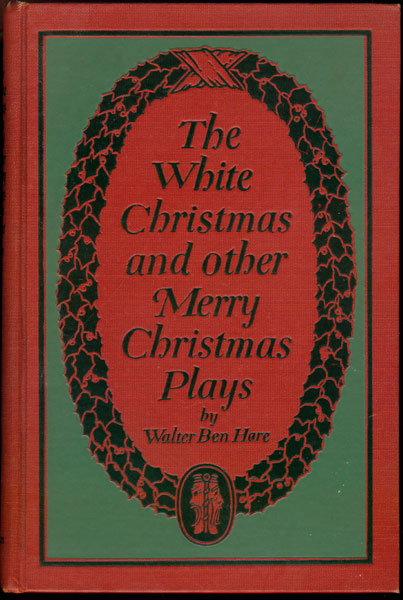
In researching prospective new plays to share this Christmas, I came across the work of Walter Ben Hare. Back in 1917 he wrote a book called The White Christmas and Other Merry Christmas Plays. His work is too dated to re-use, but the notes he included in the prologue are charming and spot-on.

“The director’s aim should be to establish a happy co-operation with the players that will make the whole production, rehearsals, dress rehearsals and final performance, a series of good times crowned by a happy, if not perfect, production,” says Hare. “The director should always strive to be cheerful and happy, ever ready to give advice and ever ready to ask for advice, even from the youngest players. Take them into your confidence. Discuss color schemes, costuming, property making, lighting and scenic effects with your actors.”

I like that! Producing a play should be fun. It’s not a time to be handing out letter grades, nor a time to channel your inner Kubrick. In fact, it doesn’t really matter if the play turns out to be a “perfect production,” as Ben Hare would have you aim. A “happy” performance is the greater goal!  

That doesn’t mean it’ll be easy. Your students will stumble. They’ll stutter. They’ll leave their scripts at home. But some tenacity and determination like that of my colleague will be worth it in the end. As Hare concludes, “The pleasure of the work and the pride in a production well done, will amply repay an ungrudging lavishment of time and labor.”

For a pleasurable production this Halloween, Veterans’ Day, or Christmas, start with a visit to my storefront at TpT or Etsy.. Most were originally published in Scholastic’s Storyworks magazine, so you know they’re of the highest quality.

Happy directing!

Six New Plays!

When last November a friend chided me for never having any free time, I decided to go on a one month writing sabbatical. It soon became a two month writing sabbatical—then six and eventually eight. I must admit, I didn’t miss the grind of slogging through another chapter, the gut punch of yet another rejection letter, or the stress of trying to balance my personal life on top of teaching on top of writing. But with summer came my annual furlough and the chance to reconnect with my keyboard. Though I’ve yet to tackle the enormous task of researching lit agents and crafting queries, I did manage to put together six new plays. Six! Granted, most of these plays were already written—usually for Scholastic—so they merely needed to be re-packaged, but you’d be surprised how much work goes into the task.

No play I’ve ever written has been more fun than The Nose. It’s Nikolai Gogol’s short story about a Russian man who awakes one morning to discover that his nose has fled his face. When he goes looking for it, he realizes the nose is masquerading as a government official. It’s an unforgettable example of farce. The events in the story cannot be explained—though students may have a lot of fun trying. They’ll have a fun time staging it, too.  In my classroom, we built a papier mâché nose and stuck a kid inside. We also worked on our Russian accents, holding a “Talk Like a Russian Day” in which we did all our lessons while trying to emulate the cosmonaut from the movie Armageddon. We had a blast. The play is from my Scholastic book, Read Aloud Plays: Classic Short Stories, which is now out-of-print. I’ve wrapped it up with a comprehension activity and a new easier-to-read format. It’s perfect for back-to-school whether in-person or online. Start the school year talking to your kids in a Russian accent, you say? What a great way to break the ice!

Along with The Nose, I’m also releasing three other plays, but you’ll have to visit one of my digital download sites to check them out. They’re all available on TeachersPayTeachers, my Etsy store, as well as Amazon. In the next couple of weeks I’ll also be releasing the fifth and sixth plays: The Mad Scientist’s Daughter and Nature Talks Back. I’m excited about both of them. I hope you will be too.

Cheers to a successful new school year! Let’s hope we finally get past the pandemic!

Happy directing!